Paul Zacharia
Life
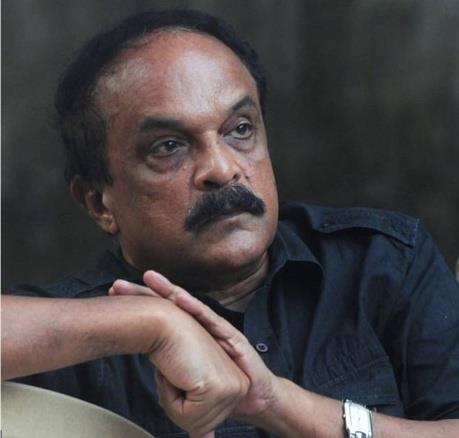
Paul Zacharia was born in 1945 in Urulikunnam, Kottayam, Kerala, and grew up as the son of Christian parents in a rural environment. After completing his Master of Arts in English language and literature, he worked for several years as a college lecturer in Bangalore and in Kerala. He later spent several years as a media consultant for major print and electronic media in Kerala.
His literary work comprises numerous volumes of short stories, novellas and essays. Many of his stories have been translated into other Indian languages as well as into English and German. His novella "Bhaskara Pattelar and My Life" was filmed by the renowned director Adoor Gopalakrishnan under the title "Vidheyan" (The Servile). Zacharia is married, has a son and a daughter and lives in Thiruvananthapuram (Kerala).
Work
Paul Zacharia stands for modernity and innovation in contemporary Malayalam literature. He freed the language from its imprint by traditional poetry and from its strong dependence on classical Sanskrit. Through him the language gained a new freshness and vitality — qualities necessary for portraying complex modern themes. Early on he broke radically with traditional narrative practice and invented new forms to realise his themes. Over time he also perfected his craft; irony and black humour are his particularly effective stylistic devices.
Zacharia grew up in a remote village in Kerala as the child of liberal Catholic parents. His texts are therefore shaped by the mentality of Christian farmers in India. Zacharia attempts to treat universal themes within a village milieu and in vernacular language. Uncertainty about the meaning of life and doubt about many articles of faith, especially the Christian religion, are recurring themes in his works. He is also preoccupied with religious conflict, the shift in values and the disorientation of modern times. With a sharp eye he takes aim at the emptiness and rigidity of social and political conventions and ruthlessly denounces the hypocrisy and moral depravity of the rich and powerful.
In many early stories Zacharia deals with existential questions such as fear of life, loneliness and death. Many of his stories address biblical themes. "Who Knows?" (in "Aarkariyam?", 1986) deals with King Herod's killing of the newborn children of Bethlehem. At one point the soldier himself desperately asks: "Can the blood of so many thousand children produce a redeemer?"
Besides more than a hundred short stories, Zacharia published important novellas that attracted attention through innovative narrative technique and provocative questions. The earliest, "Bhaskara Pattelar and My Life", appeared in 1988 and was immediately the subject of lively debate. Told from the victim's perspective, it recounts the subjugation of an unsuspecting smallholder who lives as a migrant from Kerala in the border area of Karnataka. The brutal, power-obsessed large landowner Bhaskara Pattelar spots him one day at the market in Udina and forces him to become his servant. What subsequently happens to the simple servant is a descent into total humiliation and loss of dignity.
Besides his literary work, Zacharia has made a name for himself through bold, socially critical columns and contributions to leading newspapers and magazines. He engaged in many public debates on fundamental questions. With his uncompromising stance against fundamentalism of any kind — Hindu, Muslim or Christian — and his firm grounding in democratic convictions, he has not only won the approval of his readership.
Through his innovative language and narrative technique, Zacharia has revolutionised the short-story genre in Malayalam and shown the following generation of writers new, creative ways of storytelling. The influence of Western authors such as Franz Kafka, T. S. Eliot, Albert Camus or James Joyce on his work is evident, but he has also absorbed the most significant poets of his own language — Kunjan Nambiar, Sanjayan and Vaikom Muhammed Basheer — and created an independent synthesis. Zacharia's stories can be recognised at once by their style, a testament to his originality and independence.
Jose Punnamparambil
German Translations
- Die Lehrerin Annamma – Eine Denkschrift [The Teacher Annamma – A Memorandum], in: Fünf Rupien Bakschisch für Iwan Denissowitsch: Gegenwartsliteratur aus dem indischen Subkontinent, ed. Martin Kämpchen (= die horen. Zeitschrift für Literatur, Kunst und Kritik, 1997) (in German)
- Bhaskara Pattelar und andere Geschichten. Erzählungen aus Indien [Bhaskara Pattelar and Other Stories. Tales from India], ed. Jose Punnamparambil, Horlemann Verlag, 2004 (in German)
- The stories "Es war einmal" [Once Upon a Time] and the novella "Gelobt sei der Herr!" [Praise the Lord!] in Drei Blinde beschreiben den Elefanten [Three Blind Men Describe the Elephant], anthology of stories and poetry from Kerala, India, ed. Christina Kamp and Jose Punnamparambil, Horlemann Verlag, 2006 (in German)
- The story Ein Brief [A Letter] in: Im Schatten des Taj Mahal: Indien erzählt, compiled and edited by Asok and Jose Punnamparambil, Horlemann Verlag, 2006 (in German)
- The story Bräutigam auf einem weißen Pferd [Bridegroom on a White Horse] in: Die Geister Indiens – Ein Kaleidoskop, ed. Claudia Wenner, Fischer Taschenbuch Verlag, 2006 (in German)
- The story Der Zugüberfall [The Train Robbery] in: Indien – ein Reisebegleiter, ed. Martin Kämpchen, Insel Verlag, 2004. Also in Zwischen den Welten: Geschichten aus dem modernen Indien, ed. Cornelia Zetsche, Insel Verlag, 2006 (in German)
Awards
- Sahitya Akademi Kerala Award (1979)
- Janapriya Award (2003)
- Odakuzhal Award (2003)
- Sahitya Akademi Award, New Delhi (2004)
- Muttathu Varkey Award, India (2005)
- Janapaksham Award, India (2005)
- Ezhuthachan Puraskaram (Kerala state government's highest literary honour, 2020)
Excerpt
Der Zugüberfall [The Train Robbery] (in German)