O. V. Vijayan
Biography
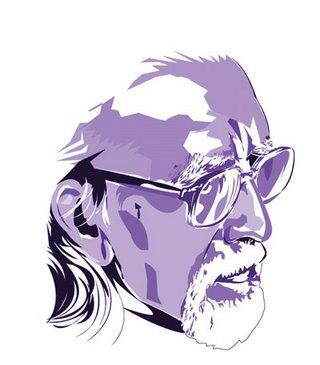
Ottupulakkal Velukkutty Vijayan, born in 1930 in Mankara, Kerala (India), grew up in a rural setting where nature and Hindu customs governed everyday life. He completed his university studies with a Master of Arts in English language and literature. From 1954 to 1957 he was a lecturer in English literature at Malabar Christian College in Calicut (now Kozhikode), Kerala. He then worked for many years for renowned newspapers and magazines as a cartoonist and columnist. He later became a freelance writer.
Vijayan wrote almost exclusively in Malayalam, his mother tongue. His extensive body of work includes six novels, numerous short stories, and essay collections. Vijayan translated some of his own novels and stories into English himself. He was married and had a son. He died on 30 March 2005 after a long illness.
Works
O. V. Vijayan is regarded as one of the most distinguished contemporary writers of India. The contradictions and tensions in the relationship between humans, God, and nature form the main source from which Vijayan drew the ideas and themes for his work. People must choose between sin or piety, technology or nature, war or peace. They long for an unambiguous choice, yet it is not available to them, because contradiction, Vijayan believed, is inherent to human nature.
This basic outlook evidently stems from Vijayan's inclination to interpret the course of things from a Hindu perspective. According to the doctrine of karma, the course of one's present life is determined by actions in previous lives. On the other hand, Hinduism also holds that everyone is free to shape their own life. Herein lies the core of the contradiction: the helplessness with which people confront their karma lends life a tragic quality from which there is no escape — unless a person purifies their karma through suffering and pain so thoroughly that they become capable of experiencing God and attaining redemption.
Vijayan began as an author of short stories. His earliest texts depict everyday rural life. He later moved on to existential themes not bound to any particular place. He writes of social change, of the conflicts it causes, of existential fear and doubt, of sexuality, of power and its destructive force, and of spirituality. In most of his stories he uses the locally coloured, rustic language of his immediate homeland.
Vijayan's first significant story, Oru yuddhathinte Aarambham ("The Beginning of a War"), was published as early as around 1958. Its central theme is the conflict between a landowner and the village's field labourers. The landowner succeeds, through the mechanisation of agriculture, in increasing yields — but at the expense of the smallholders, sparking their resistance.
Vijayan's stories are marked by a diversity of themes, dense language, remarkable flights of imagination, and frequent allusions to events and figures from Indian myth. His razor-sharp mockery is balanced by a pronounced compassion for human suffering.
With his debut novel, Khasakkinte Ithihasam ("The Legends of Khasak", 1969), Vijayan proved himself a writer of world stature. Because of this groundbreaking work, on which the author had worked for around 12 years, Vijayan is often referred to as the Gabriel García Márquez of Malayalam literature. The way in which Vijayan fused myth and reality, as well as eroticism and metaphysics, in this work was without precedent in Malayalam literature. In style and narrative technique Vijayan was original, and his manipulation of time and space electrified readers' imaginations. With The Legends of Khasak, Vijayan introduced "magic realism" into Malayalam literature, thereby simultaneously paving its way toward modernity.
Ravi, a student of astrophysics and the novel's narrator, abandons his studies and all worldly ambition, tormented by guilt over a sexual relationship with his stepmother. He arrives in the fictional village of Khasak and takes up work there as a teacher. Involuntarily, as a representative of progressive forces, he becomes entangled in the dispute between Muslims and Hindus in the village. But even more, Ravi falls under the spell of the legends and myths that live on everywhere there.
After this novel, Vijayan wrote five further significant novels: Dharmapuranam ("The Saga of Dharmapuri", 1985); Gurusagaram ("The Infinity of Grace", 1987); Madhuram Gayati ("Sweet Is the Music", 1990); Pravachakante Vazhi ("The Path of the Prophet", 1992); and Thalamurakal ("Generations", 1997).
Looking back, it can be said that no other major author of Malayalam literature has so consistently sought to interpret historical development and progress on the basis of an Indian worldview.
Jose Punnamparambil
Works in German Translation
- Die Legenden von Khasak, Insel Verlag, Frankfurt am Main, 2004 (in German)
- The story Nach der Hinrichtung was first published in Hermann Gundert – Brücke zwischen Indien und Europa, Süddeutsche Verlagsgesellschaft, Ulm 1993, and later in MEINE WELT, issue 1/1993 (in German)
Awards
Kerala Sahitya Akademi Award (1990); Vayalar Award (1991); Ezhuthacchan Award (the highest literary honour for writers in Malayalam, 2001); Odakuzhal Award and Mathrubhumi Literary Award; Padma Bhushan, New Delhi (2003).
Excerpt
- Nach der Hinrichtung (After the Execution, in German)
📄 Download this author profile as a PDF (in German)