Vijay Tendulkar
Biography
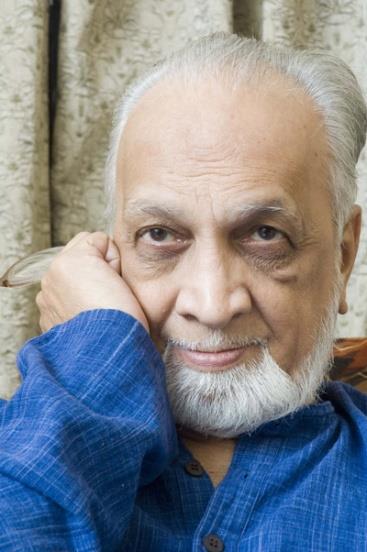
Vijay Tendulkar (6 January 1928 – 19 May 2008) was an Indian playwright and screenwriter who also wrote short stories and autobiographical articles. He wrote predominantly in his mother tongue, Marathi. He is famous above all for his plays (27 full-length plays and 25 one-act plays).
Vijay Tendulkar's father, alongside his job as an office clerk, ran a small publishing business, which brought Vijay into contact with literature from an early age. He wrote his first short story at the age of six and his first play at fourteen. Early in his career he also tried his hand at journalism. His works and autobiographical essays show him committed to truth alone. Without fear of the consequences, he criticised both social conditions and politicians.
He belonged to the young generation of realists on the Indian literary and theatre scene. His stage works of the 1970s were psychological studies of violence with reference to contemporary politics. In interviews Tendulkar said that both real and merely imagined violence fascinated him, and that he repeatedly explored this perennially topical theme in his work.
Among his best known, most successful and most controversial works are Sakharam Binder (1971) and Ghashiram Kotwal (1972). The latter was also performed in its original version in Europe and the USA. The first European tour took place in September/October 1980, with the play performed 25 times in total across Germany, France, the Netherlands, Britain and Italy. In 1986 the company travelled to North America. A second European tour with 21 performances took the play to Hungary, Yugoslavia, Russia and East Germany in October/November 1989.
A recording of Ghashiram Kotwal with English subtitles, well worth watching, is available on YouTube.
Plays like Ghashiram Kotwal were unusual for their time. Folk songs and dance formed an integral part of the play, commenting on and reflecting the dialogue. At the same time, this also reached audiences who did not belong to the regular audience of bourgeois theatre. In collaboration with Tendulkar, director Jabbar Patel brought innovative ideas to the staging of the play. Ghashiram Kotwal is an example of modern experimental theatre that combines elements of traditional folk theatre with the innovations of epic theatre, in which the entertaining and the socially critical functions complement and reinforce one another.
Because the play deals with power relations and manipulation that are the same everywhere in the world, and because its form of presentation included dance and music, a command of Marathi was not strictly necessary to understand it. Articles in German newspapers, for instance in the Spandauer Volksblatt, the Tagesspiegel and the Berlin Abend, confirm this.
Before the tour came about, however, there were lengthy discussions as to whether it was appropriate to have this play — which "slanders our own politicians and our own history" — performed in far-off countries. In the end, reason prevailed, and the Indian government decided that the troupe could travel to Europe.
Mohan Agashe, psychiatrist and actor, who played the influential state secretary Nana Phadnis, one of the leading roles in Ghashiram Kotwal, and who helped organise the tours, was in contact with Tendulkar for decades. He says of him: "Tendulkar was a man of few words. But he was a very good listener. He could get anyone to confide in him ... His insight into human life is reflected in his work, and that is where his greatness lies. Had he been born in an English-speaking country, he would have become an even more famous writer than he is now. To me and many others, he stands on the same level as any of the great luminaries of world literature." (personal communication)
For his play Shantata! Court Chalu Aahe ("Silence! The Court Is in Session"), Tendulkar drew on Dürrenmatt's radio play "The Breakdown". The play shows how easily a harmless game can turn into a manhunt.
The themes of his works are varied, but share one thing in common: oppression and exploitation. "Untouchables", women, disenfranchised subjects, and so on, live under constant oppression. Tendulkar often brings violence onto the stage and, where the context demands it, uses coarse language, which has led to protests. Yet when one sees or reads his plays, everything rings true and credible. The language is simple but precise, the mode of expression authentic. The stage directions are so detailed that even reading them gives one the feeling of witnessing a performance.
Tendulkar took care never to use vocabulary from an elevated register in his works. "I had, in a sense, developed a feel for colloquial speech. I think that was what struck readers of my later works the most. Stylistically, they were quite different from what they expected of plays." (From an interview with Vijay Tendulkar conducted by Priya Adarkar in January 1971)
His satirical play Kamla is based on a true incident. To prove that human trafficking is still possible, a journalist buys a woman and takes her home. But what matters to him above all is his own career as a sensationalist journalist and boosting the circulation of the magazine he works for. The human misery of women sold into prostitution is a matter of indifference to him. At the centre of the play is a scene in which the "purchased" Kamla asks the journalist's wife: "How much did you cost him?" — prompting the latter to reflect on her own role in her husband's life.
In the play Kanyadaan ("Giving Away the Daughter"), it is shown how, even for an open-minded, emancipated couple, the cultural gulf between the castes they come from proves their undoing. People who have been exploited themselves become exploiters in turn, once given the opportunity.
From the early 1970s onward, Tendulkar also worked as a screenwriter for film.
He spoke openly about politics and was opposed to the death penalty. In his final years he had become a legend, and reactions to his statements were correspondingly extreme and intense. He was praised and revered, or else hated.
Tendulkar died in May 2008, aged 80, in Pune, from the effects of the rare muscle-weakening disease myasthenia gravis. His wife, his son, and one daughter had already died before him. His composure in hospital and in the face of death, however, was described as remarkable. He had instructed that his funeral should be conducted with as little ceremony as possible.
Chitrarekha Mehendale and Reinhold Schein
Works (selection)
Plays:
- Gidhāde ("The Vultures", 1961)
- Shantata! Court Chalu Aahe ("Silence! The Court Is in Session", 1967)
- Ashi Pākhare Yeti ("Thus Come the Birds", 1970)
- Sakharam Binder ("Sakharam the Bookbinder", 1972)
- Ghashiram Kotwal ("Police Chief Ghashiram", 1972)
- Kamalā ("Kamala", 1981)
- Kanyādān ("Giving Away the Daughter", 1983)
Many of Tendulkar's plays have been translated into other Indian languages and into English.
Literary translations (by Tendulkar):
- Adhe Adhure by Mohan Rakesh (from Hindi)
- Tughlaq by Girish Karnad (from English)
- A Streetcar Named Desire by Tennessee Williams (from English)
Published in German
- "Ruhe, das Gericht tagt", translated from the English by Christa Schuenke, in: Indische Stücke, ed. by Roland Beer, Henschelverlag Berlin 1989, pp. 21-94 (in German)
Further Reading
- On Kamla: Pramila Pandey: "Vijay Tendulkar's Play Kamla is a Symbol of Slavery"
- On Kanyadaan: Subhash: "Idealism versus Reality: A Study of Vijay Tendulkar's Kanyadaan"
📄 Download this author profile as a PDF (in German)