Urvashi Butalia
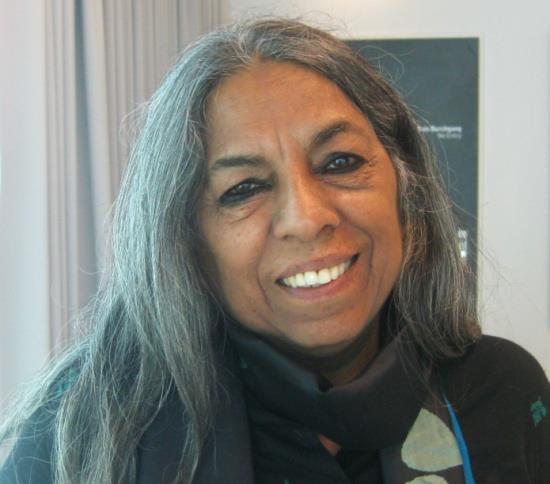
Since our first meeting at the beginning of the 1980s, I have always experienced Urvashi Butalia as publisher, author, activist and university teacher in media and gender studies all in one, with a great presence in the Indian women's movement. Back then she spoke of street theatre about dowry murders as a way of making the invisible public, visible and audible, of showing that the private is political, and of breaking the silence about what lies hidden within one's own four walls or in individual or collective memory.
With this motivation, in 1984, together with Ritu Menon, she wrote women's movement history when she founded Kali for Women, the first feminist publishing house in South Asia. The publishing goal then, and today at the successor publishing house Zubaan, was and is to create alternative public spheres beyond the mainstream and to build an alternative knowledge base. Both publishing houses see themselves as a product, and sometimes also as an organ, of the tremendously vital and diverse Indian women's movements (Urvashi deliberately uses the plural). Urvashi founded Zubaan (English: tongue, voice) in order to go beyond Kali's Hindu-identified perspective and to capture the cultural, social and religious diversity of South Asia beyond India.
About the Author
Born in 1952 in the north Indian city of Ambala, Urvashi lived from 1961 onwards in Delhi with her family, which had fled from Pakistan during the Partition of India, and studied literature there. Guided by her energetic mother, a teacher who was one of the first to draw public attention to dowry murders, Urvashi learned to defend herself against everyday discrimination and sexual harassment in the family, at college and on the way there, not to take on a victim's role but to become active. At the same time, in the turbulent 1970s, she was politicised from multiple perspectives by Indira Gandhi's authoritarian emergency laws, the radical Naxalite movement, and by social-reformist, trade union and student organising. She was interested in printing as a production process and dreamed of having her own printing press to produce leaflets for the women's and other social movements.
When Urvashi Butalia gained her first professional experience at Oxford University Press, she noticed that women did not appear as authors. "Do women write at all?" asked the friendly head of the publishing house. Whereupon Urvashi decided "to do it herself": to build up a women's publishing house and create a publication forum for women, a platform for literary and scholarly works, art and documentation – as Zubaan's self-description puts it: "books by, about and for women in South Asia". Literature here is a broad concept encompassing oral, drawn and written articulations. The aim is to give a voice to those who stand at the margins of society, the injured and the vulnerable who are not heard, who have been silenced or who deliberately remain silent, including sexual and other disenfranchised minorities.
Publisher and Bridge-Builder
Urvashi Butalia, herself an enthusiastic reader of crime fiction, began as publisher and editor to encourage women to see that their history and their stories are worth being told, recorded or written. Among them, in 2002, her 81-year-old mother, with stories about the victims and survivors of dowry violence. A central motif is the irresolvable contradiction that women are often victims and perpetrators at the same time. She did pioneering publishing work with the courageous publication of the stories of Ismat Chughtai, an Urdu author who wrote about lesbian love in the 1940s; with the illustrations by 70 illiterate women from Rajasthan about the female body, a sex education book in which the clothing can be folded away; with studies on sexual violence and impunity in conflict and border regions of South Asia; but also with translations of literature from the contested north-eastern states of India. In this way Urvashi Butalia becomes a bridge-builder between languages, between past, present and future, between parties to conflicts, and also between women's and other social movements. At the same time, the two publishing houses also became a forum for feminist scholars, who exchanged and discussed research results and theoretical approaches there.
The bestseller of the Zubaan publishing house: the life story, translated into English by Urvashi, of Baby Halder, a young woman who was married at 12, was a mother at 14, and managed to leave her violent husband and her home town and build a new existence for herself as a domestic worker in New Delhi. The book shows what distinguishes Urvashi's work. She does not speak for others, she does not want to represent others, but brings them to speak. For years she meets the same people, listens to them, gets close to them – for example Mona, a hijra/transsexual, whom she visited once a week until her death.
The Other Side of Silence
The spoken word, the told, personal stories are also the starting point for Urvashi Butalia's own authorship and her approach to history. This makes her a master of coming to terms with history through oral history. In her work The Other Side of Silence, published in 1998, she undertakes historical explorations of the Partition of India and the tearing apart of families, including her own, after realising that women do not appear in official historiography. With this book, available in German under the apt title "Geteiltes Schweigen" ("Divided/Shared Silence"), she opened a new chapter of historiography by recording the memories and individual perceptions of those who fled and those who stayed, of relatives and of survivors "from the other side" – the Pakistani and the female one. She puts the unsayable – violence, despair, guilt, trauma – into words for the first time. The narratives of what was experienced and suffered turn the inside out, exposing selective forgetting, memory loss and silence. They show that speaking does not always liberate, that memory cannot be objectified, that history is not closed, that there is no simple opposition between silence and speech, victim and perpetrator. Despite many agonising questions about how people relate to their own history, this book appeals for understanding and reconciliation between Pakistan and India.
As early as the 1990s, Urvashi published, together with the historian Tanika Sarkar, texts on the rise of Hindu nationalism and on the role of women in the right-wing identitarian movement. After Modi's triumphant election victory, she has been concerned with the contradiction that precisely in this election more women than ever before voted and won parliamentary seats, above all for the Hindu-identitarian BJP. At the same time she observes at Ashoka University, where she has been teaching gender studies for a few years, that not only many young women but also young men are keenly interested in feminism, because they see emancipatory and transformative potential in it. Urvashi places her hopes in new movement approaches and the young generation of feminists.
"We are not just victims, we act and negotiate" – that is the central message and the answer to pitying comments that it must be very difficult for a woman in India to be a publisher. She replies that nowhere is it easy to run a small feminist publishing house. Although she has since received recognition through prestigious prizes such as the Padma Shri or the Goethe Medal, she has to renegotiate her possibilities, spaces and topics in patriarchal Indian society every day. These everyday struggles, however, are her incentive and empowerment to carry on.
Christa Wichterich
Prizes
- 2000: Pandora Award for Women in Publishing
- 2011: Padma Shri
- 2017: Goethe Medal
Works
- Butalia, Urvashi / Ritu Menon (eds.) (1992): In Other Words: New Writings by Indian Women. Kali for Women, New Delhi
- Butalia, Urvashi / Ritu Menon (eds.) (1995): Making a Difference: Feminist Publishing in the South. Bellagio Pub. Network
- Sarkar, Tanika / Urvashi Butalia (eds.) (1995): Women and the Hindu Right: A Collection of Essays. Kali for Women, New Delhi
- Sarkar, Tanika / Urvashi Butalia (eds.) (1995): Women and Right Wing Movements: Indian Experiences. Zed Books, London
- Butalia, Urvashi (1998): The Other Side of Silence: Voices from the Partition of India. Penguin Books India, New Delhi
- Butalia, Urvashi (ed.) (2002): Speaking Peace: Women's Voices from Kashmir. Kali for Women, New Delhi
- Butalia, Urvashi (ed.) (2006): Inner Line. The Zubaan Book of Stories by Indian Women. Zubaan, New Delhi
- Butalia, Urvashi (ed.) (2015): Partition. The Long Shadow. Zubaan, New Delhi
- Butalia, Urvashi (2015): The Persistence of Memory. Harper Collins
Published in German
- Butalia, Urvashi (ed.) (2006): Frauen in Indien, dtv Munich
- Butalia, Urvashi (2015): Geteiltes Schweigen. Innenansichten zur Teilung Indiens, Berlin, Lotos Werkstatt
Reading Excerpt
- Opening pages and beginning of chapter 2 of "Geteiltes Schweigen" (PDF, in German) (with kind permission of the author and publisher)
📄 Download this author portrait as PDF (in German)