U.R. Ananthamurthy (1932–2014)
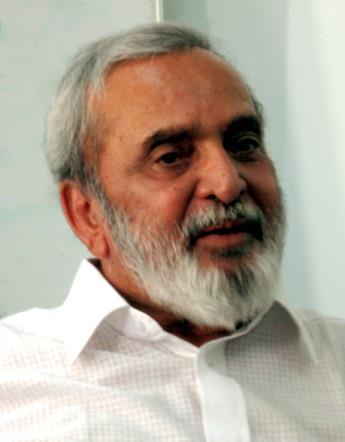
The sun was already setting when a rickshaw dropped me off in front of the house of the Kannada writer U.[dupi] R.[ajagopalacharya] Ananthamurthy in Bangalore in the spring of 2013. The author was sitting on a small terrace in the evening twilight, expecting me. His figure may have hinted at his age, but revealed nothing of his fragile state of health. He radiated a calm and kindness that merged completely with the mood of the falling evening.
We must first have exchanged the usual courtesies, probably initially in English; the author was kindly concerned that the mosquitoes might torment me. Soon, however, we had left the formalities behind — perhaps because the conversation had imperceptibly switched to Kannada, and Ananthamurthy took a quiet pleasure in the fact that I spoke with the unmistakable accent of the town of Udupi, from which his family came.
About the Author
U.R. Ananthamurthy was born on 21 December 1932 in the village of Melige in the Shimoga district of the state of Karnataka, into a family belonging to a particularly orthodox group of Brahmins. He first received a traditional Sanskrit education, later studied at the University of Mysore, where he taught English literature after completing his M.A. Some insights into his childhood and youth, as well as into influences that became decisive for his later literary work, are offered by his essay Being a Writer in India, which is now also available in German in the short story collection Sonnenpferdchen (see below). In it he describes, among other things, how his childhood world was fragmented down to the daily routine: the morning, for example, belonged to the almost medieval Vedic ritual, the corresponding texts were called into question at school, and at yet other times his father and other figures taught him respect for the English language and literature, while Gandhi's teachings also penetrated into this world.
Still very much under the impression of the aftermath of Indian independence, Ananthamurthy published a first volume of short stories in 1955, in which the focus on the human being as an individual and on the characters' self-reflection is already laid out. With his second volume of short prose (Praṣṇe) in 1962 he achieved his breakthrough as a writer.
In 1963 Ananthamurthy went to Birmingham, Great Britain, for three years to earn his doctorate. During this time his view of India changed, and his conviction to hold on to Kannada as his literary medium solidified.
The Novel Saṃskāra
This period also saw the writing and publication of his first novel, Saṃskāra (1965). For the Kannada-speaking region, Saṃskāra was not the first, but the first authoritative "new" novel (Brückner 2006: 238). Through the sensitive English translation by A.K. Ramanujan (1976), Ananthamurthy also gained recognition abroad with this novel. Saṃskāra, like many of Ananthamurthy's earlier short stories, has as its central theme the field of tension between tradition and modernity, between "Indian" and "Western" values, as expressed above all in the restriction of the individual's personal freedom. The 1970 film adaptation of the novel became the focus of a controversy after the censorship authority initially refused to release the film and the author was accused of defamation.
Saṃskāra deals with the death of a Brahmin who, through his way of life (an illegitimate love affair with a woman of a lower caste), had cut himself off from his fellow caste members in a closed, traditionally oriented Brahmin settlement. His death – the immediate necessity of properly disposing of the corpse – unexpectedly confronts the settlement with its own limits. At the centre stands the scholar Praneshacharya, initially drawn as the orthodox counter-image of the deceased, in whom it can clearly be seen how the initially external conflict increasingly becomes an internal one, just as the authorial narrative perspective shifts into interior monologues and passages of stream of consciousness.
Life and Work
After his return from England, Ananthamurthy went back to Mysore and resumed his teaching post as a lecturer in English. By marrying an Indian Christian, he also broke the caste barriers in his own life that he so often questions in his works.
Especially in the 1970s and 1980s, Ananthamurthy established his literary reputation with a series of further novels (see below). While Ananthamurthy has rightly become most famous for his prose work, he also published a number of poems as well as a play (Avahane, first performed 1969, published 1971).
Stylistically, Ananthamurthy's work was at first entirely attributable to modernism, whose literary movement in the Kannada-speaking region is called navya. Many works reflect the author's personal journey from rural to urban India. In the course of this personal journey his work also changed, coming over time to stand closer to the later protest literature (baṇḍāya).
He held on to his conscious commitment to writing in his mother tongue throughout his life, despite an excellent knowledge of English and its literature. In doing so, he laid foundations that to this day provide Kannada literature with a solid base that young authors can also draw upon. In his essayistic work in English he addresses the question of the choice of language several times; his position is that writing in his mother tongue offers him a necessary corrective that filters "undigested" Western influences out of his work. Also important is Ananthamurthy's observation that Indian writers of his generation have access to the direct experience both of modernity (as represented by the West) and of medieval realities and patterns of thought.
Of particular significance was Ananthamurthy's friendship with the scholar and poet A.K. Ramanujan (1929–1993). Inspired by Ramanujan, Ananthamurthy formulated literary and cultural positions for himself within coordinates he took from Indian cultural history, such as the continuum of oral and written culture.
Ananthamurthy's attitudes towards Indian society and politics were based above all on the socialist teachings of Rammanohar Lohia (1910–1976), who strove for a synthesis of Marxist ideas with the attitudes of Gandhi, with non-violence as the central moment of social change. As early as the late 1960s, Ananthamurthy repeatedly addressed in essays (and in some measure also in his literary work) the question of the relationship between art or literature and politics or society, and of the position the writer can take in this regard.
In his later years, political engagement became ever more important to Ananthamurthy. In 2004 he ran as an independent candidate for a seat in the Indian parliament, but did not receive the necessary number of votes. As late as 2013 he spoke out in clear words – and at considerable personal risk – against a Hindu fundamentalist government under Narendra Modi.
Ananthamurthy received numerous prizes for his work. He was the sixth Kannada author to be honoured with the Jnanpith Award. In 1998 he was awarded the Padma Bhushan. In 2013 he was on the shortlist for the Man Booker Prize. One only has to watch the speech he gave in London at the time to understand how deeply Kannada and its literary culture, alive down to the oral tradition, were rooted in him.
U.R. Ananthamurthy died on 22 August 2014. The memory of the encounter on that spring evening in Bangalore has never let go of me since. In his work, his love for his mother tongue lives on, as does his warm sympathy for the lives and feelings of people everywhere.
Katrin Binder
Works (Selection)
Novels:
- Saṃskāra, 1965
- Bharatipura, 1973
- Avasthe, 1978
- Bhava, 1994
- Divya, 2001
Short story collections:
- Endendu mugiyada kathe, 1955
- Praṣṇe, 1962
- Mauni, 1967
- Akāśa mattu bekku, 1981
- Suryana kudure, 1995
Important essays in English:
- Literature and Culture. Essays in English. Ed. by A.J. Thomas, Calcutta 2002. [including: "The Fragmented Vision: Dilemmas of the Indian Writer", "Search for Identity: A Viewpoint of a Kannada Writer", "Why not Worship in the Nude?", "Being a Writer in India"]
Published in German
- Samskara oder Was tun mit der Leiche des Ketzers, die uns im Weg liegt und das Leben blockiert, transl. Gernot Schneider, Frauenfeld 1994/Berlin 2013
- Ghatashraddha – Totenritual für eine Lebende, transl. Heidrun Brückner, in: die horen 188, vol. 42, 1997, no. 4, pp. 123–141
- Sonnenpferdchen, stories. Transl. Heidrun Brückner and Katrin Binder. Berlin 2017
Further Reading
- Brückner, Heidrun, "Dimensions of Intertextuality in Anantha Murthy's Novel 'Samskara'", in Dilip Chitre et al. (eds.), Tender Ironies. A Tribute to Lothar Lutze. Delhi 1994, pp. 152–183
- Brückner, Heidrun, "U.R. Anantha Murthy", in: Martin Kämpchen (ed.), Indische Literatur der Gegenwart, Munich 2006, pp. 238–257
- Amur, G.S., Essays on Modern Kannada Literature. Bangalore 2001
- Mukherjee, Meenakshi, Realism and reality: The novel and society in India, Delhi 1985
- Ramanujan, A.K., "Afterword", in: U.R. Anantha Murthy, Samskara. Oxford 1976, pp. 139–147
Reading Excerpt
Further Links
- U.R. Ananthamurthy on Wikipedia
- U.R. Ananthamurthy at the Booker Prize
- U.R. Ananthamurthy's Man Booker Prize speech (YouTube)
📄 Download this author portrait as PDF (in German)