Thoppil Mohammed Meeran
Biography
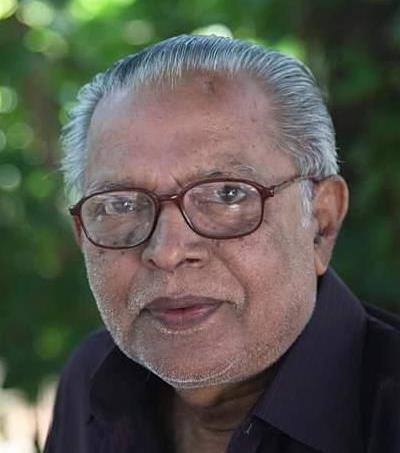
Thoppil Mohammed Meeran (1944-2019) came from the southernmost tip of India, from Thenga Pattanam in Kanyakumari District, a village of 200 houses clustered around an ancient mosque — Malik Ibn Dinar.
Starting with the origin story of the mosque, the village was the subject of numerous myths and legends, which was why the Maulvis, or religious scholars, held the top position in the social hierarchy. The next most important group were the wealthy landowners. Then came the disenfranchised labourers and the poor fishermen. At the very bottom were a few desperately poor Hindus and Muslims who lived in a small grove (in Tamil: Thoppu, from which the name Thoppil is derived) near a cremation ground. Meeran belonged to this last group. His literary work centres on this village and its inhabitants.
Thanks to his village's geographical position between Tamil Nadu and Kerala, Meeran grew up bilingual, speaking both Malayalam and Tamil. He earned his college degree in economics at South Travancore Hindu College in Nagercoil. Even then he was fascinated by the works of the celebrated Malayalam-language writer Vaikom Muhammad Basheer, and so he wrote his first stories in Malayalam.
Writing without Prospects
Alongside his trade in chillies, he always pursued his desire to write stories. However, he had to content himself with publishing his short stories and serialised novels in little-known Muslim magazines, which in turn meant that his work remained unknown to a wider, non-Muslim readership. He had to wait 35 years before his first work saw the light of day in book form, though this did not stop him from continuing to write throughout that time. His breakthrough came in 1988 with his novel Oru kadalora giramathin kathai ("The Story of a Coastal Village").
His literary output comprises six novels and seven volumes of short stories. He also translated six books from Malayalam into Tamil. His works have been translated into many Indian languages as well as into English and German.
Novels
With Oru kadalora giramathin kathai (1988, published in German as "Die Geschichte eines Dorfes am Meer", 2011), Meeran's shadowy existence as a writer came to an end. The novel pits feudalism and the traditional social order against the forces of emerging modernity. Ahmadkannu Mudalali is the powerful man of the village, who tyrannises the entire community and tries by every means to prevent the emerging changes, which he regards as a threat to the existing status quo. Opposing him is Mehmud, the shark-fin trader, who refuses to be intimidated. Meeran shows how the progressively minded Mehmud shakes the tyrant's authority by defying his arbitrary edicts. He and the village teacher form the counterweight to Mudalali: two men who want to open the way to the future, against the backward-looking obstinacy of a man obsessed with power. All three are interwoven with other finely drawn characters who make up the novel's full cast.
1991 saw the next novel, Thuraimugam ("The Harbour"). The novel's central subject is the coastal village, above all its harbour, and more specifically the waves of the sea that tell its stories. Highs and lows, joy and tears are always part of it. The novel illustrates, in exemplary fashion, how religious narrow-mindedness and prejudices born of ignorance paralyse society.
The 1993 novel Koonan Thoppu ("The Hunchback's Grove") deals with religiously motivated conflicts between Muslims and Christians and the violence that results from them.
In 1997 Meeran was awarded the Sahitya Akademi Prize, the Indian government's highest literary honour, for his fourth novel Sāyvu nārkali ("The Armchair"). The story revolves around Mustafa Kannu, a repulsive patriarch from whose lechery no woman in the village is safe. Through his reprehensible way of life he squanders the family wealth accumulated over generations. In the end, all that remains are his armchair and the cane with which he forced those around him to their knees his whole life long. Meeran skilfully weaves a painful family chronicle together with the history of the princely state of Travancore.
The central subject of the 2008 novel, with the unadorned title Anjuvannam Theru ("Anjuvannam Street"), is exactly that: the street. This is the setting in which the stories of vividly drawn characters unfold, underpinned by the core theme — the conflict between the purist-traditionalist current and the liberal current within Islam. At the end, Meeran hints at an idealistic possibility: a reconciliation between the two currents.
Meeran's final novel, Kudiyetram ("Colonisation"), published in 2017, describes the vicissitudes of Indian history in the 16th/17th centuries along India's eastern and western coasts, building a bridge between history and fiction. It concerns the bitter struggle between the Marakkayar, a Muslim community of maritime traders, and the Europeans, who sought dominance both over the land and over trade.
Short Stories
Meeran's short stories were published in 6 volumes. For many non-Muslim readers, the stories are a journey of discovery.
Suriyanai prasavikkum Pārai ("The Rock that Births the Sun"), a blend of magic and reality, describes a boy who believes that the rock in his village gives birth to the sun every morning. He has never questioned the superstitious beliefs instilled in him from every side. Among them is a snake said to live in a well within the rock and to pose a great danger. Despite the ominous warnings, the boy climbs the rock and encounters a snake. Impressed by his thirst for knowledge, the snake exposes the beliefs guarded for generations as mere superstition.
The name of the protagonist in the story Calendar Bawa is an honorific. Bawa means father and is also a form of address for a respected person. The addition "Calendar" comes from his precise ability to sight the crescent moon announcing the festival of Ramadan. This year, his failing eyesight leaves him unsure whether he has actually seen the moon or has simply let himself be persuaded by the cheering children. He thinks of the preparations the villagers have made with their meagre means. He thinks of the goats awaiting slaughter, whose suffering would be prolonged by a day if he says no. He also knows that he would become as worthless as an old calendar if he admitted his failing eyesight. He wavers between his innate honesty and his wish not to disappoint the excited children and the villagers. The decisive moment is only a few steps away. The village headman is already waiting for him.
Beyond conflict and violence, Meeran offers a heart-rending love story, Abdulla Ibn Abubaker, in which the protagonist Noorunnisa pines, from her youth into old age, for the story's namesake — an imaginary, impossibly handsome Arab ship's captain. The fantasies she indulges in earn her ridicule and mockery, which troubles her little. The world of fantasy is her only reality. She is overjoyed when one day she sees an aeroplane, as large as the captain's ship, flying overhead. "If a great ship can grow wings and fly, then surely I too can fly to my Arab," she thinks. Not only the foreseeable tragic ending but also Meeran's lyrical prose lingers long in the memory.
Awards
Meeran received eight awards for his literary work. The most important among them: the Sahitya Akademi Award, the Indian government's highest honour, in 1997 for the novel The Armchair (1995); the Tamil Nadu Kalai Ilakkiya Perumantram Award (Tamil Nadu Forum for Fiction Prize) in 1992 for his first novel, The Story of a Coastal Village (1988).
Assessments
The well-known writer and critic Jeyamohan emphasises that Meeran, more than anyone else, created an intimate bond between non-Muslim readers and Muslims. He achieved this through his art by ignoring the one-sided identities of Islam and Muslims produced by religious representatives and politicians, and by speaking with great empathy about cultural nuances, hopes, fears, and both the dark and light sides of life. "His art of writing is unpolitical. That, precisely, is the politics of art."
After reading Meeran's first novel, The Story of a Coastal Village, the well-known writer Sundara Ramasamy said: "He is an empathetic person. He has a natural affinity for ordinary people and their joys and sorrows. Their progress in life is a genuine concern of his. That is his strength."
The strongly regionally inflected language and a vocabulary made up of a mixture of Tamil, Malayalam and Arabic loanwords could cause some irritation. But as Ilija Trojanow put it in his review of the German edition of The Story of a Coastal Village, it is a pleasure "to finally be surprised again, instead of drifting off amid the repetition of the familiar."
Hem Mahesh
Published in German
- Die Geschichte eines Dorfes am Meer, 2011 (in German)
Excerpts
- Die Geschichte eines Dorfes am Meer (bücher.de, in German)
- Calendar Bawa (English translation, The Tech Agents, March 2022)
Reviews
- Die Würde eines Haifischflossenhändlers (by Ilija Trojanow, in German)
- Meeran's stories are tales of a forgotten people (by Suresh Subrahmanyan, The Asian Age, 5 February 2022)
Articles
- About myself (journal article, Sahitya Akademi, 2002)
- Meeran belonged to everyone (by Prabha Sridevan, The Hindu, May 2019)
- His mission is to dispel myths (by M. Balaganessin, The Hindu, 7 October 2005)
- Writer Thoppil Meeran took muslim culture to the masses (The Federal, May 2019)
- Living Legend (The Hindu, 2011)
📄 Download this author profile as a PDF (in German)