Sunil Gangopadhyay
About the Author
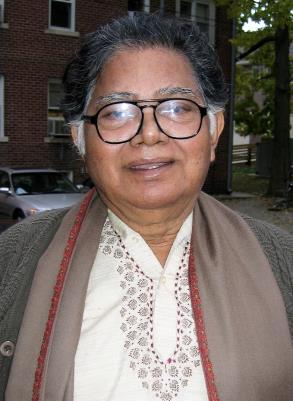
Sunil Gangopadhyay was, during his lifetime, the most widely read novelist writing in Bengali. He was born in 1934 in Faridpur, in what is today Bangladesh. He died in 2012 in Calcutta.
In his native Bengali there are around 300 publications by him, including novels, many stories, as well as essays and volumes of poetry. Many of these have been translated into English or other Indian languages. Although he was better known for his prose, he told me he felt himself to be more of a poet. I met him several times, conducted a detailed interview with him at his flat in south Calcutta, and later supported him as a moderator during a reading tour in Germany. Besides stories and poems in anthologies, however, only one of his books was published in German, "Der Widerläufer" ("The Adversary"), an early novel in which — as in almost all his longer narrative texts — the partition of Bengal into the Indian state of West Bengal and what was then East Pakistan forms the fateful backdrop for his protagonists.
Siddhartha, the hero of this story, is, like Sunil Gangopadhyay himself, a refugee, one of the first generation to leave, or be forced to leave, East Bengal. He is the eldest son — his father has recently died — and is responsible for the family, but cannot find work. Sunil Gangopadhyay described to me the absurd job search of his alter ego, who queues along with three hundred others for a position, as follows: "That describes largely my own experiences at job interviews back then. Because even before they invited us in, they had already chosen one or two people. So the whole thing was a farce. They really only allowed themselves a joke at our expense."
An incipient first love softens the protagonist's hopeless situation and gives the reader insight into the quite self-confident understanding of their role held by young women of that time, the early 1970s. Yet his protagonist ultimately does not feel equal to this situation either. He oscillates between a paralysing complex of inadequacy and an escalating rage against everyone and everything. "He thought to himself," says Sunil Gangopadhyay of his character, "that one day he would punish everyone. He would punish his sister's boss, the people who hold fake job interviews, he would punish the police, the government, everyone!"
Shortly after the novel was published, the Naxalites, a radical, Maoist-oriented movement, erupted in West Bengal. The movement took its name from Naxalbari, a small village in North Bengal, from where it originated. Driven by the same anger and hopelessness felt by the character Siddhartha, thousands of young men organised themselves in the early 1970s. In this respect, Sunil Gangopadhyay's early novel, like his later ones, repeatedly portrays in rich detail and subtlety the social situation in which it is set.
The Bengali writers of that time gathered in Calcutta under the term "Hungry Generation". Asked about this, Sunil Gangopadhyay said: "I did not belong to it, but some of my friends formed this group. 'Hungry Generation' is derived from the 'Angry Generation' that existed in England and America's 'Beat Generation'. I was too proud to follow these Western patterns." On the other hand, Sunil Gangopadhyay had close connections precisely to the "Beat Generation". He introduced Allen Ginsberg and his friend Peter Orlovsky to Calcutta's very lively literary scene during their first famous trip to India. In return, he got to know the wild life of the Beatniks in New York in the early 1960s. During a scholarship stay there he also met Jack Kerouac: "I met him in Greenwich Village, where they all came together, read poems aloud and talked and sang through the nights; it was a wonderful time that I experienced then."
Subsequently Gangopadhyay wrote his first novel, inspired by suggestions that, as he said, came from Kerouac. Satyajit Ray later filmed it under its original title, Pratidwandi, which certainly significantly increased the book's fame. Other of his novels were also made into films, another likewise by Satyajit Ray, two later ones by Gautam Ghosh.
Sunil Gangopadhyay was not only a significant figure in the literary scene of Bengal and India through his own writing, but was also a founding member of the later-famous literary magazine Krittibas (1953), which published mainly poetry. For many decades he was also an editor at the publishing house "Ananda Bazar Patrika" and was thereby always in close contact with writers, especially those in the Bengali language. During these professional years, provided he was present and one was oneself out and about writing, one could meet him at any time and talk with him in his small, paper-cluttered office on the premises of the publishing house.
For larger works he regularly travelled to write in rural Shantiniketan, the place where Tagore, whom he himself came to appreciate rather late, had founded his famous university in the countryside. Sunil Gangopadhyay's last novel, Bhanu ebong Ranu, published in 2012, is precisely about him — the aged Tagore — and a young girl who inspires Tagore to write again. In Shantiniketan, much teaching and learning still takes place in the open air. During my visit I found that everyone I asked knew who Sunil Gangopadhyay was, where his house stood, and even whether he happened to be there at the time or not.
Sunil Gangopadhyay received all the high honours of Indian literature, including the Sahitya Akademi Award (1985). Two decades later (2008) he himself became the elected president of the Akademi and remained so until his death.
Regina Ray
Works (Selection)
Novels:
- Pratidwandi (The Adversary/Der Widerläufer)
- Sei Somoy (Those days)
- Prothom Alo (First Light)
- Purbo-Pschim (East-West)
- Bhanu ebong Ranu (Bhanu and Ranu)
Children's books: Kakababu series
Film Adaptations
- Pratidwandi, filmed by Satyajit Ray, 1970
- Aranyer Din Ratri, filmed by Satyajit Ray, 1970
- Moner Manush, filmed by Gautam Ghose, 2010
Published in German
- Der Widerläufer, novel, translated by Alokeranjan Dasgupta, Lotos Verlag Roland Beer, Berlin 2002
- Drei Männer, story, translated by Ulrike Seeberger, in "Zwischen den Welten. Geschichten aus dem modernen Indien", ed. Cornelia Zetsche, Insel Verlag 2006
- Athen – Kairo, poem, translated by Lothar Lutze and Alokeranjan Dasgupta, in "Ganz unten, wie Shesha, bin ich" (text samples for the literature symposium on the focus theme "India – Change in Tradition" at the 38th Frankfurt Book Fair 1986), p. 64
- Auszug, short story, translated by Alokeranjan Dasgupta, in "Flucht und Identität", companion booklet to a symposium as part of the Indian Festival 1991/92 at the Haus der Kulturen der Welt, Berlin 1991, pp. 55–59
- Shah Jahan und seine Privatarmee, excerpt from the story, translated by Lothar Lutze and Alokeranjan Dasgupta, ibid. pp. 63–66
- Vier Gedichte, translated by Lothar Lutze and Alokeranjan Dasgupta, ibid. pp. 60–62
Web Links
- Review of "Der Widerläufer" on Deutschlandfunk (in German)
- "Die Entdeckung des Alltäglichen" – on Sunil Gangopadhyay by Christian Weiß (in German)
- Book review at DNA India
📄 Download this author portrait as PDF (in German)