Sethu (Sethumadhavan, Anelil)
Biography
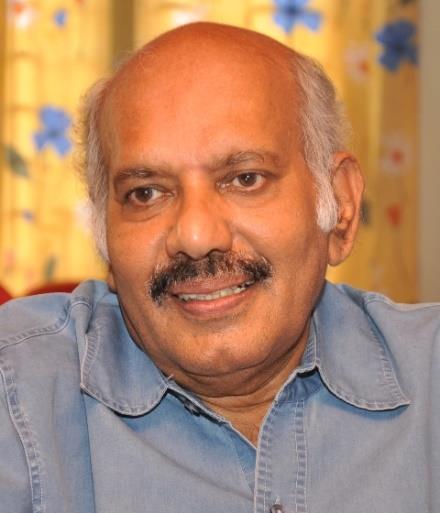
Sethu was born in 1942 in Chendamangalam, Ernakulam, Kerala (South India), and grew up in a rural setting. He studied physics and initially worked for several years for the central government in the meteorological sector. He then moved into banking, holding senior positions there for nearly four decades. After his retirement, he was appointed by the central government in 2012 to a three-year term as chairman of the National Book Trust, New Delhi.
Sethu is one of the leading fiction writers in the Malayalam language. His literary output comprises story collections, novels, novellas, children's books and essay collections. Several of his novels and many of his short stories have been translated into other Indian languages as well as into English. His best-known novel, Pandavapuram, has also been translated into German and published as Pandavapuram – die Stadt der Liebe by Draupadi Verlag, Heidelberg, 2016. Four of his novels, including Pandavapuram, have been adapted for film. The film Jalasamadhi (Death in Water), produced by Venu Nair, is based on a story and screenplay by Sethu. This film was shown at 55 international film festivals in 24 countries and won numerous awards.
Sethu is married to Rajalakshmi, has two sons, and lives in Chendamangalam (Kerala).
Works
Until the mid-20th century, modern Malayalam fiction dealt mainly with themes such as caste hierarchy and class structure in society. In the 1960s and 1970s, however, a new generation of writers emerged who, as pioneers, helped radically change the prevailing view of literature and give it a new orientation — a preference for the subjective over the objective, for imagination over the real, for the uncanny over everyday life. Within this new generation, Sethu was a leading figure. His themes are often death, human suffering, and above all the predetermination of human life and the individual's — mostly unsuccessful — attempts to overcome it. In doing so he draws innovatively on modern narrative techniques such as magic realism, a blend of fantasy and reality, and on the stylistic device of stream of consciousness that James Joyce employed in his novel Ulysses.
Sethu's first story, Daahikyunna Bhumi ("Thirsty Earth"), was written in 1967, while he was living in Delhi for work. The story was published in the renowned Malayalam magazine Mathrubhumi. He subsequently published more than 200 stories in various publications. He also wrote 16 novels and 2 novellas. His most recent novel, The Cuckoo's Nest, he wrote in English.
One of his most important novels, as already mentioned, is Pandavapuram, published in 1979. The novel was groundbreaking, both in its choice of subject and in its innovative narrative technique. As the protagonist, Devi, tries to escape the monogamous practice embedded in the contemporary family structure, she lays claim — at least in her imagination — to Kerala's traditional polyandrous way of life (marriage to multiple husbands) within a matriarchal family. In doing so, the novel also references the Indian epic Mahabharata, which describes how the five Pandava brothers lived in a single marriage with one wife, Draupadi. This desire to overcome a woman's imposed monogamous sexuality, and how this becomes reality within a fantastical dream world, is at the core of the novel's theme. Today, wishes, thoughts and emotions are constrained by society to fit whatever conventions happen to apply. From this strictly policed confinement of social morality, Devi saves herself by escaping into a new reality created by her erotic imagination and her longing for freedom and self-determination. Seen in this light, the novel — which has won numerous awards and exists in many translations, including German — also carries a feminist dimension.
Another significant novel by Sethu is Aliya, published in 2013. The work tells the story of a Jewish family across three generations in Kerala. They belonged to the Jewish inhabitants (known as Malabari Jews) who had been an established part of Kerala's population since the 11th century. After the State of Israel was founded in 1948 and its first prime minister, Ben-Gurion, called on all people of Jewish descent to return to the "promised land", the roughly 200 members of the Jewish community living around a synagogue in Chendamangalam (Sethu's home town) gradually left their true homeland and emigrated to Israel. This exodus to Israel was called Aliyah ("ascent"), and the novel deals with great sensitivity with the painful decision-making process of its protagonist, Salamon, torn between homeland and identity on the one hand and world Jewry's call to return on the other. In the end, Salamon leaves behind his beloved homeland of Kerala, and with it a large part of his cultural identity, and emigrates permanently to Israel.
Works in English Translation
Novels:
- Pandavapuram
- Once Upon a Time (Adayalangal)
- The Wind from the Hills (Niyogam)
- The Saga of Muziris (Marupiravi)
- Aliya
Story collections:
- During the Journey and Other Stories
- A Guest of Arundhati
- Jalasamadhi and Other Stories
Works in German Translation
- "Die Botschaft", story, translated from Malayalam by Thomas Chakkiath, in: Drei Blinde beschreiben den Elefanten. Kerala erzählt, ed. by Christina Kamp and Jose Punnamparambil, Horlemann Verlag, Bad Honnef, 2006 (in German)
- Pandavapuram – Die Stadt der Liebe, novel, translated from the English by Salome Heyn, Draupadi Verlag, Heidelberg, 2016 (in German)
Major Awards
- Kerala Sahitya Akademi Award (1978 and 1982)
- Vayalar Award (2006)
- Sahitya Akademi Award (India's central literary academy, 2007)
- Odakkuzhal Award (2014)
- Kerala Sahitya Akademi Fellowship (2020)
Jose Punnamparambil
Excerpt
The Message
Retranslated into English from the German rendering ("Die Botschaft") in Drei Blinde beschreiben den Elefanten. Kerala erzählt, Horlemann Verlag, Bad Honnef, 2006, translated from Malayalam by Thomas Chakkiath.
"May I call you Uncle Kochunni too?"
"Of course. Plenty of people call me that already."
"You probably didn't recognise me."
"No need to. Nowadays nobody tries to recognise anyone. It's just as well to do without a bit of knowledge you don't strictly need."
"But…"
"No buts. If I don't want to get to know you, sir, that doesn't hurt anyone."
"But it isn't like that, Uncle Kochunni…"
"And what if it is?"
"I've come from Achuthankutti's firm."
"Oh yes? How nice."
"It's terribly hot. The children are just on school holidays. I thought I might as well take some time off myself. That's why I came. And besides, the firm even throws in the first-class ticket."
"Really? Lovely. If you get a free ticket, there's no end to where you could travel!"
"Before I got back from my holiday, I was supposed to visit you — Achuthankutti made a point of it."
"Remarkable! And why did the good fellow take it into his head?"
"No particular reason. After all, the same blood runs in your veins, doesn't it? Shouldn't one be a little curious to hear from one another?"
"Ha, how nice. You may have seen Achuthankutti's blood. But if you, my good sir, now want to see mine, there's nothing for it but to cut my finger. But since I have a touch of sugar, the wound won't heal so fast."
"That isn't what I meant."
"Whatever you may have meant, one ought to be a little careful speaking with such certainty of shared blood. Nowadays the machine plays its little game. If you take someone's blood these days, put it in the machine and test it, and it turns out the blood groups are different — won't everything our forebears and teachers told us about blood ties turn out to be pure nonsense?"
"But even so, it can't be that Achuthankutti isn't your son."
"Who knows that for certain? Not that I mean to doubt my Davakikutty, who's up there now. She was such a dear woman."
"Achuthankutti told me everything. I'm his best friend. And he's president of the Malayali Samajam over there. I'm the secretary."
"Really? How nice! So that's how it is. So Achuthankutti can be president too. Lovely. And if he ever becomes president of India, will you still be his secretary?"
[…]
"And after that, no one ever saw the statue again?"
"No."
"I see. Well, you've taken up a great deal of time. Never mind. Now I'll tell you something. Please listen carefully. […] What is there really to begin and carry on with here? Isn't everything already within us? What matters is that it takes time to find this out, to perceive it. Some manage it sooner, others later, and for some, three lifetimes wouldn't be enough."
"I don't understand any of this, Uncle Kochunni."
[…]
"I'd like to…"
"To go, is it? I don't know whether it's gotten too late for you. But there's a comfort at least. These trains never come as punctually as we think."
"Never mind. Instead of walking, I'll run. But one last thing before I go. Uncle, you must promise me. After all, I've gone to all this trouble to come here, haven't I? I'm supposed to bring Achuthankutti something back."
"Do you think I've tried to cheat the messenger?"
"No, never."
"Well then, what would you like, sir? What more can I give beyond my respect for the messenger?"
"Just a single blessing. One small word of consent. Achuthankutti would like to come here himself sometime. He'd like to see you. When he comes, Uncle, you should recognise him."
"At least you didn't say I should slaughter a fatted calf. So much the better… Fine, he may come. I never forbade it. But as for seeing me — that, I think, won't happen."
"Why not?"
"I'm going travelling."
"Where to?"
"When someone my age goes travelling, it's pure nonsense to ask where, isn't it, my friend? Rest assured it's a long journey."
"Well, what should I tell Achuthankutti…"
"Tell him I'm travelling."
"And if he wants to come?"
"Tell him I'm travelling."
"And if he wants to see you sometime?"
"You can just say I'm travelling."
© of the original 1998 Sethu; © of the German translation 2006 Thomas Chakkiath
📄 Download this author profile as a PDF (in German)