K. Satchidanandan (born 1946)
Biography (Life and Work)
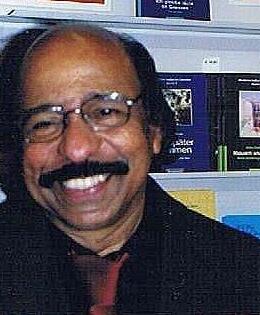
The nationally and internationally renowned and much-honoured Indian poet, critic, essayist, translator and editor Kayamparambath Satchidanandan (K. Satchidanandan) is a leading representative of contemporary modern poetry in Malayalam, the official language of the South Indian state of Kerala. He was born on 28 May 1946 in the village of Pulloot, Kodungallore (Thrissur), Kerala. Today he lives with his wife and two daughters in New Delhi, dividing his life between the capital and Kerala.
Education and Academic Career
Satchidanandan earned a master's degree in English at the University of Kerala and a doctorate with a dissertation on post-structuralist theory at the University of Calicut, Kerala. He taught English for 25 years at Christ College, part of that university. In 1996 he was unanimously elected Secretary of the Sahitya Akademi (India's national academy of letters) in New Delhi, which he led to a decade (1996-2006) of successful literary flourishing. He also served as editor of the literary journal Indian Literature and gained wide recognition across the nation's multilingual literary scenes. In 2006 he returned to academic life and became Director and Professor of the School of Translation Studies and Training at Indira Gandhi National Open University, New Delhi, until his retirement in 2011. K. Satchidanandan was appointed President of the Kerala Sahitya Akademi and took office on 9 March 2022.
Poetic Concepts and Works
What Satchidanandan says about the origin of his own poetry is worth noting: "I cannot say where poetry came to me from: I had no poet ancestors. Whenever I try to think about it, I hear the various strands of the unbroken rain in my village in Kerala, and I also recall the luminous lines of the Malayalam Ramayana that I read as a schoolboy. My mother taught me to talk to cats, cows and trees. From my father I learned to communicate with gods and spirits. My mentally ill grandmother taught me to create a parallel world in order to escape the common normality of the exhausting everyday world; the dead taught me to be one with the earth. The wind taught me to move and shake without ever being seen; and the rain trained my voice in a thousand modulations. With such teachers, it was impossible for me not to become a poet." (Source: K. Satchidanandan, Ich glaube nicht an Grenzen, selected and translated from Malayalam into German by Annakutty Valiamangalam K.-Findeis, Draupadi Verlag, Heidelberg, 2006, p. 9)
He gradually developed a "polyphonic and open concept" of poetry. Satchidanandan is a bilingual poet, writing poems in Malayalam and prose in English — drama and plays, essays and travel writing. Translating Indian and international poetry, rendered in a linguistic adaptation entirely his own, is likewise part of his literary repertoire — an important contribution to the broad horizon of intercultural openness and the integrative potential of Malayalam literature.
Satchidanandan draws his inspiration from three sources: the specific oral and written traditions of Malayalam poetry, the broader Indian classical and modern traditions of poetry, and the avant-garde trends of modern European or Western poetry.
In the 1960s Malayalam poetry underwent a radical transformation in theme, mood and form. This radical change had its effect on Satchidanandan's poetic output, and conversely his poetic creativity enriched Malayalam poetry with new directions, impulses and dimensions. In his early attempts he was inspired by the Malayalam Ramayana and biblical texts such as the Book of Psalms and the apocalyptic imagery and language of the Book of Revelation. His wide-ranging and intense reading of foreign literary works opened him to the influence of Pablo Neruda, Bertolt Brecht, Ho Chi Minh, Mao Zedong, Japanese haiku writers, African radicals, and others. Through his encounter with poetic concepts and modes of expression within shifting cultural and social contexts, Satchidanandan became a committed, cosmopolitan, humane-Marxist writer. His poems address values such as justice, equality, freedom, democracy, the questioning of borders, migrants, women's emancipation, language, love, suffering, death, respect for all forms of life, nature and environmental problems, criticism of fascism, Stalinism, religious fundamentalism, and caste distinctions, as well as criticism of the shocking pogroms against Muslims in Gujarat (2002), among other themes. In the field of tension between individual and society, globalism and particularism, the fears and decadence of present-day India are reflected; poems such as "Karnan" and "Hymn to the Goddess" are filled with grief and prophetic anger. Alongside mythical figures and metaphors from the Puranas, the Mahabharata and so on, stand Buddhist and biblical motifs — for instance the poem "Good Friday". In the 1970s the socio-political-revolutionary element intensifies; awareness of the threat to the environment also grows steadily. The lyrical texture becomes more complex; paradox and dissonance set the tone; contemporary India appears under the spell of disastrous political guiding ideas.
Range of Work and Growing Recognition
Satchidanandan's groundbreaking major contribution as a poet to the "New Poetry" in Malayalam is documented in numerous volumes of poetry (38) since 1970. He has also produced (22 or more volumes of) poetry-translation collections, (22) collections of critical essays, two plays, and five books on Indian literature in English.
He receives attention in India and internationally also through his numerous essays, topical statements, interviews in renowned literary magazines and respected newspapers, presentations, lectures and dialogues on radio, television and YouTube, through his travels around the world, his participation in international literary festivals, honours, readings, and increasing contacts in the literary world. A few examples of his international standing: he was a guest, for instance, of the Frankfurt Book Fair (2006), which that year featured India as its guest-of-honour theme. On that occasion the poetry collection "Ich glaube nicht an Grenzen" (Draupadi Verlag) was presented and displayed at a well-attended reading. Satchidanandan was subsequently invited to Bonn by the Haus der Sprache und Literatur for a very well-attended and much-discussed reading and conversation. The Malayalam poet has repeatedly been a valued Indian guest for readings abroad — for instance in 1986 in Russia (then the Soviet Union), at the "Printemps des Poètes" in Paris (2003), the Berlin International Poetry Festival (2005), and later the Poetry International Festival Rotterdam (2012) — each welcoming him as a guest for readings and conversation about his understanding of poetry, as did Italy (Rome, 2002 and 2005), among others.
Satchidanandan's standing is underscored by 35 awards for his literary contribution within India. He has been honoured with almost all the major literary prizes of both the Indian nation and the state of Kerala. Among his many honours from abroad, a few may be mentioned here: the Friendship Medal, Government of Poland (2005), and Knighthood of the Order of Merit, Government of Italy (2006).
As one of the founders of "post-modern" Malayalam poetry, with a poetic career spanning more than half a century, Satchidanandan remains unsurpassed. His words and presence remain a public force: his poems proclaim a world without borders, without discrimination or oppression, and advocate freedom, democracy, equality, solidarity, the protection of nature, and peace. His poems are philosophically reflective, in dialogue with himself and with the reader, but also sceptical, critical, ironic and humorous. Written in simple, easily accessible language, his poetry opens itself to anyone who turns to it and lets it speak to them. He is a poet of great political and ethical sensitivity. Although he began as a Marxist writer, he grew gradually more critical of authoritarian Marxism, yet remains faithful to Marxism and socialism in his open-mindedness and critical engagement with them. His intensive engagement with Bhakti and Sufi poets such as Kabir, Namdev, Lal Ded, Akkamahadevi and Andal, whom he translated into Malayalam, and his deep engagement with Indian thinkers such as Lohia, Vivekananda, Ambedkar and Gandhi — who called himself an "artist of non-violence" and worked through the power of his words — have led him to develop a close affinity with the Indian understanding of the interconnectedness of the secular and the sacred, in contrast to the Western concept of "secularism". Satchidanandan combines Marxism and spirituality. He regards poets as "artists of the word" and honours great poetic testimonies such as the Gita as "philosophy in verse". He also places strong emphasis on his sharp criticism of every kind of religious and ideological fundamentalism, such as Hindutva, Islamophobia, racism and so on.
Satchidanandan's poems have been included in school textbooks and university syllabi. Several dissertations have already been written on his poetry. His social and literary role in women's emancipation is reflected in his reputation as a "pioneer in Women's Studies" in Malayalam and in the Malayalam term he coined, "Pennezhuthu", for women's literature.
Satchidanandan is a master of translation, which for the poet means "a transmigration of ideas and cultures!" Through his translations of poetry from many Indian and foreign languages into Malayalam, he has enriched the Malayalam language and literature, opening the differentiated Malayalam linguistic culture to the multilingual space of other cultures and their literatures and poetries. At the same time he furthers the development of Malayalam and its modern expressive capacity through constant encounter with the linguistic artistry of other traditions, perceptions, namings and forms across literary genres. In recent years Satchidanandan has himself translated 60% of his own Malayalam poems into English. His works have likewise been translated by others into Arabic, Assamese, Bengali, English, Hindi, Gujarati, Marathi, Punjabi, Kannada, Telugu, Tamil, Urdu, French, German, Italian, Chinese, Swedish and other languages.
Prof. Dr Wolfgang Kubin, himself a German poet and sinologist at the University of Bonn, portrayed the Indian poet from Kerala and his poetry so aptly in his review of the collection "Ich glaube nicht an Grenzen" in the journal Orientierungen (2/2007): "K. Satchidanandan is definitely not a poet who holds himself apart from the world ... He is a poet on a journey. For him, poetry is a cry against all walls. It is his cosmopolitan worldview that makes him and his poetry compelling far beyond the borders of India."
Annakutty Valiamangalam K.-Findeis
Selected Publications
Original works in Malayalam – collected volume:
- Satchidanandante Kavithakal, 1965-2015 (Collected Poems in a Single Volume), 2016
English translations (by the poet himself):
- Summer Rain, RD Yugutsu-Nirala Publishers, Delhi
- How to Get to the Tao Temple, Har Anand (ed.), Delhi
- So Many Births, Konarak Publishers, Delhi, 2001
- Stammer and Other Poems, Konarak Publishers, Delhi
- Imperfect and Other Poems, Olive Publishers, Calicut, Kerala, 2000
Hindi translations (selection):
- Apurna aur anya Kavitayem, Delhi 2000
- Chunnee Huyee Kavitayen, 2008
German translation:
- Ich glaube nicht an Grenzen, edited and translated from Malayalam into German by Annakutty Valiamangalam K.-Findeis, Draupadi Verlag, Heidelberg, 2006 (in German)
French translation:
- Tant de Vies, Editions Characteres, Paris, 2002
Italian translation:
- Iriti della Terra, Castelvecci, Rome, February 2005
Excerpts from "Dukham Enna Veedu", DC Books, Kottayam, 2020
Democracy
Translated into English from the German rendering by Annakutty Valiamangalam K.-Findeis.
There are two kinds of people: We and You. To define us, there are several ways: one caste, one religion, one god, one colour, one flag, one enemy. To define You is easy: those who are not us. Your history is different, your geography different too. We are from here, You have come. We are the victors, You are the losers. When we kill, we are patriots. When You kill, traitors. We rule, you fall. There will be no more slaves, only owners will remain. Ours, by us, for us: that is democracy.
(Translated by Annakutty Valiamangalam K.-Findeis from the Malayalam, 29 September 2021)
Letter from a Soldier
Dear Mother,
please send me the following things straight back by return post:
- When cannonballs crash into the desert to sweeten my ear, please send me the song of the blackbird that it always strikes up when it visits our yard.
- When I hide under the bushes, send me a parrot and a rainbow high in the sky above my head.
- When I freeze in the cold, please send me the guru's words to warm me.
- Send me a match to light a fire. In it I want to burn the army captain's vulgar curses.
- To still my hunger through long days, I need a spinach leaf from your kitchen.
- To quench my tormenting thirst, send me a dark cloud creeping over Panipat.
- Send me the barking of our house dog Jagthar, so I can tell north from south.
- The memory of Samira drives me to run home; send me a chain to shackle my legs.
- If a shot from the helpless brother on the other side brings me to the ground, I ask for a kiss from my as-yet-unborn daughter.
- When the breath of life leaves us forever, I need a blanket woven from the tears of our little sister Jugnu, to cover me and my younger brother.
PS. Don't forget, please tell my friends: when my coffin is brought home, no flag should cover it, and please no honour salutes either. Don't let the children of our house appear in uniform!
Your Surjit
Translated by Annakutty Valiamangalam K.-Findeis from the Malayalam into German on 28 September 2021; rendered here into English.
Excerpts from the Poetry Collection "Ich glaube nicht an Grenzen"
Head (p. 46)
The whole body under the earth, the head alone outside; pondering how the earth might be saved.
I Do Not Believe in Borders
With those who believe in borders, springs and stars do not speak. I do not believe in borders. How can grains of sand know which country they lie in? The roots of apple trees break through the walls built by men and clasp their hands together. Wind, water and roots act against walls, birds cut through borders with their sharp wingtips. The borders on the map cannot even stop the withered leaves. Let us become rivers.
(From the back-cover blurb of the poetry collection)
Hitler, Stalin
Hitler said to Stalin: Let's divide the globe, left half for you, right half for me. Dungeons, asylums, gas chambers, weapons, bombs, army: all half and half. Fields, workplaces, meadows, palaces, parks, cooks, servants, all by half. The trees to be felled, by half, the peasants to be won over, by half, the Jewish synagogues for me to destroy, the Christian churches for you to collect. Stalin whispered, eyes twitching, into Hitler's ear: Our uniforms and intentions are just as one. Our moustaches and our books may differ a little. For socialism, whether mine or yours, there are only two enemies: first, the people. Second, God. Both we shall finish off. Stalin and Hitler, hand in hand, left, right, changing step, began the victory march around the globe.
© for the translations: Annakutty Valiamangalam K.-Findeis
Further Links
- Library of Congress, New Delhi office – with readings of selected texts from Terannet utta kavitakal, Trissur, Karant Buks, 1999 (with further Malayalam authors: overview)
- poemhunter.com – on his life and work (selected poems in English)
- Very helpful insights into the conditions and the motivating, formative influences that shaped his poetic abilities
- K. Satchidanandan (Wikipedia, English)
- K. Satchidanandan (Poetry International)
- Gained in Translation (The Indian Express, 20 October 2019)
- Lecture by Prof. K. Satchidanandan – University of Hyderabad
- Mog Sundays – K. Satchidanandan – Poetry: Reading and Dialogue
📄 Download this author profile as a PDF (in German)