Saadat Hasan Manto
Biography
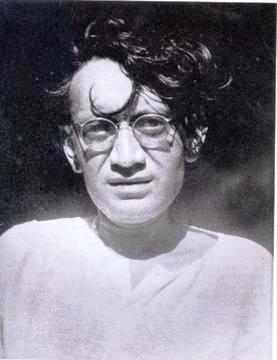
Despite his short lifespan of 1912-1955, Saadat Hasan Manto was one of the most prolific writers of his time and is regarded by many as the unsurpassed master of the Urdu short story. He gained his first literary experience translating French and Russian short stories into Urdu via English. His first collection of stories appeared in 1936, but he only achieved wider fame with his second collection, Manṭo ke afsāne (Manto's Stories, 1940), which contained masterpieces such as "Nayā qānūn" (The New Constitution, Manto 2006: 7-19) and "Hatak" (The Insult, ibid.: 20-44). Further volumes of short stories and radio plays for All India Radio followed. His stories often centred on society's outsiders, such as prostitutes, whom he portrayed with great sensitivity, capturing their humanity and their will to live.
At the time of the Partition of India in 1947, Manto was living in Bombay, where he worked for the film industry. His years in Bombay had been the happiest and financially most secure period of his life, but in 1948, flaring hostilities in Bombay too, along with the accusation that he was favouring Muslims, forced him to follow his family to Pakistan, where he lived first in Karachi and then, until his death, in Lahore. Partition became a deeply personal catastrophe for Manto as well. In Pakistan he initially fell completely silent. Manto illustrates the absurdity of partition along religious lines in an almost paradigmatic way in what is probably his most famous short story, "Toba Tek Singh". (The title refers to a village and district in what is now the Pakistani Punjab, named after the legendary, charitable Sikh Tek Singh.)
In the years that followed, Manto processed the experience of Partition and the human tragedies bound up with it in numerous short stories and in the darkly humorous sketches that gave the German translation volume Schwarze Notizen (Black Notes) its title. Many writers of the time turned to the subject of Partition, but Manto's treatment of the theme stands out for certain distinctive qualities that explain the lasting validity of his works: he dispenses entirely with ideological premises and, with very few exceptions, with sentimentality. His attempt at a detached view of events must not be mistaken for a lack of empathy. By plumbing the depths of the human psyche, in the process of which the boundaries between victims and perpetrators partly dissolve, he avoids painting things in black and white. For all their despair, his works repeatedly convey a belief in humanity, a commitment to life and to human dignity. In the end, it is inhuman circumstances that turn some of his characters into beasts.
The "Letters to Uncle Sam"
Manto's critical engagement with contemporary events in his short stories is well known through numerous translations that have reached readers far beyond India and Pakistan. Less attention has so far been paid to the quasi-journalistic texts he wrote after moving to Lahore, among which the nine "Letters to Uncle Sam" stand out in particular as ironic-satirical masterpieces. The "Letters" were written between 1951 and 1954 and published in 1954 in the collection Ūpar, nīce aur darmiyān (Above, Below and In Between). Two letters are included in the 2012 translation volume Manto and are also available online: an English translation of the first letter and of the second letter.
On the surface, Manto's "Letters" might seem to betray an anti-American stance. On closer inspection, however, it becomes clear that it is specific political attitudes and measures of the US administration that he satirically exposes in exaggerated form. He sees in their conduct a glaring gap between the professed ideals of liberty and democracy and the realities of power politics. He is no less critical of his own elite, dependent on American aid since the 1950s, and of representatives of the literary establishment. And not least, he questions Pakistan's founding Islamic ideology, here too ruthlessly exposing the gap between ideal and reality. At the same time, the texts hint at the seed of an attitude that has since become an ideological weapon — one in which a stereotypical, angry anti-Americanism combines with a dependence on dollar gifts and a secret longing for the "blessings" of Western life.
It is striking how little Manto's texts have lost in relevance. Even today, violence is regarded as an acceptable means of resolving conflicts, and the consequences are no less brutal than they were in his lifetime. Even today, an elite in Pakistan prevents the country's prosperity from benefiting everyone. Even today, freedom of expression and of conscience are endangered goods, particularly in Pakistan but not only there. Even today, carefully cultivated images of the enemy prevent humanity's real problems from being solved. So reading these texts remains, to this day, at times amusing but at times also disturbing.
Christina Oesterheld
Bibliography (selection)
- Manto, Saʿādat Ḥasan: Kulliyāt-i Manto (complete works in 2 vols.). Lahore: ʿIlm va ʿIrfān Publ., 2005 (in Urdu)
- Manto, Saadat Hasan: The armchair revolutionary and other sketches; translated by Khalid Hasan; edited, with an introduction by Ali Mir and Saadia Toor; prologue by Nandita Das. New Delhi: Left Word Books, 2016
Published in German (selection)
- "Sharifan", in Allahs indischer Garten. Ein Lesebuch der Urdu-Literatur, ed. and transl. by Ursula Rothen-Dubs. Frauenfeld: Verlag im Waldgut, 1989: 368-372 (in German)
- Blinder Wahn. Berlin: Lotos Verlag Roland Beer, 1997 (in German)
- "Der Geruch" (transl. by Christina Seemann), in Orientalische Erzähler der Gegenwart, ed. by Konrad Meisig. Wiesbaden: Harrassowitz, 1999: 101-108 (in German)
- Schwarze Notizen, selected by Christina Oesterheld, with an afterword by Tariq Ali. Frankfurt am Main: Suhrkamp, 2006 (in German)
Reviews
- Josuweit, Sascha (2006): Saadat Hassan Manto: Schwarze Notizen (in German)
- Klas, Gerhard (2008): Saadat Hassan Manto: "Schwarze Notizen" (in German)
Further Reading (selection)
- Manto, Saadat Hasan: Another lonely voice: the Urdu short stories of Saadat Hasan Manto; introd. by Leslie A. Flemming. Berkeley: Center for South and Southeast Asia Studies, 1979
- Manto, Saadat Hasan: Manto, edited by Ayesha Jalal and Nusrat Jalal. Lahore: Sang-e-Meel Publ., 2012
- Oesterheld, Christina: "Ein enfant terrible der Urdu-Literatur: Saadat Hasan Manto zum Gedenken". Südasien-Chronik – South Asia Chronicle 2/2013, pp. 8-40. edoc.hu-berlin.de (in German)
- Ayesha Jalal in conversation with Christopher Lydon: "What would Manto say?"
- Manto, Saadat Hasan: Manto on and about Manto: 18 English translations of selected works of Manto and his friends / translated by Mujahid Eshai. Lahore: Sang-e-Meel Publications, 2014
- Oesterheld, Christina: "Manto als kritischer Zeitgenosse", in Swati Acharya (ed.), Sa'adat Hasan Manto: Chronist des ungeteilten Irrsinns der Teilung Indiens. Heidelberg: Draupadi Verlag, 2015: 73-102 (in German)
Audio Excerpt (in Urdu)
📄 Download this author profile as a PDF (in German)