Qurratulain Hyder (1927–2007)
About the Author
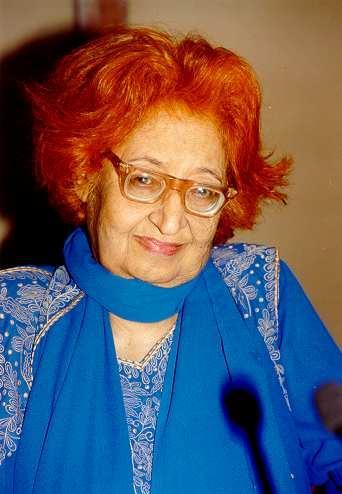
When the Urdu writer Qurratulain Hyder died on 21 August 2007 in Delhi, numerous obituaries in Urdu- and English-language media across the South Asian subcontinent and its diaspora paid tribute to her outstanding achievements for Indian literature. In these eulogies, however, a phenomenon repeated itself against which she had already fought during her lifetime: the one-sided fixation on her monumental novel Ag ka darya (River of Fire, 1959), which to the end overshadowed her extensive later work.
Qurratulain Hyder was born in 1927 in Aligarh (U.P., India) into a family in which writing seemed to be hereditary. Her father, her mother and one of her aunts were noted prose writers. In her parental home Qurratulain Hyder found a stimulating intellectual milieu. She was encouraged to engage with music and painting, and got to know many famous literary figures of the time. She wrote her first short stories already during her college years in Lucknow in the 1940s, but became suddenly famous with her first novel, Mere bhi sanamkhane (My Temples, Too, 1948). This novel was written in Pakistan, where the author had followed her brother in 1947. It treats the highly topical subject of the Partition of India not only as a human but also as a cultural tragedy. The founding of the new state of Pakistan forced Indian Muslims to decide between India and Pakistan. Since then, Muslims who remained in India have repeatedly been suspected of insufficient loyalty. At the same time, the partition of the country called into question the future of the Indo-Muslim cultural synthesis that had enriched the intellectual life of North India for centuries. This introduced two of the main themes that would occupy Qurratulain Hyder into her late work.
The novel Ag ka darya, however, became a true bestseller. It was translated into several Indian languages and is also available in an English version prepared by the author herself, published under the title River of Fire in 1999 in Delhi by Kali for Women. Over the vast span of 2,400 years, the novel leads us through pivotal stages of Indian history, beginning in the period when Buddhism arose, continuing with the arrival of Muslims in North India, the advance of the British, and finally into the period of the 1930s to 1950s. The novel culminates in a rejection of a separate Muslim identity and a somewhat romantically idealised commitment to the secular Indian state.
To achieve greater authenticity, the author made use of numerous montages and quotations. Despite some weaknesses in characterisation and imbalances in plot construction, she succeeded in creating a work unique in its thematic breadth and artistic execution, rightly described as a milestone in Urdu literature. Although the book is considered intellectually demanding and difficult, it became a bestseller — which is likely why this one work has come to overshadow her entire body of work.
Qurratulain Hyder's creativity, however, by no means dried up after this great achievement. After a brief interlude in London, she returned to India for good in 1962, settling first in Bombay and later in Delhi. She was editor-in-chief of several magazines, worked as a radio journalist, screenwriter and literary translator, and taught as a visiting professor at several Indian universities. At the same time she wrote further short stories, novels and a family saga, and edited collections of letters and interviews.
In 1979 her unjustly less-noticed novel Akhir-i shab ke hamsafar (Fellow Travellers at the End of the Night, 1979; published in English in 1994 under the title Fireflies in the Mist) appeared — one of her best works. Here she deals with the immediate prehistory of independence and thus of Partition, devoting herself to an aspect otherwise unaddressed in Urdu literature: political terror in Bengal. An important, perhaps the most important, theme here is the personal responsibility of the individual.
Besides the themes already mentioned, she repeatedly dealt with the fates of women, with the social changes in independent India, and with questions of spirituality and the search for meaning as a counterweight to the pursuit of wealth and power. On the other hand, she wrote delightful satires on the commercialisation of ostensibly spiritual offerings. In general she remained constantly in search of new material and means of expression, and experimented with the most varied literary techniques. Curiously, it is hardly mentioned when her work is appraised that she worked, for instance, with the tools of science fiction and fantasy in order to address, in a thoroughly amusing way, questions of unequal gender relations. All this — an overflowing joy in storytelling, a photographic memory, sharp intellect, encyclopaedic knowledge and an alert engagement with all events in her surroundings and in the world — made her a truly outstanding writer of her time.
Qurratulain Hyder's entire body of work can be understood as the cultural memory of generations of Indian Muslims. In her writing, the author drew not only on her own life experience but also conducted meticulous research on certain themes in archives, family documents, historical treatises and the like. An example of this is the novel Gardisch-i rang-i chaman (roughly: The Colours of the Garden Are Always Changing) from 1987. This 704-page work contains a wealth of plotlines and a variety of stylistic devices — from historical interpolations, intellectual debates, satire and comedy to slapstick and a good dose of melodrama. Here, besides the social consequences of the 1857 uprising, the author addresses above all questions of the identity of the so-called Anglo-Indians, offers satirically exaggerated criticism of uncultured nouveaux riches and upstarts and of the boom in modern saint-worship among the educated middle class, illuminates the fates of several famous courtesans of the 19th and early 20th centuries, and the beginnings of the modern entertainment industry (theatre, gramophone, film) in India. The glamour and misery of courtesans in India are depicted very impressively and skilfully linked to the fictional fate of a highly educated young woman of the present, whose descent from a courtesan family becomes an insurmountable obstacle to her personal happiness. The fates of women are also at the centre of her last novel, Chandni Begam (1990).
Christina Oesterheld
Bibliography (Selection)
- Mere bhi sanamkhane/My Temples, Too (novel), 1948; English: My Temples, Too, 2004
- Ag ka darya (River of Fire, novel), 1959; English: River of Fire, 1999
- Patjhar ki avaz (The Sound of Falling Leaves, short stories), 1965
- Sitaharan (The Abduction of Sita, stories), 1968
- Kar-i jahan daraz hai (The World's Business Goes On, family saga/autobiography), vol. 1 1977, vol. 2 1979, vol. 3 Shahrah-i harir (The Silk Road) 2008
- Akhir-i shab ke hamsafar (Fellow Travellers at the End of the Night, novel), 1979; English: Fireflies in the Mist, 1994
- Gardish-i rang-i chaman (The Changing Fortunes of the Rose Garden, novel), 1987
- Chandni Begam (novel), 1990
Published in German (Selection)
- Der Fotograf (short story, abridged, translated by Mujahid Husain Zaidi and Rudolf Wunderlich), in: "...ganz unten, wie Shesha, bin ich". Frankfurt/M. 1986, pp. 69–73
- Der Qalandar (short story, translated by Ursula Rothen-Dubs), in: "Allahs indischer Garten", Frauenfeld 1989, pp. 446–465
- Der Berg der Fakire (short story, translated by Christina Oesterheld), in: "Erkundungen. 23 Erzählungen aus Indien", Berlin 1990, pp. 165–177
- Die wechselvollen Schicksale der Andalib Bano (novel excerpt, translated by Christina Oesterheld), in: "Gesteht's! die Dichter des Orients sind größer. Urdu-Literatur", Berlin 1991, pp. 38–53
- Novel excerpts from Ag ka darya and Chandni Begam (transl. Christina Oesterheld) in "Flucht und Identität im Spiegel indischer und deutscher Gegenwartsliteratur", Berlin 1991, pp. 71–79
Further Reading
- "Qurratulain Hyder. Tod einer literarischen Ikone." In: Südasien 27:4 (2007–2008), pp. 10–13 (in German)
- My Temples, Too – by Qurratulain Hyder
- Turner, Elen (2014): Concern for the Destiny of the Country: Indian Feminist Novels
- Christina Oesterheld: Gemeinsamkeit und Trennung in Romanen der Urdu-Schriftstellerin Qurratulain Hyder, Südasien-Chronik – South Asia Chronicle 7/2017, pp. 61–92 (PDF, in German)
Reading Excerpt
The author portrait PDF below contains a lengthy excerpt (in German) from Gardisch-i rang-i Tschaman: a conversation in 1980s Lucknow in which Andalib — herself the concealed daughter of a courtesan — tells her daughter's friend Mansur about the legendary singer and courtesan Gauhar Jan, weaving in stories of princes, scandal, defiance of British colonial authority, and the precariousness of women's independence, whether "bought" or "selling themselves". The excerpt, translated by Christina Oesterheld, closes with Andalib's dry verdict: "Rechtmäßig oder unrechtmäßig sind auch nur relative Begriffe" ("Lawful or unlawful are themselves only relative terms.")
📄 Download this author portrait as PDF (in German, includes the complete excerpt from "Gardisch-i rang-i Tschaman")