Perumal Murugan
Biography
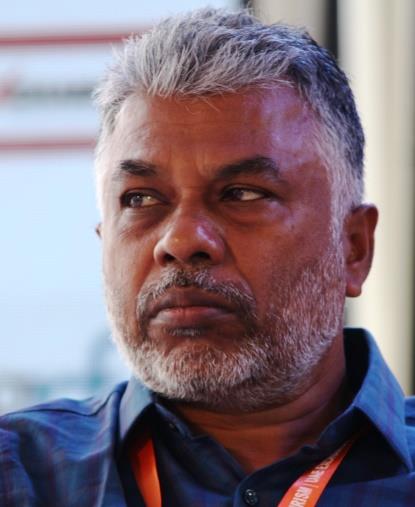
Perumal Murugan was born on 15 October 1966 in Kootapalli near Thiruchengodu in western Tamil Nadu. His father, a smallholder, had to supplement the family income by running a drinks stall in a cinema in order to keep the family afloat. As the first in his family to want to go to university, Murugan completed his bachelor's degree in Tamil literature in Erode and his master's degree in Coimbatore. He then earned his doctorate in Chennai.
Perumal Murugan came to be known as "the chronicler of the Kongu region". His impressive body of literary work grew out of the soil of this region and is populated by its villagers.
Kongu Nadu is a dry, low-rainfall upland region. Its literary landscape, too, had until then been largely barren, with the exception of the classic novel Nagammal by R. Shanmugasundaram (1942). It is thanks to Murugan that this hitherto little-noticed region has found its place on the literary map of South India.
The Literary Work
Although Murugan has also written non-fiction books on folk traditions and the history of his region, it is fiction that appeals to him most as a writer. Novels, short stories and poems give him a broader platform for exploring complex human relationships against the backdrop of society and geography, of customs and caste issues. In the rural microcosm he presents, there is barely any privacy, and everyone who believes they hold authority entrenches themselves behind inherited customs and traditions, rendering the boundaries between groups separated by caste and status impermeable. Love, a central theme in his works, matters more to him than the institution of marriage. In his view, marriage is a complicated affair, entangled in a web of questions of wealth, caste and inheritance.
Between 1988 and 1991 he published numerous short stories in the magazine Manvosai. These stories were later published in a collection titled Thiruchengodu (1994). His body of work comprises ten novels, five collections each of short stories and poems, and ten non-fiction books on language and literature.
Novels
His first novel, Eru Veyyil, 1991 ("Rising Heat"), deals with family, greed and corruption. The 1993 novel Nizhal Mutram ("The Shady Courtyard", 2004) is set in a cinema and contains echoes of his own youth. Aalandapatchi (2012) ("The Bird that Shuns People") distils the essence of the Kongu region on many levels. Kanganam, 2007 ("The Vow"), addresses the sensitive subject of female foeticide, Pookkuzhi, 2013 ("Glowing Embers"), is a heart-wrenching story about the destructive effects of caste barriers on young love, and Poonachi alladhu Oru Vellaatin Kathai, 2016 ("Poonachi, or the Story of a Black Goat") are other critically acclaimed novels. Murugan explains his choice of subject by saying that he felt safer writing about a goat than about people, gods, or even taboo animals such as cows or pigs — an understandable choice, since the novel was his first prose work after a forced two-year silence.
Murugan's best-known novel, Mathorubagan (2010, published in German as "Zur Hälfte eine Frau", 2018), set in the final phase of British colonial rule, describes the life of a childless couple, Kali and Ponna. Not only must they come to terms with their suffering and disappointment, but they must also endure the villagers' malicious mockery and ridicule. After all their attempts — from various home remedies to countless temple visits and rituals — have failed, Kali's mother and Ponna's brother propose a shocking solution: an ancient practice that permits childless women, during a temple festival, to have consensual sex with strangers — the festival of Ardhanarishwara, the god who, together with his consort, forms a single figure that is half man and half woman. According to belief, children conceived in this way are a gift from God. From this point the plot builds to a crescendo.
Author on Trial
Paradoxically, the writer and chronicler who had put his home region on the literary map was accused of defaming that very region. Four years after the publication of his novel Mathorubagan, the work came under fire in late 2014 from politically motivated groups who saw the description of the ancient temple-festival custom as a defamation of the Hindu religion. The book was publicly burned, the author threatened and driven into hiding. This campaign ended with Perumal Murugan temporarily giving up writing altogether. Legal proceedings against his forced exile followed over the next two years, until the High Court in Chennai ruled in favour of Murugan and freedom of expression, and against a ban on the book.
Murugan countered attacks on the novel by pointing out that the story criticises not faith, but superstition. In 2018 two sequel novels were published (in English under the titles A Lonely Harvest and Trial by Silence), each describing a different scenario for how the main characters' lives might have unfolded.
Short Stories
Murugan has written more than 80 short stories. The first anthology of ten stories in English translation is titled The Goat Thief, 2017. Murugan says he chose these stories because they represent exceptions to society's rules. Exceptions, he believes, have a way of calling old rules into question, demanding and allowing new perspectives. Some of the characters in these stories are hesitant, uncertain, and subject to their fears and prejudices. Murugan accompanies their extraordinary actions within their ordinary everyday lives with empathy, without passing judgment.
Poetry
By his own account, of all literary genres poetry is closest to Murugan's heart. He regards poetry as a cure-all for any crisis in life. "No matter how burdensome the situation, I can get through it with the help of the one single word that takes shape within me," he says. After the two-year writing silence that followed the vilification of his novel One Part Woman, it was the poetry collection Kozaiyin Paadalgal ("Songs of a Coward") with which he announced his return. He explains the term "coward" by noting that there is a moment in every person's life when they feel this way, or when circumstances brand them so. The more than 200 poems in this volume are the outpourings of a troubled soul, a rich mosaic of images and emotions. The poem Divine Tongue ends with the words:
"But my divine tongue
knows no curses.
Go away, live!"
He explained the reason for his comeback in an interview by quoting the court ruling. He said he had taken to heart its final line, which read: "The writer must rediscover what he does best — writing," which struck him as both a command and a blessing.
Committed Artistic Collaboration
Poetry and classical music come together in the joint initiatives of singer and activist T.M. Krishna with Perumal Murugan, for instance on the subject of the farmers' protests against the planned — and since withdrawn — agricultural reforms.
Academic Work
His work as a professor of Tamil at Government Arts College in Namakkal gave rise to in-depth research into Tamil literature, with a particular focus on the Kongu region he comes from. This includes a lexicography, the documentation of Kongu folk traditions, and an anthology of texts by forgotten writers, notably the history of the Kongu region by T.A. Muthusamy Konar. Beyond his fictional treatment of the caste system and social hierarchy, Murugan has also published a non-fiction book on the subject: Saathiyum Naanum, 2013 ("Caste and I"), a collection of around 30 personal essays on caste, edited by Murugan and translated by Ambai under the title Black Coffee in a Coconut Shell – Caste as a Lived Experience, 2017.
Awards (selection)
In 2016 the English translation of the novel Mathorubagan (One Part Woman) was awarded the Sahitya Akademi Translation Prize, the Indian government's highest honour. In 2005 Seasons of the Palm was shortlisted for the Kiriyama Prize. Poonachi (The Story of a Black Goat), as well as Trial by Silence and Lonely Harvest (both sequels to One Part Woman), were shortlisted for the JCB Prize for Literature in 2018 and 2019 respectively. The National Book Foundation (USA) placed Murugan on the longlist for the National Book Award for Translated Literature twice: in 2018 with One Part Woman and in 2020 with The Story of a Black Goat.
In 2018 Perumal Murugan was elected one of the Vice Presidents of PEN International.
Translations
Besides 12 titles in English, Murugan's works have been translated into numerous Indian languages. The controversial novel Mathorubagan was translated into German by Torsten Tschacher (Zur Hälfte eine Frau, Draupadi Verlag, 2018).
Perumal Murugan's works in English translation (Penguin, 2020)
Hem Mahesh
Published in German
- Zur Hälfte eine Frau, translated by Torsten Tschacher, Draupadi Verlag, 2018 (in German)
Excerpts
- Zur Hälfte eine Frau: book details and excerpt (in German)
- Translator's afterword (in German)
- In English: Pyre
Reviews
- Zur Hälfte eine Frau: review in SÜDASIEN 1/2019 (in German)
- Publisher's description of the book with 2 New York Times reviews (in German)
- Goat Thief (scroll.in, 2017)
Articles
- In defence of the chronicler of Kongu (The Hindu, 2015)
📄 Download this author profile as a PDF (in German)