Mridula Garg
About the Author
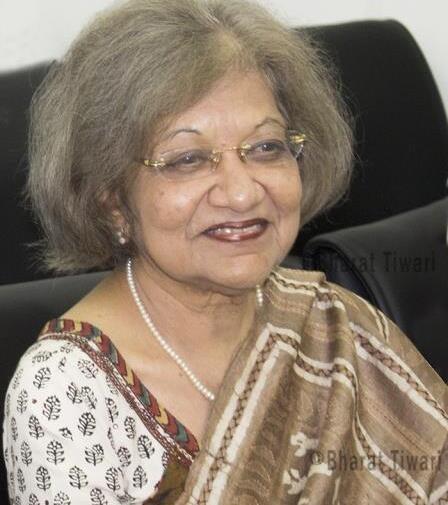
Mridula Garg (Mṛdulā Garg) was born on 25 October 1938 in Calcutta and lives in Delhi. She is one of the most important and most widely read contemporary authors of India and writes in almost all prose genres. Before her literary career she studied economics, graduated in 1960 and subsequently taught for three years at the University of Delhi.
Work
To date Mridula Garg has published around 30 books in Hindi, including eight novels, twelve volumes of short stories, four plays and six volumes of essays. Some of her earlier works are available in her own English translation, including the short-story collection Daffodils on Fire (orig. Daffodil jal rahe hain, 1978), published in 1990, and the novel Cittakobra, first published in Hindi in 1979 (English translation Chittacobra, 1990), which also appeared in German in 1987 under the title Die gefleckte Kobra.
With her early works such as Uske Hisse ki Dhup (novel 1975; English A Touch of Sun, 1978), Daffodil jal rahe hain or Cittakobra, she broke new literary ground, experimenting with literary form on the one hand and taking up socially taboo subjects on the other. According to Mridula Garg, the emphasis on thought processes and multilinear dialogues, developing plot and characters gradually rather than constructing them from the outset, is characteristic of her narrative style.
The themes of her novels are wide-ranging, yet always socially critical. Freedom for the individual as for society is ultimately the leitmotif of her works, usually depicted through the dilemma provoked by individual convictions that deviate from social norms, and the courage it takes to assert and live them against all resistance. Garg's protagonists are often women, which has earned her the reputation of a feminist — a label, however, she does not wish to apply to herself. Her literary works and essays have led to many controversies over the more than four decades of her career. Her novel Cittakobra alone caused a scandal over its allegedly obscene content: books were confiscated, Garg fell victim to a witch hunt, and police came to arrest her. She was able to prevent an arrest, but the subsequent legal dispute dragged on for years. "The most ridiculous and at the same time uncomfortably familiar aspect of the story," Garg said, "was that hardly any of those who accused the author and the work of obscenity had actually read the book. What they took offence at were a few passages describing a woman who regards her husband solely as a body with whom she has sex, while completely different thoughts race through her mind." Because of this persecution, she received the Hellman-Hammett Grant for Persecuted Writers from the human rights organisation Human Rights Watch in 2001.
Her most recent novel, first published in English, The Last Email (2017), returns to the theme of Cittakobra: it tells the story of two people who, more than forty years after having had an affair with each other, get back in touch by email. One is Kevin, a Scottish minister devoted to the political struggle for Scottish independence; the other is Maya, a respected author of Indian literature.
Mridula Garg has also appeared as a columnist. In her columns she addressed, among other things, environmental issues, women's rights, child labour and literature. For the renowned news magazine India Today she wrote a satirical column called Kataksh ("Mockery") for more than seven years.
For her literary work Garg received numerous awards, including the Sahitya Akademi Award of the Indian literary academy in 2013.
Jürgen Neuß
Published in German
- Die gefleckte Kobra (novel). Edition Collage, Hildesheim 1987 (2nd ed. 1989)
Short stories (all three in Chili, Chai, Chapati. Geschichten aus Indien, Kitab-Verlag, Klagenfurt-Vienna, 2011):
- Vom Gletscher ("From the Glacier", Gleśiyar se, Delhi 1980)
- Abscheu ("Revulsion", Vitṛṣṇa, from Urf saim, Delhi 1990)
- An die Stadt ("To the City", Śahar ke nām, Delhi 1990)
Further Links
Reading Excerpt: Abscheu (Revulsion)
It is just before half past one — half past one in the afternoon. The sun stands directly overhead. The heat has emptied the street. Nearby there is not even a tree that could offer a little shade, thin as a cloth.
Gripping the handlebars of his motorbike, Dinesh stands at the roadside. Under his helmet it is as hot as inside a furnace. He takes it off and lays it on the seat. Now the sun's rays beat down on his bare head like whiplashes. Sweat runs from his head over his forehead and face, gathering under his collar. His wet shirt clings to his back. His hands and feet are damp with sweat. The glare of the sun makes red-orange circles dance before his unprotected eyes.
Under such circumstances, everyone thinks of home. It is, after all, precisely for protection against heat and rain that people build houses — four walls and a roof.
On the other side of the street, directly opposite, is his flat. He would only need to push the motorbike a few steps. To open the front door he would only need to cross the courtyard and climb twenty-one steps. Then he would be home. All in all it would not even take two minutes.
He looks at his watch again. Yes, it is almost half past one — exactly the right time. Shalini will just be eating. If he waits any longer, she will have gone to her room to sleep. If the doorbell then rings, she would certainly come and open the door, but then — her face — Dinesh finds it ever more unbearable.
She would come, slowly and draggingly. He would recognise her by her footsteps — her gait is always the same. She would come, unbolt the door and go straight back again. Dinesh would then have to push the door open himself. As he entered, since she would be walking away, he would be able to catch a fleeting glimpse of her back, but not of her face. And then the door of her room would slam shut. He would remain in the outer room, which they use as living and dining room. On the dining table the food would stand, neatly prepared. A plate, not too large and not too small. On it two small bowls and a spoon, beside it a cup; on a tray two bowls of vegetables, two large serving spoons, and four flatbreads wrapped in cloth. Dinesh would first carefully wash his face and hands — a fresh towel would be hanging at the basin — then fetch a bottle of cold water and yoghurt from the fridge, and finally take his meal. If he wanted, he could also go into the kitchen and warm up the food. Right next to the gas stove there would be matches and a scrubbed-clean frying pan. There would be no reason at all for complaint.
(The German original continues at length, following Dinesh through his memories, his return home, and Shalini's perspective at the window, until — as he finally re-enters the flat — she disappears behind her door and he is left alone in the comfortable room. The complete story in German can be found in the author portrait PDF below.)
German translation by Jürgen Neuß, Berlin. From: Chili, Chai, Chapati. Geschichten aus Indien, Kitab-Verlag, Klagenfurt-Vienna, 2011.
📄 Download this author portrait as PDF (in German, includes the complete story "Abscheu")