Manjul Bhagat (1936–1998)
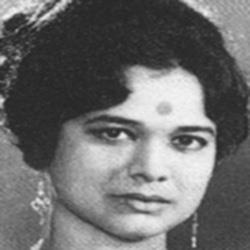
One day in April 1992 I met Manjul Bhagat in Delhi for the first time. Beforehand we had been in lively correspondence. This allowed me to get to know her life and her philosophical-literary approach more closely. She wanted to support me in every possible way. My intention was to write a research paper on her literary work. The idea came from Prof. Dr. Georg Buddruss, professor of Indology in Mainz. He had met Manjul Bhagat in 1989 at the Frankfurt Book Fair, when the focus was on the literature of India. There, and at the South Asia Institute of Heidelberg University, the author presented her novel "Anaro". This novel had made her famous in India. "Anaro" was translated into German and published in 1989 by Heidemarie and Indu Prakash Pandey. Manjul Bhagat acted as an advisor to the translator couple at the time.
As a young woman I approached her with great respect — after all, one does not meet a famous writer every day. But she quickly won me over with her polite, yet refined and elegant nature. We talked in Hindi and sometimes in English; conversing with her seemed so effortless. She made it easy for me. She was the perfect hostess. After a small lunch we made ourselves comfortable on the large bed and chatted casually like old friends about this and that, about her books and the characters in her novels. Manjul Bhagat left a lasting impression on me.
About the Author
Manjul Bhagat was born on 22 June 1936 in Meerut, Uttar Pradesh. She spent her first years growing up in the bosom of the extended family on her grandparents' feudal estate. From the age of five she lived with her family in Delhi. The writer was one of six sisters from a well-to-do family. Her father made an effort to bring history and culture closer to his daughters. Their upbringing was marked by an open, fertile atmosphere. It is therefore not surprising that besides Manjul Bhagat two other sisters also became writers, namely Achla Bansal and the famous Mridula Garg.
Manjul Bhagat pursued higher education. She completed her studies at the University of Delhi in 1955 with distinction and a Bachelor of Arts.
In 1960 she married, and in 1961 she became the mother of twins. She spent the first two years of her marriage in Kanpur, then lived for five years in Bombay and one year in Jaipur, until the family found its permanent home in Delhi.
Professionally, she worked for two years at the Birla Institute of Economic Research. She made her first attempts at writing under her maiden name Manjul Jain. She wrote columns in newspapers, including India Today, in which she commented on women's issues or offered suggestions on advice pages. She also took part in over 50 radio plays as a speaker for All India Radio. From 1982 to 1985 she was a member of the Hindi Salahakar Samiti, an institution of the Ministry of Broadcasting and Information in Delhi.
From 1970 onwards she worked continuously on her literary oeuvre. All novels and short stories were written in Hindi. Of her novels and short story collections, two novels in particular became famous, namely Khatul and Anaro.
The novel Anaro received two awards at once in 1978. Later, thanks to its many dialogues, Anaro was also successful in its stage version (1986), was performed as a radio play, and can also be found in a read-aloud version on Youtube.
Her second important novel Khatul received the prize of the Hindi Academy.
Manjul Bhagat later undertook to render her own novels Anaro and Khatul as well as some short stories into elegant English.
The literary scholar Dr. Indu Prakash Pandey stated in the afterword to the German translation that she "undoubtedly belongs to the ten most important Hindi women writers of the present day and, within a new current of the women's movement that emerged towards the end of the 1960s, took on the leading role in the 1970s".
Manjul Bhagat died in Delhi on 31 July 1998.
Her Novel Anaro
Anaro aroused great literary interest and made Manjul Bhagat famous as a writer. What was special was that in it an "ordinary woman" from the lower class, speaking in her own street language, became the main character of a novel. In Anaro she succeeded in capturing the atmosphere and milieu of a slum quarter of New Delhi in a very vivid, impressive and authentic way, without lapsing into pathos and clichés.
Manjul Bhagat comments on the character of Anaro as follows:
"Anaro trusts in the traditions. At the same time she regards the earnings gained by her own hands – unlike the support of traditional protectors such as husband or brother – as her very own power. She does not consider herself a representative of the weaker sex. In this respect she is completely independent. But on an emotional level she harbours so many expectations of her worthless husband that she cannot detach herself from him emotionally."
What Does Writing Mean to Manjul Bhagat? What Is Her Philosophical Background?
Manjul Bhagat was influenced in her thinking by the existentialist worldview of Jean-Paul Sartre and the feminist one of Simone de Beauvoir. For the author, writing was a way of escaping the transience of life and giving her own existence a deeper meaning. The freedom of choice lifts the individual above the absurdity of life. She postulates this possibility of choice for the characters in her stories as well. Her heroes are meant to seek a way out of their personal dilemma. Nothing is hopeless and fundamentally impossible, even beyond the boundaries of caste and class. Her female characters in particular are distinguished by their courage, their tenacity and their never-ending fighting spirit, even if they are not always successful in their efforts.
As an author, Manjul Bhagat represents the type of the enlightened woman with a mind for social reform. In the field of tension between tradition and modernity it is impossible to implement feminist demands radically. Instead, she wants to help Indian women find their way under changed, modern conditions. One could call her a feminist of an Indian stamp.
Birgit Groß
Books in English or German
- Anaro & other stories (2001), translated into English by Manjul Bhagat
- Khatul (1996), translated into English by Manjul Bhagat
- The Search and Other Stories (1982), translated into English by Manjul Bhagat
- Kālā November. The Carnage of 1984 (1994), Syāh ghar translated into English by Saroj Vasishth
- Anaro oder die Tücken des Alltags (von Delhi). Translated from Hindi by Heidemarie and Indu Prakash Pandey (1989), new edition (1992)
📄 Download this author portrait as PDF (in German)