Mahasweta Devi (1926–2016)
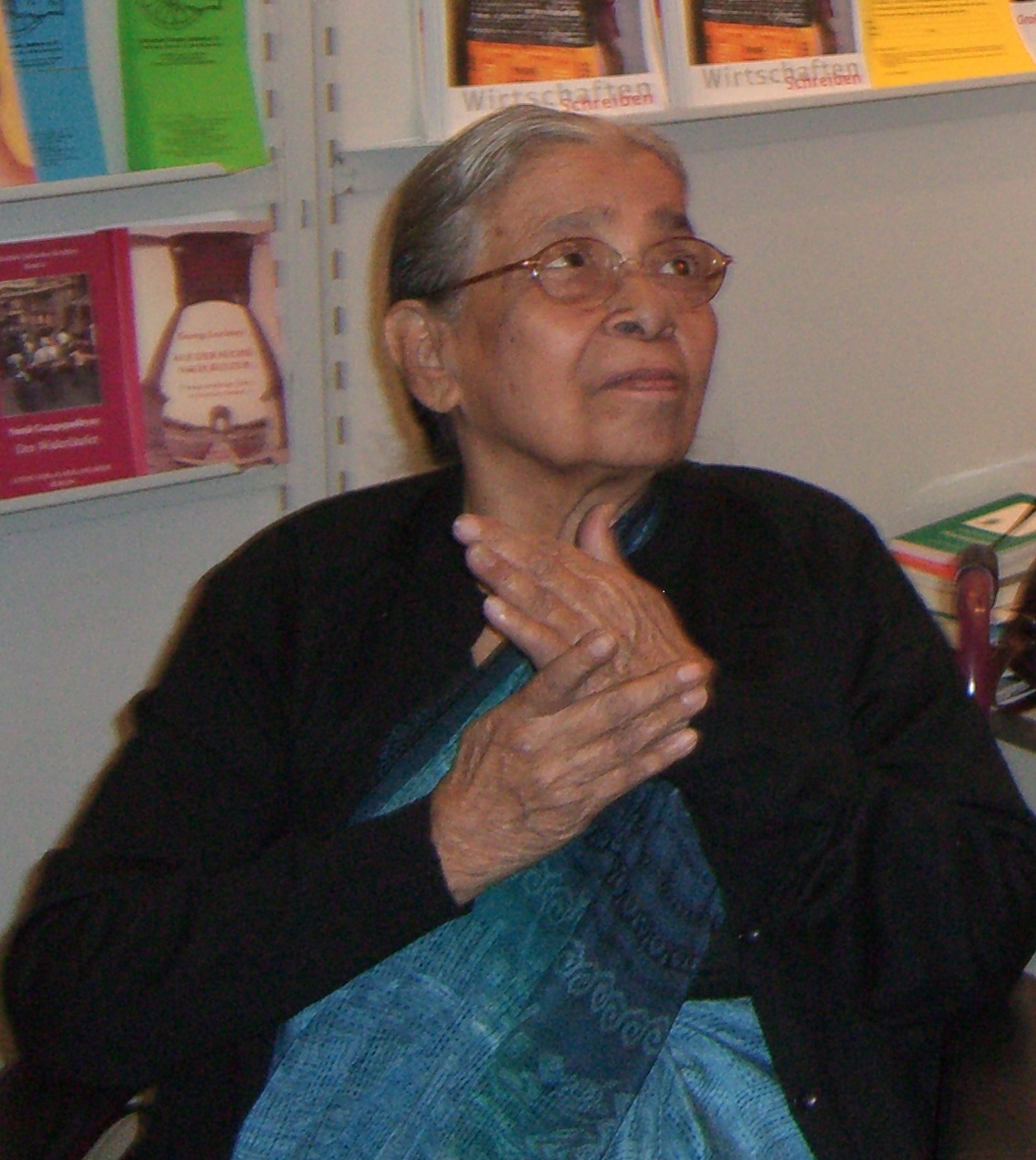
Mahasweta Devi (Mahāśbetā Debī) is one of the most important writers of modern India, whose art is inseparable from her social commitment. She was born on 14 January 1926 and died on 28 July 2016. Her parents, Manish Ghatak and Dharitri Devi, were both noted writers. From 1936–38 she attended the school/college founded by Rabindranath Tagore in Shantiniketan, to which she returned from 1944–46 to complete a B.A. in English literature. In 1947 she married the playwright Bijon Bhattacharya. Their marriage produced Nabarun Bhattacharya, who likewise became a noted writer. She visited Germany several times, most recently for the 2006 Frankfurt Book Fair as head of the delegation of India, the guest-of-honour country.
Activism and Awards
In her works she championed the human rights of India's lower classes, particularly in rural areas, and denounced the widespread practice of bonded labour found there. Her passionate commitment, however, was directed above all at the tribal communities of India's indigenous peoples, who are increasingly being driven from their traditional settlement areas and stripped of their basic rights, and whose existence remains threatened to this day. As a journalist she exposed cases of blatant injustice, supported the founding of human rights organisations, and engaged with the precarious living conditions of indigenous peoples as well as with their resistance.
For her "compassionate crusade through art and activism to claim for tribal peoples a just and honourable place in the national life of India," she received the Ramon Magsaysay Award in 1997, considered Asia's Nobel Peace Prize. Mahasweta Devi also received numerous Indian awards for her literary work and social commitment, including the Sahitya Akademi Award, the Padma Shri, the Jnanpith Award, the Padma Vibhushan, and the French Ordre des Arts et des Lettres.
Work
Mahasweta Devi wrote more than one hundred novels, twenty collections of short stories, and a number of plays and children's books.
Characteristic of her work is her own statement: "I have always believed that real history is made by ordinary people. I keep discovering the recurrence of folklore in different forms — ballads, myths and legends." In this way, through many of her characters (Bashai Tudu, Draupadi) she creates a kind of modern myth. Her heroes and heroines, beyond their individual traits, take on a universal character tied to their particular situation. Precise on-the-ground research always mattered greatly to Mahasweta Devi. This is especially true of the harrowing novel Aufstand im Munda-Land [Uprising in Munda Land], which retraces the last great uprising of the Munda indigenous people against British colonial rule in the late 19th century, along with the life of their leader Birsa, who died in English captivity before he was even 30 years old.
A comprehensive insight into the author's life and work is offered by the volume Mahasweta Devi – Indische Schriftstellerin und Menschenrechtlerin [Mahasweta Devi – Indian Writer and Human Rights Activist] by Hans-Martin Kunz (Draupadi Verlag, 2006).
Barbara Dasgupta
Published in German
- Pterodactylus (Bonner Siva Series, 2000) (in German)
- Daulati (Bonner Siva Series, 2002) (in German)
- Mutter von 1084 [Mother of 1084] (Bonner Siva Series, 2003) (in German)
- Aufstand im Munda-Land [Uprising in Munda Land] (Horlemann, 2005) (in German)
- Das Mädchen Warum-Warum [The Girl Why-Why] (children's book, Draupadi 2006, reissued 2012) (in German)
- Das Brahmanenmädchen und der Bootsmann [The Brahmin Girl and the Boatman] (Draupadi, 2013) (in German)
Excerpt
The author portrait (PDF, below) contains an excerpt from Aufstand im Munda-Land (Horlemann Verlag, 2005). (in German)
To mark Mahasweta Devi's 100th birthday, Literaturforum Indien e.V. held an online conference in February 2026 — see Events (in German).
Further Links
📄 Download this author portrait as PDF (in German) (with excerpt)