Krishna Baldev Vaid (1927-2020)
Biography
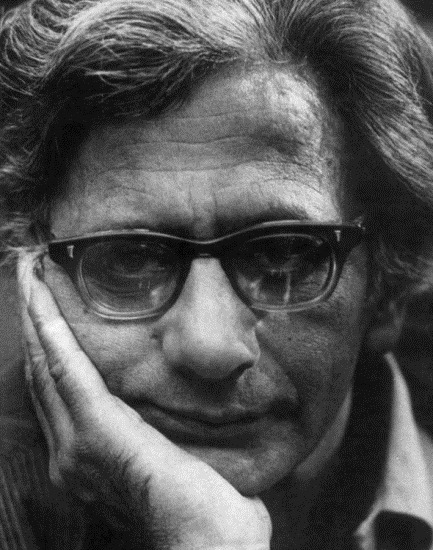
Vaid is one of the most prominent senior Hindi writers. Like so many other Hindi writers, he came from the part of Punjab now in Pakistan, from which his family had to flee at independence in 1947. He studied English literature at Panjab University in Chandigarh and, thanks to a scholarship at Harvard University in the USA, was able to earn his doctorate with a dissertation on narrative technique in Henry James (Harvard University Press, 1964). After his doctorate he initially returned to India, but as early as 1966 took up another position in the USA. He spent the greater part of his career as a professor of English literature at the State University of New York, until, following his retirement in 1985, he decided to return to India. In 2010 he moved back to the USA. He died on 6 February 2020 in New York.
As a writer, he chose Hindi very early on, a language closely related to his mother tongue, Punjabi. His literary models, however, he saw above all in the French avant-garde literature of the early 20th century. Within Hindi, he sees himself on the one hand in the tradition of social realism, but on the other also points to writers less "progressivist" in the strict sense, such as Nirmal Verma, Vinod Kumar Shukla, Ashok Vajpeyi, and Krishna Sobti. Some of his short stories experiment with surreal plots and narrative structures reminiscent of European existentialist literature.
A first novel, Uskā bacpan (His Childhood), was published as early as 1957. The hero of this early masterpiece of Hindi literature is a child whose play, amid an economically precarious environment marked by domestic violence, becomes an image of the fragility of the human condition in general.
As with later works, he translated his own novel into English himself, under the title Steps in Darkness. Two collections of short stories also appeared in English translation, Silence (1972) and The Sculptor in Exile (2014). Over many years he was an extremely productive author and translator: eleven novels, seven plays, four volumes of literary diaries, and 13 collections of short stories were published in Hindi, along with his collected short stories in two volumes. Vaid was also active as a translator from English into Hindi. His translations of Samuel Beckett's Waiting for Godot and Endgame into Hindi (1968) are particularly well known.
Besides the translations into English, his work is also available in other languages, including French, Polish, Russian, Japanese, and German. At its centre are usually members of the lower middle class, their hopes and traumas — not least the trauma of displacement, undertaken at mortal risk, during the 1947 independence.
Tagebuch eines Dienstmädchens (A Maidservant's Diary) has been published in a German translation by Anna Petersdorf by Draupadi Verlag and by Unionsverlag. A French translation is by Annie Montaut. The fictional diary is a kind of interior monologue by the young, uneducated maidservant Shano, who — like her mother before her — works in precarious employment; in the end she is offered the permanent position she had longed for, but decides to resign — and in the process comes to know the inner life of wealthy Delhi households. The everyday and the abysses of human relationships lie close together, not only among her employers but within her own family too. Behind the façade of respectability lie unhappy love, exploitation, crime, violence, and suicide. Yet Shano has accepted her way of life; there is no attempt at escape.
Vaid has often been critical of trends in modern Hindi literature and its discourses. He is particularly critical of the "journalistic style" of many Hindi authors and calls for deeper textual craftsmanship, for attention to form. In doing so he made enemies of some of his contemporaries in the world of Hindi literature, who accuse him of being narratively too close to European literary models and insufficiently political. He has therefore been denied major literary prizes. Nevertheless, he is today widely recognised as an elder statesman of Hindi literature.
Heinz Werner Wessler
Published in German
- "Wir Inder" (short story, translated by Rita Seuß), in Zwischen den Welten. Geschichten aus dem modernen Indien, ed. by Cornelia Zetsche, Frankfurt/Leipzig: Insel Verlag 2006, pp. 106-114 (in German)
- Tagebuch eines Dienstmädchens (novel, translated from Hindi by Anna Petersdorf), Zurich: Unionsverlag 2014 (also available as an e-book) (in German)
Review
Interview
- Interview with Krishna Baldev Vaid (in English)
Excerpt: A Maidservant's Diary
Retranslated into English from the German edition, Tagebuch eines Dienstmädchens.
For all working women,
in whom I recognise Shano.
Ma says Sahibs and Memsahibs are wicked by nature. Never trust any of them!, she says, they have no pity for people like us. Never believe what they say! Ma has spent her whole life scrubbing other people's pots. That's what's made her old. I feel sorry for her. But I'm angry at her too. At Bapu even more, though. Without Ma we'd all be dead by now. Bapu included. He's been sick forever and has no job. Ma says: Now he's sick, but the good-for-nothing never had anything else on his mind except where to get his next bottle of liquor. By now Bapu can barely eat or drink anything. He can't keep anything down. His liver's finished. Let him croak, Ma says, sooner rather than later. And then she starts crying. I feel sorry for Bapu, but I'm angry at him too. Ma frightens me sometimes, but when she curses at Bapu, I get angry. I'm often angry at myself too. Sometimes I could tear myself to pieces with rage. Ma says girls shouldn't get so angry. Look at me, she says, everything I've been through! Day in, day out, I have to listen to your father's nonsense and scrub other people's pots. That's what's made me old.
I'll slave away for other people too, until I'm old. Like Ma. And my children too. And I'll marry someone who's sick and unemployed, like Bapu. Why am I even thinking this? I don't want any children at all, and I don't want to get married either. And how exactly are you going to prevent that?, says Ma. All women have children, that's our fate. Fate! Karma! I don't need any of that nonsense. You must be out of your mind!, says Ma. If I'm not yet, I soon will be. I have to stop doing this work. I shouldn't have dropped out of school. Then I'd have long since finished tenth grade. And then what? Then I'd be a maidservant with a school certificate. Now I'm a maidservant who dropped out in eighth grade. I'll be scrubbing pots forever and growing old over it like Ma. But I won't get married. And I won't have children either. I'm modern. A modern maidservant. Now I have to laugh and cry.
***
When I was dusting at the fat Memsahib's place today, she started nagging at me again: Tell me, where do people like you get all this energy from? Is it something in your diet? Do you want to break everything! How many times do I have to tell you not to rush around like that! But you go flinging things about here! And the expensive china too! What have you got in your head, brains or straw?
The fat one nags without pause. I'd love to give her a proper telling-off. In my head I already do. One of these days I'll fling the duster right in her face! Ma tries to calm me down: If she likes picking on you so much, then let her! Stay calm and get on with your work. As soon as you find another house, you can quit on her. Ma says all Memsahibs love to nag more than anything. Some more, some less. Some quietly, some loudly. She's right. The Memsahibs are all the same. More suspicious and stingier than you could ever imagine! And the Sahibs are all lechers. But the fat one talks an extreme amount. Whenever she's sick, I'm genuinely glad. Although she's still a nuisance even in bed! I feel sorry for her husband. The poor man is a real wretch. A thin shirt of a man. I've noticed that fat women often have thin husbands. And thin women, fat ones. No idea why. Ma says that's just nature's way of playing games. To me it seems more like a bad joke. Thin men are often weaklings, fat men domineering. Fat women too.
The fat one is jealous of me because she knows I'm prettier than her. Her husband surely knows it too. Poor little sausage. All the Memsahibs are jealous of their young maidservants. They see us as rivals and are afraid we might steal their husbands away. Ma says some maidservants do exactly that. She also says I have to watch out for the Sahibs. And for their sons. I have no idea everything Ma has seen and been through in her life. Judging by what she hints at, it must be quite a lot. Maybe even everything. We'll see what all I still have to go through. Once, when I was cleaning the fat one's bathroom, the door suddenly opened and her husband came in. The poor man clearly didn't know I was in there, because when he saw me he recoiled and rushed back out. I pushed the door shut again, because the fat one always gets upset if water splashes out of the bathroom while cleaning. Right outside the door she launched straight in: Tell me, have you no shame at all! What were you gawking at in there? This slut really has no shame, and neither do you! But that's enough now. I'm throwing the little whore out!
She wouldn't let up on him, and I stood in the bathroom listening, since after all she was putting on this whole scene because of me. That made me angry, but somehow I had to laugh too. No idea why. When I came out of the bathroom later, she was still at it. I feel sorry for the poor man, but he makes me angry too. Why doesn't he just slap her one? Why doesn't he shout back at her? He probably went into the bathroom because he wanted to wash. For a moment I wondered whether he'd really had some ulterior motive. No, absolutely not. That thin shirt of a man is far too afraid of the fat one. He wouldn't even dare glance at me sideways. When he flinched like that and stumbled backward out of the bathroom, I had to laugh. If only the fat one had heard that! She's always threatening to throw me out. But she doesn't do it, and she won't in future either. These days it isn't so easy to find a good maidservant. Besides, the fat one's son is on my side. He's always pointing out how clean and tidy I am and what good work I do. The son is just as fat as his mother. Children of fat people are usually fat, and women often get fat after having children. I'll probably get fat too one day. No, never! I'm not having any children at all. What for anyway? They'd only spend their whole lives cleaning fat people's bathrooms. The fat one's bathroom is always properly filthy. Especially after she's showered. I don't want to know where all that dirt comes from. Fat people make fat dirt. Every few days she uses hair-removal cream and leaves the hairs lying around. Sometimes I just flush them down the drain. And when it gets blocked, she gets upset all over again. Let her scream. What do I care.
***
© Draupadi Verlag, 2012
📄 Download this author profile as a PDF (in German)