Kiran Nagarkar (1942-2019)
Biography
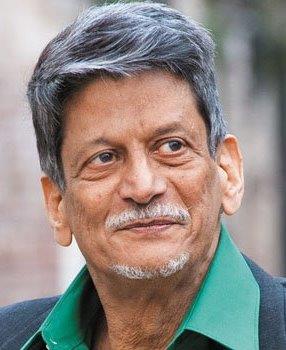
Kiran Nagarkar (2 April 1942 – 5 September 2019) was an Indian writer, playwright and screenwriter. He wrote in both Marathi and English. His provocative and critical screenplays, plays and novels make him an outstanding figure in contemporary Indian literature. His work also resonates strongly in Germany.
Born in Mumbai into a family whose outlook was strongly shaped by the principles of the "Brahmo Samaj", he attended an English-medium school. Nagarkar studied in Mumbai (SIES College) and in Pune (Fergusson College), where he completed his bachelor's degree in English literature, subsequently also earning a master's degree in the same subject at the University of Mumbai.
Founded in 1828 by Raja Ram Mohan Roy, the Brahmo Samaj was a reform movement within Hinduism that rejected Hindu rituals and turned toward Christianity by adopting some Christian concepts.
Work
Influenced by the existentialism of the French writer Albert Camus, Nagarkar's work focused on a realistic depiction of characters from Indian society. While addressing various aspects of social life in India, such as poverty and the oppression of women, he took a critical view of religious institutions and presented the personal and social struggles his heroes derived from them. The Hindu-Christian perspective that pervades Nagarkar's work is an exception within Indian literature as a whole.
Already for his first novel in Marathi, Saat Sakkam Trechalis ("Seven Sixes Are Forty-Three", 1974), he received the H.N. Apte Prize for the best debut novel of 1974. The novel's main features are its non-linear plot, its mixture of Marathi, English and Hindi, and its black humour. The story of the young man Kushank Purandare, who consciously chooses a path of self-destruction and the pain and death that come with it, broadened the horizons not only of Marathi literature at the time but of postcolonial Indian literature as a whole.
His English-language novel Ravan and Eddie (1994) tells the story of two boys — Ravan, a Marathi Hindu, and Eddie, a Catholic of Portuguese descent — who live in a tenement building in Mumbai's Mazagaon neighbourhood. The novel offers a deep insight into the complex life of multicultural Mumbai, where poor communities live in close proximity to one another, into the moral crisis of Indian society after independence, and into the rise of fundamentalist forces such as the RSS.
For his historical novel Cuckold (1997, published in German as Krishnas Schatten, 2002), Nagarkar received the prestigious Sahitya Akademi Award in 2001. The novel is set in the time of the saint Mirabai. Its protagonist is Mira's husband, the prince Bhoj Raj. He rejects the Rajputs' tradition of warfare, which costs him his support within Rajput society. This crisis is further compounded by the failure of his marriage. Mira's devotion to Krishna arouses his suspicion; he comes to see the god (Krishna) as his rival. Nagarkar observes the relationship between Mirabai and the Raja with great precision. Although it is a historical novel, the deliberate use of contemporary language lends it a certain immediacy.
As a playwright, Nagarkar was a provocateur. His Bedtime Story (1977) is a four-act play in Marathi. Each act is based on a well-known episode from the Mahabharata. Nagarkar reinterprets these episodes to raise questions about caste, patriarchy, religion and war. In contrast to the epic, the play shows that the good — the Pandavas — are weak and subject to human folly, and that the villains — the Kauravas — are no better. It is a choice between dark and darker. Nagarkar had a hard time getting his controversial play staged. Dr Shriram Lagoo attempted it by inviting several experimental theatre groups to a reading in 1978. Meanwhile, the play was submitted to the Maharashtra state censorship board. It came back with 78 cuts. Nagarkar said some of the censors' questions were utterly pointless, for instance: "Why are you distorting the original myths?" In his view, the censorship board was firmly convinced that the play was a blot on Indian culture and should therefore be quickly disposed of. In an interview in 2018, Nagarkar recalled a time when radical groups in Mumbai had threatened to prevent a performance of Bedtime Story. Nagarkar said: "These things happen from time to time, and only then can we be sure that art is still alive."
Recognition in Germany
The bilingual writer had a special bond with Germany. Almost all of Nagarkar's novels have been translated into German. His fourth novel, God's Little Soldier, was particularly well received by German readers and remained on the German bestseller list for a long time. God's Little Soldier deals with the subject of extremism. The Freiburg Theatre also turned it into a musical. In 2006 Nagarkar gave his first reading from the book to nearly 100 German members of parliament and diplomats in Berlin. In 2008 he was invited by the University of Tübingen to give a series of lectures, later published in book form. The university awarded him the rank of Poetics Lecturer, equivalent to a professorship. Nagarkar received a Rockefeller Fellowship and a fellowship from the city of Munich. He was a fellow of the DAAD (German Academic Exchange Service) and of the Wissenschaftskolleg (Institute for Advanced Study) in Berlin.
For his fifth novel, The Extras (2011, published in German as Die Statisten, 2012), the then German Ambassador to India, Michael Steiner, presented him with the Cross of the Order of Merit of the Federal Republic of Germany, Germany's highest civilian honour. At the award ceremony he said: "Kiran Nagarkar is one of the best-known Indian authors in Germany. Nagarkar's work makes a colourful, complex and in many ways complicated society tangible to our senses. His book God's Little Soldier in particular was a bestseller in Germany and offers a unique insight into the world of extremism…. At the intersection of our cultures, he became an important voice of India in Germany and, I am convinced, a resonant voice of Germany in India."
Isha Pandit
Published in German
- Krishnas Schatten, translated from the English by Ditte and Giovanni Bandini, A1 Verlag, Munich 2002. (Cuckold, 1997) (in German)
- Ravan und Eddie, translated from the English by Ditte and Giovanni Bandini, A1 Verlag, Munich 2005. (Ravan and Eddie, 1994) (in German)
- Gottes kleiner Krieger, translated from the English by Ditte and Giovanni Bandini, A1 Verlag, Munich 2006. (God's Little Soldier, 2006) (in German)
- Sieben mal sechs ist dreiundvierzig, translated from the Marathi and English by Ditte and Giovanni Bandini, A1 Verlag, Munich 2007. (Saat Sakkam Trechalis, 1974) (in German)
- Die Statisten, translated from the English by Ditte and Giovanni Bandini, A1 Verlag, Munich 2012. (The Extras, 2011) (in German)
Interviews with Kiran Nagarkar
- »In das Herz meines Helden«: 2006 (an interview from Der Spiegel, in German)
- Arts.21 # Between Berlin and Bombay – The Indian Writer Kiran Nagarkar: 2009 (an interview by Deutsche Welle, in English)
- Kiran Nagarkar on his new novel »Die Statisten«, Western influences on old Hindi films, and the new Bollywood: 2012 (an interview from Artechock, in German)
Excerpts
- Excerpt from Ravan und Eddie (in German)
- Excerpt from Die Statisten (in German)
- Excerpt from Krishnas Schatten (in German)
Reviews
- Reviews on Perlentaucher of Die Statisten (in German)
- Reviews on buecher.de of Ravan und Eddie (in German)
- Reviews on buecher.de of Sieben mal sechs ist dreiundvierzig (in German)
- Review by Alex Rühle in Süddeutsche Zeitung of Gottes kleiner Krieger (in German)
Further Links
- Veracity of Religious Prominence in Select Novels of Kiran Nagarkar: L. Vaishnavi, Dr. V. Suganthi, 2019. infokara.com
- On his life and work: Niti Sampat-Patel on Kiran Nagarkar in: Sanga, Jaina C.: South Asian novelists in English: An A to Z guide, Greenwood Press, Westport, Connecticut, 2003, pp. 177-179. google.de/books
- Kiran Nagarkar: the playwright provocateur (The Hindu, 6 September 2019)
- Unapologetically Nagarkar (Harmony India)
- 'Encounter with Kiran': Exchange between Kiran Nagarkar and Nayantara Sahgal
📄 Download this author profile as a PDF (in German)