Khushwant Singh (1915-2014)
Biography
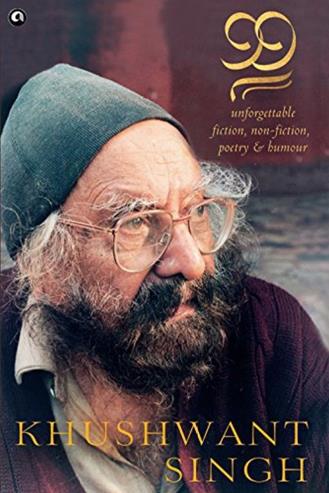
Khushwant Singh was an Indian writer, diplomat, lawyer, journalist and politician. He was born on 2 February 1915 in Hadali, Punjab (now in Pakistan), into a Sikh family. (At the time, most births and deaths went unregistered. Khushwant Singh's father therefore simply gave 2 February 1915 as his date of birth when enrolling him in school. Khushwant Singh's grandmother, however, believed he had been born in August. This prompted Singh himself to later adopt 15 August 1915 as his date of birth.) As a child, Singh attended the Modern School in Delhi. He later studied at Government College (Lahore), St. Stephen's College (Delhi), and King's College (London).
As a critic of the establishment and of social hypocrisy, Khushwant Singh occupied a distinctive place in the world of Indian literature. He wrote his literary works in English. His characteristic habit of viewing things from an outsider's perspective stemmed from his own experience of the Partition of the Indian subcontinent in 1947. As someone whose roots lay in what is now Pakistan, he felt himself to be an outsider.
While still working as a lawyer at the Lahore High Court, he once travelled to Kasauli at the foot of the Himalayas to visit his family. It was only a few days before the Partition of the subcontinent into India and Pakistan in August 1947. Along the way he came across a jeep full of Sikhs who proudly told him how they had just slaughtered all the inhabitants of a Muslim village.
This and other incidents are vividly described in his 1956 novel Train to Pakistan (published in German as "Der Zug nach Pakistan", 2008). The novel is set in the summer of 1947 and tells the story of a fictional village called Mano Majra, located on the border between India and Pakistan — a place where Sikhs and Muslims had lived together peacefully for centuries. The turning point of the novel is the arrival of a train laden with the corpses of Sikhs, which gives the village its first taste of the horrors of civil war. Mano Majra, once a peaceful, multi-religious village, is seized by a wave of religious hatred and turns into a battlefield.
Besides novels, Khushwant Singh wrote many short stories, published in various collections such as The Mark of Vishnu and Other Stories (1950), The Voice of God and Other Stories (1957), A Bride for the Sahib and Other Stories (1967), and The Portrait of a Lady: Collected Stories (2007). In several of his stories, Khushwant Singh highlights how much harm superstition can cause. In "The Mark of Vishnu", for instance, a devout but ignorant servant, believing he is performing a good deed by reverently setting out a bowl of milk for a cobra every day, is severely punished for his faith: one day the snake bites him and he dies.
In his 2002 autobiography, Truth, Love & A Little Malice, Singh writes with complete candour about his encounters with prime ministers Jawaharlal Nehru and Indira Gandhi, as well as with the terrorist Jarnail Singh Bhindranwale, with the talented painter Amrita Sher-Gil — notorious for her uninhibited attitude to sexuality — and with ordinary people who became murderers during the Partition of India. He also writes unflinchingly about his own life, documenting his professional triumphs and failures as a lawyer, journalist, writer and member of parliament, as well as the comforts and disappointments of his marriage of more than sixty years, his fear of ghosts, and his fascination with death.
Khushwant Singh also edited several prominent Indian newspapers and magazines, such as The Illustrated Weekly of India, The National Herald, and the Hindustan Times. During his nine years as editor of The Illustrated Weekly, circulation rose from 65,000 to 400,000. He was the founder and editor of the Indian government magazine Yojana. After his tenure as an editor at the Hindustan Times ended, he continued to write a column titled With Malice Towards One and All for various leading Indian daily newspapers. This column was enormously popular with readers. With his characteristic wit, Singh used it to describe, among other things, the typical behavioural quirks of Indians and Western foreigners alike.
Isha Pandit
Awards
- Padma Bhushan from the Indian government (1974; in 1984 Khushwant Singh returned this honour in protest against the Indira Gandhi government's military action at the Golden Temple in Amritsar, Punjab)
- Punjab Rattan Award from the Government of Punjab (2006)
- Padma Vibhushan from the Indian government (2007)
- Sahitya Akademi Fellowship (2010)
- Fellow of King's College London (2014)
Published in German
- Die Brücke am Satledsch, novel, translated from the English by Iris Foerster and Rolf Hellmut Foerster, 219 pp., Diederichs Verlag, Cologne and Düsseldorf, 1957 (in German)
- Die Sikhs, illustrated volume, translated from the English by Ernest L. Wich and Odilie Pembaur, 144 pp., Burg Verlag, Sachsenheim and Stuttgart, 1986 (in German)
- Delhi, novel, translated from the English by Martin Hielscher and Sabine Niemann, 460 pp., Dölling und Galitz Verlag, Hamburg 1995 (in German)
- Paradies und andere Geschichten, short-story collection, translated from the English by Claudia Wenner, 268 pp., Dörlemann Verlag, Zurich 2006 (in German)
- Der Zug nach Pakistan, novel, translated from the English by Axel Monte, 235 pp., Insel Verlag, Frankfurt am Main 2008 (in German)
Reviews
- Review of Delhi by Aman Kaul
- Reviews of Der Zug nach Pakistan on perlentaucher.de (in German)
- Reviews of Paradies und andere Geschichten by Martin Zähringer (in German)
Further Links
- Face to Face with Karan Thapar: an interview with Khushwant Singh, BBC (1999)
- Face to Face with Karan Thapar: an interview with Khushwant Singh, BBC (2002)
- Kiran Bala interviews Khushwant Singh (2009), on The Quint
- Quotes from the column With Malice Towards One and All (2014)
- Subverting Language: A Study of Linguistic Innovation in the Prose-Work of Khushwant Singh, an article by Sudha Mishra on academia.edu (2014)
- Decolonization, Partition and its Corollary in Contemporary India: A Study of Train to Pakistan by Khushwant Singh, an article by Rashmi Malik on academia.edu (2014)
📄 Download this author profile as a PDF (in German)