Jaiwanti Dimri
About the Author
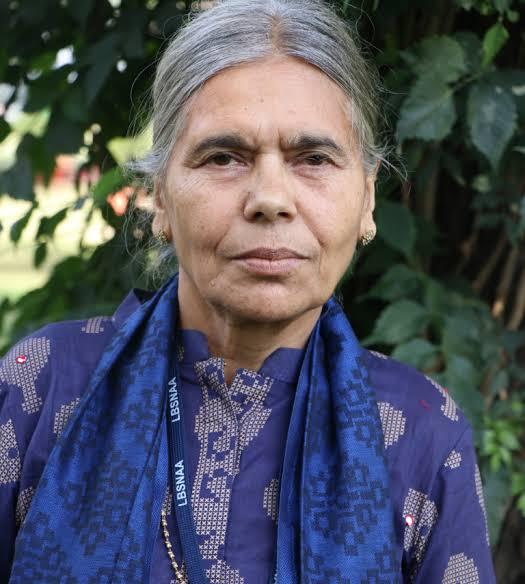
Jaiwanti Dimri was born in a village in the Chamoli district of Uttarakhand and grew up in Mussoorie. The mountains are an important part of her life, and it is no coincidence that she has spent most of her years in Mussoorie, Shimla and, outside India, in Bhutan. A love of travel and adventure, however, also brought her formative experiences in other geographical and cultural settings. In 1982–83 she was a lecturer in Damaturu in northern Nigeria, a region that today is unfortunately known above all in connection with the baleful activities of the terrorist organisation Boko Haram.
From 1997 to 1999 she lived and worked as a lecturer at Sherubtse College in Kanglung, Bhutan, and in 2013 she spent a shorter period in Portland, USA. By training and profession she is a scholar of English literature. Her research and teaching focuses include postcolonial studies and subaltern studies as well as engagement with questions of translation theory. For many years she worked as a professor in the Department of English at Himachal Pradesh University, Shimla. Since her retirement she has also worked as a visiting professor at the University of Dehradun.
Her origins and family ties, her advocacy for women's rights, her curiosity about other cultures, her work at the university and her activity as a freelance author — all this makes up Jaiwanti Dimri's personality. Of herself she says: "Having been born into a Brahmin family, knowledge of Hindu religion and philosophy is deeply rooted in me. What has always been a challenge for me, however, is the combination of profession and vocation. In one of my stories, Gale Pari Kahani, I described this dilemma of wanting to dance at two weddings."
Work
Jaiwanti Dimri's literary career began in 1989 with the publication of her story Miss Gloria ki vaapsi ("The Return of Miss Gloria"). Since then she has published a series of books in Hindi and English. She writes mainly short stories, for which she was awarded the Arya Smriti Sahitya Samman literary prize in 2002. A selection of her stories was published in English in 2016 under the title The Inner Eye and other Stories. A collection of stories was published in Hindi in 2012, with a second edition in 2022. It takes its title from the story Pinddaan, which, starting from the Hindu ceremony of feeding the ancestors, deals above all with the fate of women in North India.
In 2023 the short novel Für Surju was published in German — an autobiographically tinged account of the relationship, fluctuating between caste and class consciousness on one side and female solidarity on the other, between a domestic worker and her employer, set against the social circumstances of foreigners in Bhutan, the "happiest country in the world". Jaiwanti Dimri herself produced a very free rendering of the Hindi original, which was published under the title To Surju. With Love.
Of this work the author says: "Nothing in life is planned. Things happen in life in their own way — that is my firm conviction. I am not among those writers who sit down at their desk every day as a ritual in order to write. On the contrary, I write only when I have something very urgent to write, an event or a thought that absolutely must come out. Für Surju is such a work, one that simply wanted to be written down."
Alongside her fiction, she has published several non-fiction books, including Images and Representation of the Rural Woman: A Study of the Selected Novels of Indian Women Writers as well as her books on Bhutan: The Drukpa Mystique: Bhutan in Twenty First Century (2004) and Memorable Memories of Bhutan (2021), for which she received the NISSIM Prize for English Prose in 2023. Bhutan and its culture impressed her deeply and inspired her to translate the novel The Hero With Thousand Eyes by the Bhutanese writer Karma Ura into Hindi. It was published in 2009 under the title Sahasranetradhaari Naayak.
Her deep connection to the culture of the mountain regions of northern India, as well as her interest in strengthening the position of women, is reflected in the volume Short Stories and Memoirs of Women Writers of Uttarakhand in English Translation (2017), edited together with Madhu Singh, and in her contribution to a collection of poems by women in Garhwali and Kumauni (Triveni, ed. Madhu Singh, 2013).
Almuth Degener
Book Published in German Translation
- Für Surju. Novel. Translated from Hindi by Almuth Degener. Draupadi Verlag 2023
Reading Excerpt
📄 Download this author portrait as PDF (in German)