Ismat Chughtai (1915–1991)
About the Author
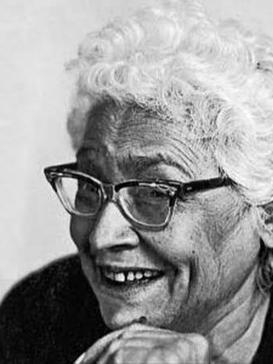
Ismat Chughtai (Iṣmat Cughtā'ī, 1915–1991) is regarded as one of the most important Urdu short-story writers of the 20th century. She was born in Badayun (UP) as the youngest of ten children. Her father was a lawyer and administrative official who rose to the rank of Deputy Collector. Since her elder sisters were married early, she grew up mainly with her brothers, which significantly shaped her personality. Her liberal father gave her the same opportunities as his sons, including in education, and thereby fostered her rebellious temperament. She resisted an arranged marriage and, against her mother's opposition, fought for permission to study.
Ismat grew up in a family with literary interests. Her brother Mirza Azim Beg Chughtai (1898–1941), a successful humorist and writer, became her first teacher and mentor. She later paid tribute to him in a literary portrait. In her youth she first read romantic stories in Urdu, then, on her brother's advice, the novels of Thomas Hardy, followed by Dostoevsky, Somerset Maugham, Chekhov and O'Henry, whom she called her role model. In Urdu, Premchand (1880–1936) became her favourite author. She met him personally when she attended the first meeting of the Progressive Writers' Association in Lucknow in 1936. There she also met the physician and writer Rashid Jahan (1905–1952), whom she later described as her greatest role model.
After completing her BA in 1936, Ismat became headmistress of a girls' school in Bareily in 1937. In 1939 she gave up this post to enrol in a teacher-training course (BT) at Aligarh University, where she was one of the first Muslim women graduates. From 1940 to 1941 she taught at a school in Jodhpur and afterwards became a school inspector in Bombay. In 1942 Ismat married, without her family's consent, the filmmaker Shahid Latif, with whom she had already been friends for a long time. Her first daughter was born that same year, a second in 1952. Until Shahid Latif's death in 1967, Ismat and he together realised numerous film projects, some based on Ismat's works and screenplays. Even after Shahid Latif's death, Ismat remained closely connected to the Bombay film industry.
Ismat continued to be involved in the Progressive Writers' Association and took part in its conferences. In 1954 she travelled to a peace conference in Finland. That same year she visited China, and in 1955, together with the Urdu poet Ali Sardar Jafri, one of the leading figures of the progressive movement, she visited Moscow. In 1976 she travelled to Pakistan for the first time since the Partition of India, and again in 1985, where some of her siblings lived. In 1978 she travelled again to the USSR, visiting, besides Moscow, Tashkent, Leningrad (today St Petersburg) and the Pamir region. She died in Mumbai in 1991.
Literary Work
Ismat began writing small romantic stories in 1924, which, however, remained unpublished. In 1937 she wrote her first essay on her childhood memories. From 1938 onwards her texts were published in renowned literary magazines. Until the end of her life she wrote regularly not only for literary but also for several popular magazines. In addition, her short stories, radio plays and essays were also published in book form from 1941 onwards. In 1981 she gathered memories of stages of her life, combined with commentary on the situation of women in Indian society and other social themes, into the volume Kāghazī hai paihāran ("A Shirt of Paper"). This volume is not only an important source for her biography but also gives direct insight into her convictions.
In 1939 Ẓiddī ("A Stubborn One") appeared, her first short novel, which was made into a film in 1948. Further novels and novellas followed, as well as childhood memoirs and screenplays for several Bollywood films, of which Garam Havā ("Hot Wind", 1973) and Junūn ("Blind Madness", 1979) were honoured with numerous awards. In the screenplay for Garam Havā, Ismat took up motifs from her masterful short story Chauthī kā joṛā ("The Bridal Dress", published 1946), which deals with the tragedy of a young girl who, without a dowry, must give up all hope of marriage and dies under wretched conditions. In the film, the Partition of India and the emigration of many Muslims to Pakistan form the backdrop for a tragedy that ends with the girl's suicide.
Ismat wrote about the things she knew best: life in a sprawling extended family, the atmosphere in girls' schools and boarding schools, the literary gatherings of the Progressives, and Bollywood's film world. Many of her stories are based on true incidents. Childhood memories also served as the background for Liḥāf ("The Quilt", 1942), one of her most famous short stories, which brought her a trial for obscenity, since it hints at a lesbian relationship. In 1945 she travelled, accompanied by Saadat Hasan Manto (1912–1955), to the first hearing of her case, followed by a second in 1946. She described the stay in Lahore and the course of the hearings, which ended in acquittal, in a very amusing way. Manto and Ismat were bound from then on by a close friendship, marked by open criticism but at the same time by deep mutual understanding. Ismat impressively described this relationship in her portrait of Manto, Merā dost, merā dushman ("My Friend, My Enemy"). She also wrote a defence of Manto when, after his death, fellow writers in Pakistan began a general condemnation of him.
In 1945 Ismat's arguably most important novel, Ṭeṛhī lakīr (English: The Crooked Line, 1995), was published. Especially in its first part, which is strongly autobiographical, it offers a good picture of her family environment, her studies and her first professional years. As in all her narrative texts, the main focus here is on the lives of women in Indian society and the manifold restrictions to which they are subjected. The novel allows deep insights into the child's psyche, such as had scarcely been found before in Urdu literature, and critically settles accounts with the relationship between the sexes in the intellectual milieu, which for many men, despite all progressive rhetoric, was determined by romantic clichés and a rather conventional image of women. She also gave expression to her radical rejection of the segregation of women and their restriction to the roles of wife and mother in numerous essays.
Ismat processed her experiences in Bollywood in the short novel Ajīb ādmī (1968; English: A Very Strange Man), modelled on the figure of the famous director and actor Guru Dutt (1925–1964). It is certainly not among her masterpieces, but it was the first to allow such unvarnished, psychologically deep insights into the world of film. The author shows here how the complicated relationship between the sexes, torn between calculation and passion, financial problems and constant time pressure, the difficult balance between commerce and aesthetic ambition, unrestrained alcohol abuse and an unhealthy work rhythm drive not only the main character but also his wife and other members of the film set into physical and psychological ruin.
In her essays, Ismat also commented on the literature of her time and proclaimed a progressive credo based on strict realism and socially critical engagement. In doing so, she did not shy away from criticising contemporaries who, towards the end of the 1940s and the beginning of the 1950s, did not conform to the very narrow, dogmatically interpreted literary view of the Progressives. Here she reveals the same combativeness, unsparing openness and honesty that her contemporaries already attested to her during her lifetime, and which also characterises her literary works. In her own writing, Ismat remained true to her credo throughout her life. Her unmistakable style includes expressive metaphors, concretely drawn, realistic settings and lively characters who speak a colloquial language coloured by rich idiom. With their numerous details and the wide range of accurately depicted social milieus, the texts are also often important ethnographic sources. If they are still read today, this is due above all to the reading pleasure that her so vividly told stories provide.
Christina Oesterheld
Translations (Selection)
German:
- "Kindheitserinnerung" (pp. 431–432), Die Steppdecke (pp. 432–444), Manto: "Ismat und ihre 'Steppdecke'" (pp. 444–445), in: Allahs indischer Garten. Ein Lesebuch der Urdu-Literatur. Translated and edited by Ursula Rothen-Dubs. Frauenfeld: Verlag im Waldgut, 1989
- Das Brautkleid und andere Erzählungen. Translated from Urdu by Christina Oesterheld and Ursula Rothen-Dubs, from English by Axel Monte. Berlin: Lotos Werkstatt, 2017
English (selection):
- The Quilt and Other Stories. Transl. by Tahira Naqvi. New Delhi: Kali for Women, 1990
- The Crooked Line. Transl. from the Urdu by Tahira Naqvi. New Delhi: Kali for Women, 1995
- My Friend, my Enemy: Essays, Reminiscences, Portraits. Translated and introduced by Tahira Naqvi. New Delhi: Kali for Women, 2001
- A Very Strange Man (Ajeeb aadmi): a novel. Transl. from the original Urdu by Tahira Naqvi. New Delhi: Women Unlimited, 2007
- Masooma: a novel. Transl. from the original Urdu by Tahira Naqvi. New Delhi: Women Unlimited, 2011
- A Chughtai Quartet. Transl. from the Urdu by Tahira Naqvi. New Delhi: Women Unlimited, 2014
- Kaghazi hai pairahan. The Paper Attire. Transl. by Noor Zaheer. Karachi: Oxford University Press, 2016
- The Three Innocents, & Ors.: Chughtai on Childhood. Transl. from the original Urdu by Tahira Naqvi. New Delhi: Women Unlimited, 2017
- One Drop of Blood: The Story of Karbala, a novel. Transl. from the original Urdu by Tahira Naqvi. New Delhi: Women Unlimited, 2020
- The Collectors' Chughtai: Her Choicest Stories. Transl. from the original Urdu by Tahira Naqvi. New Delhi: Women Unlimited, 2021
Awards
- 1976: Padma Shri Award, India's fourth-highest civilian honour
- 1977: Ghalib Award of the Ghalib Institute, Delhi
- 1979: Makhddoom Literary Award of the Andhra Pradesh Urdu Akademi
- 1982: Soviet Land Nehru Award
- 1989: Iqbal Samman of the Rajasthan Urdu Akademi
Renowned literary magazines in India and Pakistan dedicated special issues to her, her short stories and essays were compiled into collected works in India and Pakistan several times, and her works were translated, besides English, into numerous Indian languages.
Published in German
- Das Brautkleid und andere Erzählungen. Lotos Werkstatt, Berlin 2017
Reading Excerpt
Reviews
- Review by Irmtraud Gutschke in Neues Deutschland (in German)
- Review by Reinhold Schein in SÜDASIEN 4/2017 (PDF, in German)
Sources
- Tahira Naqvi, "Introduction", in The Quilt and Other Stories, New Delhi: Kali for Women, 1990, vii–xix
- Ismat: Her Life, Her Times. Edited by Sukrita Paul Kumar. New Delhi: Katha, 2000
Further Links
- Ismat Chughtai at Live History India
- List of works by Ismat Chughtai (Wikipedia)
- Ismat Chughtai on Wikipedia
📄 Download this author portrait as PDF (in German)