Habib Tanvir
Biography
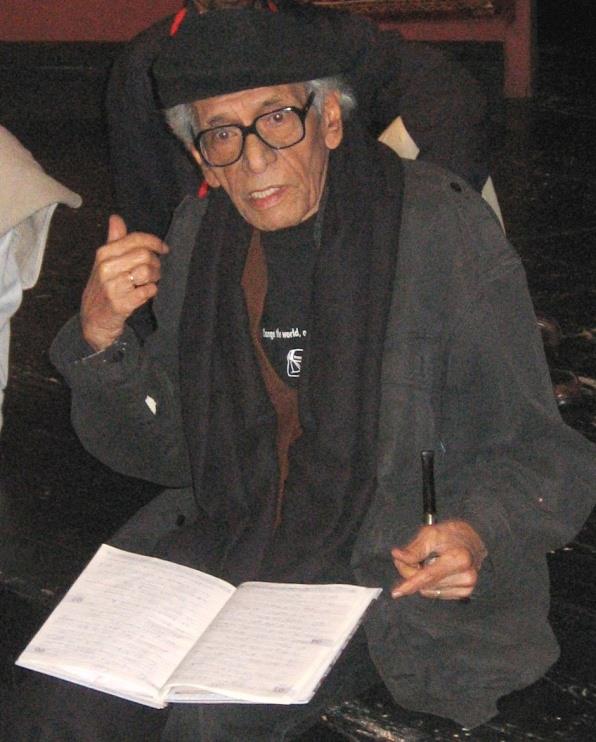
Habib Tanvir (Habīb Tanvīr), born 1923 in Raipur/Chhattisgarh, died 2009 in Bhopal/Madhya Pradesh, became known as an actor, playwright and theatre director.
From 1945 to 1954 he worked in Bombay as a journalist, wrote film songs in Urdu and Hindi, and joined the IPTA (Indian People's Theatre Association), which was closely aligned with the Communist Party of India.
In 1954 he moved to Delhi, where he worked at the Hindustani Theatre. There he created his first major play, Agra Basar. It is set around 1810 in the marketplace of Agra, once the capital of the long-declining Mughal Empire, which was gradually giving way to British colonial rule. The play depicts the hustle and bustle of the bazaar, its various traders and their customers, the bookshop where the local intelligentsia gathers, and the establishment of the beautiful Benazir, which lures those hungry for love. A recurring group of singing fakirs accompanies and comments on the action with songs by the popular Urdu poet Nazir Akbarabadi (1740–1830). Agra Basar became a modern classic of the Indian stage and saw numerous performances, many of them open-air. For the Bonn-India Biennale 2006, Tanvir was invited together with the amateur acting troupe of the Naya Theatre, which he had founded in Bhopal.
In 1955 Tanvir furthered his training in acting and directing in England; in 1956 he spent eight months in Berlin, where he saw several plays staged by Bertolt Brecht's Berliner Ensemble. Brecht's epic theatre provided important impulses for his later work. From then on his work as author and director rested on two pillars: the grassroots tradition of Indian folk theatre and the innovations introduced by Brecht. Tanvir's theatre work always had a political dimension. In the 1980s and 90s he worked intensively with the street theatre group Jan Natya Manch, founded by Safdar Hashmi.
From 1972 to 1978 Tanvir was a member of the Rajya Sabha, the upper house of the Indian parliament.
Works
Among the best known of his 15 plays are:
- Agra Bazar (1954)
- Mitti Ki Gaadi (1958, "The Clay Cart", an adaptation of the Sanskrit play Mricchakatikam by Shudraka)
- Charandas Chor (1975, "Charandas the Thief")
- Ponga Pandit ("The Foolish Priest", Tanvir's version of a popular satire about an outwardly pious Brahmin priest who carries on a love affair with an "impure" casteless woman)
- Moteram ka Satyagrah (1988, a stage adaptation of Premchand's story Pandit Moteram Shastri ka Satyagrah)
Published in German
Agra Basar. Schauspiel in zwei Akten, Draupadi Verlag, Heidelberg 2007 (in German). Also contains the essay "Je näher an Brecht, desto indischer" by Vasudha Dalmia.
Film Adaptations
Charandas Chor (1975, director: Shyam Benegal)
Awards (selection)
- Sangeet Natak Akademy Award (1969)
- Padma Shri (1983)
- Padma Bhushan (2002)
Reinhold Schein
Excerpt: Bazaar on Tour
Afterword to the German edition of Agra Basar, by Steffen Kopetzky, retranslated into English from the German; by kind permission of Draupadi Verlag, Heidelberg.
A thoroughly scrambled schedule meant that the first piece of Indian theatre I ever saw in my life was Habib Tanvir's Agra Basar. It was on the programme of India's most important theatre festival, staged by the National School of Drama in New Delhi.
It was a wonderfully mild January evening, and one could make out the location of the venue from far away, because people were standing all the way out into the street and the flow of traffic had almost ground to a halt at that spot.
The crowd was so enormous that one might have thought it was not a play at all but a film premiere, with some film star or other in attendance; nor did it consist only of an audience pressing to get into the performance — the crowd itself was so spectacular that countless onlookers had gathered who perhaps did not even have the money to attend the performance, but simply wanted to see what was actually going on.
I soon found myself hopelessly wedged between people of every age, every build, and varying degrees of personal hygiene, experiencing an Indian crush of the kind one perhaps knows best from scenes on Indian railway platforms just before the last and most important local train leaves the station. It was my first encounter with that phenomenon, peculiar to Indian crowds, oscillating between intoxicated excitement and the suffering of being squeezed — and I will never forget how, half a metre in front of me, a younger man, perhaps a bank clerk or a computer specialist, freed his left arm in slow motion from its unwelcome confinement, brushed it along the back of an equally squeezed fellow human being, and tried to create room with his right arm in order to turn around: he was doing this with such concentration, as though it were serious work, sweat standing on his brow, and it was fascinating to watch him in his highly focused liberation manoeuvre, somehow reminiscent of yoga — at least until a tectonic upheaval at my back pushed me further towards the centre and I lost sight of him, since my face came to lie sideways flat against the back of a thin but tenaciously position-defending elderly gentleman, and I had to make sure I wasn't pushed downward and trampled flat like a piece of flatbread.
After a good half hour, however, I was sitting safely in my seat, deeply impressed by that enormous crush, which — as my Indian companion explained to me — had to do with the unique reputation this production enjoyed in the consciousness of the Indian theatre-going public.
Without understanding a word, I followed — as a travelling theatre scout does — the visual impression of the staging instead: its astonishing abundance of characters and their entrances and exits, repeatedly structured by music and song. The folk quality of the scenario and the characters stood in astonishing contrast to the unshakeable professionalism of the performers — for again and again the audience forced an interruption of the play through fierce laughter that seized the whole hall, bursts of applause between scenes, and once even through the loud, many-throated demand that a particular song be repeated immediately — which then duly happened, as a matter of course.
It almost felt to me as though I were the only person in the audience who did not yet know Agra Basar, so assured and confident were the comments and interjections, so overwhelmingly unanimous the laughter. I found it most remarkable that a small bookshop seemed to stand at the centre of the play, within whose suggested walls — presumably learned — conversations kept taking place between various characters. A folksy, popular play in which readers of books, that is, intellectuals, played a central role. Remarkable.
I still didn't know exactly what it was about, which books were being read or whose verses recited, but the first impression — which, as with people, usually decides matters in one's encounter with a production too — was so positive that, once back in Germany, I had Agra Basar right at the top of my wish list for the Bonn Biennale 2006. This longest-running production on the Indian subcontinent, staged continuously for more than fifty seasons, was to have its premiere outside India in Bonn: and so we began working towards that.
This process took many months, during which the heated goings-on of the bazaar were, so to speak, re-enacted by our office and by a wide variety of German and Indian institutions and authorities. It repeatedly seemed doubtful whether we would manage to bring Tanvir and his troupe from Bhopal and the villages of Raipur district to the Rhine, since a good number of those involved did not even remotely meet the requirements for obtaining EU visas — they could not read or write, had neither bank accounts nor passports, or were simply too young. There were also repeated misgivings on the Indian side that the villagers around Tanvir might not be the ideal representatives of Indian theatre life. Finally, the master himself, already well into his eighties, doubted whether he could manage the long journey and all the preparatory organisation at all. Everything was delicate, precarious; the phones never stopped ringing — no sooner was one problem solved than a new difficulty arose the next day, so that right up until the moment the thirty-strong group landed in Frankfurt, it remained uncertain whether they — supplemented by a few actors from other ensembles staying in Bonn — would actually be able to perform.
But then the master stepped onto the floor: Tanvir, in a huge beret and leaning on a cane hardly thinner than himself, took his seat right at the front in the first row, his group gathered in a wide circle around him. His voice was that of a very old man, but the diction of his English was brilliant and clear, full of composure and calm. He first thanked us for the invitation. Then he looked at me, smiling, and said that he was well aware of what was and was not permitted in theatres, but that he would nonetheless ask for the privilege, here in Bonn too, of doing what he had already done in countless theatres scattered across the world: namely, to smoke his pipe! The stage manager was informed, the fire brigade notified, and the smoke detectors switched off. Finally, a bucket of water was also placed beside Tanvir's seat.
Then, at nine o'clock in the morning, everyone gathered for the first rehearsal at the Godesberger Kammerspiele, our main venue. I was there to welcome them and wish them a good morning, and was deeply moved by the serious faces looking back at me. Without costumes, tired from the journey and from the task ahead of them — having to perform for a German audience — and probably facing it with a certain dread, our Agra Basar company looked somewhat intimidated. Worry was written on their faces.
Once that was taken care of and the first wisps of smoke drifted cheerfully and fragrantly through the theatre's rafters, he addressed his words to the troupe: something very difficult lay ahead of them, namely performing for an audience that had never heard anything of them, or of Agra Basar, or of "Nazīr". It would be anything but easy, and would demand the utmost concentration from every single one of them, and he repeated once more: from every one of you! The master had spoken aloud what everyone feared, and now everyone looked down at the floor, stricken — a moment of fear-filled silence.
But then a broad grin appeared on Tanvir's face, the grin of a theatre man through and through: "And because everything is so difficult, my friends, we shall perform as though the devil himself were after us — and we shall be better than ever! So now, let's do the first run-through!"
Steffen Kopetzky
Reviews
- Je näher an Brecht, desto indischer, review by Sandra Frey of Agra Basar, published in "Meine Welt – Zeitschrift des deutsch-indischen Dialogs", January 2008, pp. 36-37 (in German)
Further Links
- Habib Tanvir and Naya Theatre (YouTube)
- On the Theatre of Habib Tanvir, in: The Dramatic Touch of Difference: Theatre, Own and Foreign, by Erika Fischer-Lichte, Josephine Riley, Michael Gissenwehrer, Gunter Narr Verlag, 1990, pp. 221-233
📄 Download this author profile as a PDF (in German)