Gagan Gill
About the Author
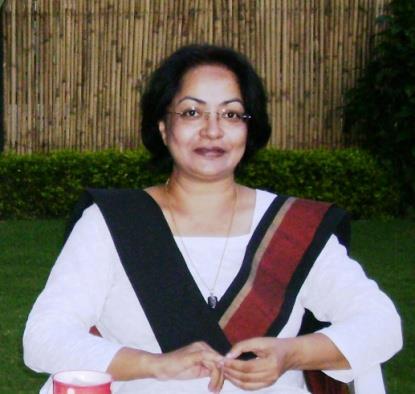
Gagan Gill was born in 1959 in Delhi and took her M.A. in English Literature at Delhi University. For eleven years she worked successfully as a journalist and editor before turning increasingly to her own creative writing from the late 1980s onwards. In 1989 she published her first collection of poems, Ek din lautegi larki ("One Day the Girl Will Return"), in which she casts intense personal feelings of pain and loss, as well as snapshots of everyday surroundings, into vivid metaphors and carefully arranged, almost spare poetry.
In 1996 followed the collection Andhere mem buddha ("Buddha in the Dark"), which circles around the theme of grief and suffering that inevitably accompanies human existence. The third collection, Yah akanksha samay nahi ("Turning Away from Desire", Lotos Verlag Roland Beer 2006), appeared in 1998 and is distinguished by its highly condensed language and the artfully formalised structure of its poems. Like the previous one, this collection also contains some of her epigrammatic prose pieces, which fall into line with the poems, sometimes under a shared thematic heading. The fourth collection of poems, Thapak thapak dil thapak thapak ("Thump Thump, Heart, Thump Thump"), appeared in 2003 and plays with sound patterns and a return to rhyme and metre. In 2018 she published a further collection of poems entitled Main jab tak ayi bahar ("Until I Came Outside").
The prose volume Dilli mein uninde ("The Sleepless of Delhi", the eponymous short story published in die horen 223) appeared in 2012. Two prose volumes are currently in press: a volume of literary essays, Deh ki munder par ("On the Windowsill of the Body"), and a volume of personal memoirs, Ityadi ("And So On").
Editions and Translations
Alongside her focus on creative writing, she has remained active as a translator and editor. In 1996 she received particular recognition for the large-format art volume she compiled, A Journey Within, presenting the work of the prominent modern painter and writer Ram Kumar. Since the death of her husband, Nirmal Verma, in 2005, she has been occupied with editing his unpublished writings; four volumes of letters and interviews have since appeared.
Travel and Travel Writing
Travel and engagement with different cultures and habits of thought, as well as with her own cultural identity, occupy an important place in Gagan Gill's work. Her widely noted book Awaak. Kailash Manasarovar - ek antaryatra (2008) ("Speechless. Kailash Mansarovar – An Inner Journey") presents a spiritual travelogue about circumambulating Mount Kailash, sacred to Hindus and Buddhists, and conveys subtle reflections on myth, faith and identity. Not least, the author attempts, on this journey in the manner of a rite de passage, to take leave of her husband, who had died a year earlier.
Women's Literature and Feminist Discourse
Besides editing special collections, for instance on "New Women Writing in Hindi", Gagan Gill is a sought-after guest in TV interviews and panel discussions on the subject of women's literature. As an author she is particularly critical of the expectation that women's literature, or literature written by women, must necessarily provide a platform for the exposition of feminist questions (stri vimarsh), and she argues for more courage for literary risk-taking in content and form, such as she finds, for example, in the work of Krishna Sobti.
International Reputation
Gagan Gill's poetry and prose texts are today included in most anthologies of modern Hindi literature. At the same time, through her profound contributions to international seminars and readings, she has made a name for herself as a voice of contemporary literary India. From the 1990s onwards she travelled with various author sponsorship programmes to Europe, Great Britain and America, among others as a Nieman Fellow for Journalism at Harvard University. Her works have been translated into English, German and Polish.
Barbara Lotz
Prizes and Honours
Among the numerous awards for her work, the Bharat Bhushan Puruskar (1984), the Sanskriti Puruskar (1989), the Kedar Samman (2000), the Sahitykar Samman of the Hindi Akademi (2008) and the Dvijdev Samman (2010) deserve particular mention.
Published in German
- Abkehr vom Verlangen. Ausgewählte Gedichte. Translated from Hindi by Barbara Lotz and Lothar Lutze. Lotos Verlag Roland Beer, Berlin 2006
Reviews and Interviews
- Review by Alessandra Consolaro of "Awaak"
- TV interview with Gagan Gill on the programme Tejasvini, Durdarshan, 17.9.2016 (in Hindi)
- Interview by Prayag Shukla with Gagan Gill on her Kailash travelogue, four parts (in Hindi)
Reading Excerpt
The following poems are English renderings of the German translations printed in Gagan Gill: Abkehr vom Verlangen, Ausgewählte Gedichte (translated from Hindi by Barbara Lotz and Lothar Lutze, Lotos Verlag Roland Beer, Berlin 2006), reproduced with the kind permission of the publisher.
She Will Return Into Her Body
She will desire him like sin She will desire him like virtue In an unknown room In an unknown place She will embrace him in thought As if she had gone there Sleepwalking Without reason, uninvited As if she had sat for centuries In that place within her Where nightmares dwell and wait For desires to turn to madness She will desire him Like the dream She may always have dreamed Only with open eyes As if he were the shoulder For a fearless weeping As if desire were a curse An unrestrained lament Or a talking to oneself – She will desire him As if desire were a refuge from happiness As much as from suffering – She will desire him She will desire him Like sin Like virtue And return into her body Like a hidden wound
There Must Be a Little Hope
There must be a little hope Like on the earth a sparkling Ray of sun Like in water the taste Of a wet stone Like on wet sand The flailing of a fish Like in the throat of the mute The memory of a song Like a light breath Caught in the chest Like in the insect stuck to the glass The greed for life Like the thirst Sunk to the bottom of the river There must be a little hope.
Buddha in the Dark
In the dark the Buddha steps Out of his likeness In the dark the Buddha steps Out of his body Out of his stupa Out of his shrine In the dark the Buddha circles Illusion Salvation The earth On the sharp thorns The Buddha in the dark gets caught Suffering for those Who believe in him Suffering too for those Who do not believe in him The Buddha in the dark Bows his head Before what is Before what is not From one position to another From one statue to another He changes his place The Buddha in the dark As if he could not find his place Only that of suffering
Being a Monk
Being a monk Is like being banished Into the kingdom of God Is like Being expelled From the kingdom of God
Someone Else's Love
Sometimes, by mistake, someone else's love enters our life for a while. Like something found on the street, which belongs to us no more than it was taken from anyone. The temptation to keep it passes after a short time. Usually, after a while, someone comes looking for it and takes it away. Or it tells us itself where it belongs, and we deliver it there. It comes like a miracle. And leaves again. To get over it we wait for another love. And sometimes we ourselves leave our love behind in someone else's house.
She Touches Him
One morning, very early, she touches him On a distant planet Above all spheres of consciousness In the strange light of desire She touches him Like a heavy cloud Like still air Like sacred fire She touches him thus Like God on the sixth day Who, as she emerges from it, Must destroy her Then create her anew One morning, very early, she touches him The deceptive one Like water And chooses for herself The death Of a fish
📄 Download this author portrait as PDF (in German)