Bhisham Sahni (1915-2003)
Biography
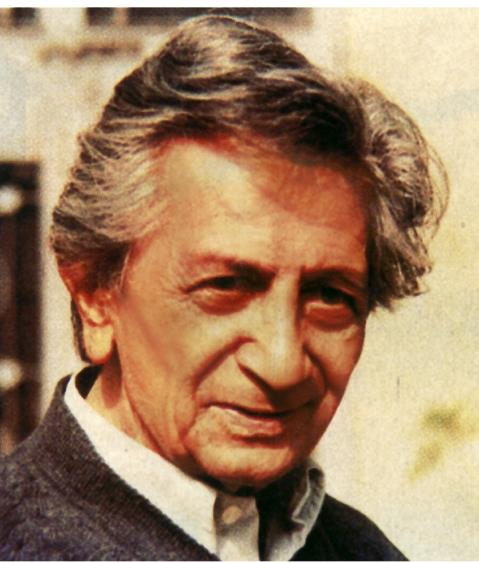
Bhisham Sahni, born on 8 August 1915 in Rawalpindi into the family of a Punjabi import agent in what was then undivided India (now Pakistan), was a respected Hindi novelist, short-story writer, playwright, translator, teacher and actor. His work reflects his unwavering commitment to India's pluralistic ethos and secular foundations. After completing his master's degree in English literature in 1935 at the renowned Government College in Lahore, he took up a teaching post there. Already during his studies he joined the Congress Party and took part in the struggle for freedom from British colonial rule. In 1942 he took part in the Quit India Movement launched by Mahatma Gandhi and was arrested as a result.
When communal unrest broke out in Rawalpindi in March 1947, he worked as a volunteer in a refugee camp. After Partition, Sahni and his family had to emigrate to the now-independent India. In 1948 he joined the Indian People's Theatre Association (IPTA) in Mumbai and worked as a stage actor and director under the leadership of his elder brother, Balraj Sahni, at the time a renowned actor in the Hindi film industry. After a brief spell of teaching at a college in Ambala and at Khalsa College in Amritsar, he moved to Delhi in 1952 and worked as a lecturer in English at Delhi College. He gradually distanced himself from active involvement with the IPTA and devoted himself more fully to writing. Sahni wrote more than 100 short stories, published in several collections, among them Bhagya Rekha ("Line of Fate", 1953), Pahla Path ("The First Lesson", 1956), Bhatakti Raakh ("Scattered Ashes", 1966) and Nishachar ("Demon", 1983).
The short story Amritsar Aa Gaya Hai ("We Have Reached Amritsar", 1973) is regarded as one of his masterpieces. The story is set aboard a moving train at the time of the Partition of India. The main characters belong to three religious communities: a Sikh, a Hindu, and three Muslim Pathans. The initially peaceful, easygoing atmosphere in the compartment changes abruptly when the passengers learn en route of unrest. From then on, fear and hostility prevail. When the train arrives in Amritsar, the initially calm and gentle Hindu Babu has become so enraged that he kills a Muslim who is just trying to board the train. It is probably his pent-up hatred of the Pathans, who had mocked him and prevented Hindu refugees from boarding the carriage, that he now vents on an innocent person, once the train passes through territory where he feels safe as a Hindu. Through this transformation of the Babu, Sahni illustrates how ordinary people became murderers in the violence-charged atmosphere of that time.
Bhisham Sahni lived in Moscow from 1957 to 1963, working as a translator for the Foreign Language Publishing House there. Besides his mother tongues, Punjabi and Hindi, Sahni was also fluent in English, Urdu, Sanskrit and Russian. He translated 25 books from Russian into Hindi, including Tolstoy's Resurrection. After his return he spent two years as editor of the literary magazine Nayi Kahaniyan ("New Stories").
Sahni's Hindi novel Tamas ("Darkness"), published in 1974 and translated by the author himself into English in 1988, achieved worldwide recognition for its sensitive and anguished portrayal of the communal unrest and massacres that accompanied the Partition of India. The novel processes events that Sahni himself witnessed at the time of Partition. The story begins when a low-caste man named Nathu slaughters a pig. Murad Ali, an influential Muslim, offers Nathu five rupees to slaughter the pig, claiming it is needed for veterinary purposes. Murad then instructs Nathu to dump the carcass in a wheelbarrow. Nathu follows Murad's instructions. The next morning, the pig's carcass is found by the Congress committee on the steps of the local mosque. This act is seen as a provocation, and Hindus are suspected of having committed it. In retaliation, a cow is slaughtered, and in the town — already tense with the impending Partition — riots and murder break out. These disturbances spread from the town into the surrounding villages. In 1988 filmmaker Govind Nihalani adapted the novel into a television series for Indian state television, in which Bhisham Sahni himself played the role of the Sikh Harnam Singh.
Kabira Khada Bazaar Mein ("Kabir Stands in the Marketplace", 1981) is one of Sahni's best-known plays and is still frequently performed. The play is based on the life of the medieval Indian mystic and poet Sant Kabir. At its centre is the transformation of an ordinary man into a mystic poet. The play depicts various problems Kabir encountered in his life, including caste discrimination and religious conflicts that divide society. Set in what was then Kashi (Benares), the play remains relevant today. It begins with Kabir's father complaining about his son's unpredictable behaviour and his "arrogant" attitude towards his mother. At this point Kabir overhears the ongoing disputes between his parents and learns that he was given away by a high-caste woman and adopted by a family of Muslim weavers. On recognising his true identity, he decides to renounce his religion and turn instead to a higher power that can be loved and revered by all.
Bhisham Sahni's fifth novel, Mayyadas ki Marhi ("The Mansion of Mayyadas", 1988), tells a story from a small town in Punjab. The town and its inhabitants undergo massive political and social change as the old Khalsa Raj (Sikh rule) is overthrown and British rule established. These changes are illustrated through the example of a mansion belonging to a Diwan (minister) named Mayyadas — a symbol of feudal rule. Mayyadas is a respected Diwan in the era of the Khalsa Raj, when traditions are honoured and values such as loyalty and integrity are upheld. With the fall of the Khalsa Raj, Mayyadas's star also begins to fade. His nephew, Dhanpat Rai, who had already been trading with the British during their wars against the Sikhs, offers his services to them after they seize power. In return, Dhanpat Rai is rewarded with special privileges and quickly rises to wealth and influence. So begins the changing fate of the town.
Isha Pandit
Awards
- Lotus Award of the Afro-Asian Writers' Association (1981)
- Soviet Land Nehru Award (1983)
- Padma Bhushan for Literature (1998)
- Sahitya Akademi Fellowship, the highest literary honour of the Sahitya Akademi (2002)
- Colour of Nation Award at the International Theatre Festival in Russia for his play Madhavi (2004)
Published in German
- Basanti, novel, translated from Hindi by Margot Gatzlaff, 191 pp., Reclam Verlag, Leipzig 1984 (in German)
- Tamas oder Der Muslim, der Hindu, der Sikh und die Herren, novel, translated from Hindi by Margot Gatzlaff, 315 pp., Frauenfeld Verlag, Waldgut 1994 (in German)
- Der Preis eines Huhns: Erzählungen (ed. by Hannelore Lötzke), translated from Hindi by M. Gatzlaff, M. Kämpchen, J. Kalmer, R. Kimmig, H. Lötzke, L. Lutze, B. Mayer-König, R. Seuß, 198 pp., Lotos Werkstatt, Berlin 2015 (in German)
- Fünf Minuten vor Vier: Erzählungen. Translated from Hindi by Barbara Bomhoff and Silja Behnken with the collaboration of Birte Plutat, 91 pp., Draupadi Verlag, Heidelberg 2017 (in German)
Reviews
- Review of Tamas oder Der Muslim, der Hindu, der Sikh und die Herren by Nicole Brechmann (in German)
- Review of Der Preis eines Huhns: Erzählungen by Reinhold Schein (in German)
- Review of Fünf Minuten vor Vier: Erzählungen by Renuka Jain (in German)
Further Links
- On Partition: Bhisham Sahni in conversation with Sukrita Paul Kumar, an interview
- Von verratenen Kriegern und exzentrischen Glücksrittern: Bhisham Sahni und sein historischer Roman Mayyādās kī māṙī: an essay by Dr Ines Fornell, in Brandt, Carmen and Harder, Hans (eds.): Wege durchs Labyrinth: Festschrift zu Ehren von Rahul Peter Das, Heidelberg; Berlin: CrossAsia-eBooks, 2020 (in German)
- Bhisham Sahni: essay by Barbara Bomhoff (in German)
- Partition Voices: Bhisham Sahni in conversation with Andrew Whitehead (1996)
Further Reading
- Fornell, Ines: Der Hindi-Romançier Bhīṣm Sāhnī: eine Analyse seiner realistischen Methode am Beispiel der Werke "Kaṛiyā", "Tamas" und "Basantī", Marburg: Diagonal Verlag 1998 (in German)
- Bomhoff, Barbara: "Bhisham Sahni", in: Martin Kämpchen (ed.): Indische Literatur der Gegenwart, Munich: edition text + kritik 2006, pp. 193-211 (in German)
Excerpts
- Bhai Ram Singh's Mausoleum from Fünf Minuten vor Vier: Erzählungen, translated by Barbara Bomhoff (in German)
- Excerpt from Der Preis eines Huhns: Erzählungen (in German)
📄 Download this author profile as a PDF (in German)