Arundhati Roy
Biography
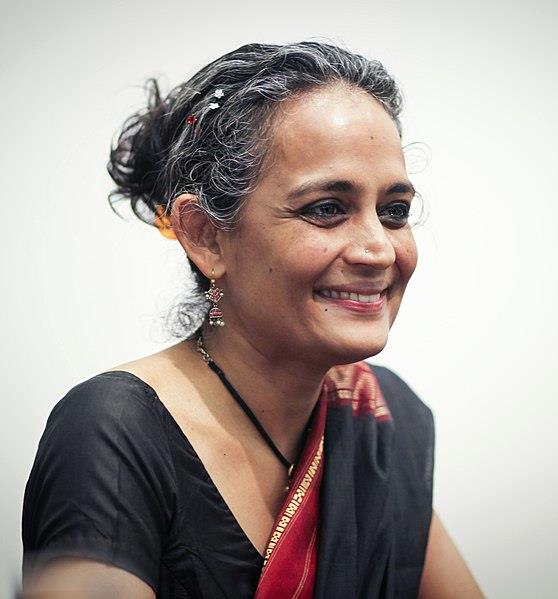
Arundhati Roy is an Indian writer, actress and political activist. For her novel The God of Small Things (1997) she was awarded the Booker Prize. She was born on 24 November 1961 in Shillong (Meghalaya), the daughter of a Christian mother from Kerala and a Bengali Hindu father. (Most sources give 1961 as her year of birth, while S. Fischer Verlag, which publishes the German translations of Arundhati Roy's work, gives 1959.) After her parents separated, she grew up in the village of Aymanam in Kerala. Although she later studied architecture in Delhi, she repeatedly dreamed of a career as a writer. After many odd jobs, she wrote the screenplay for the film In Which Annie Gives It To Those Ones (1989), in which she also acted. She subsequently wrote many more screenplays, for instance for the film Electric Moon (1992) and for numerous television dramas.
In 1995 two newspaper articles by Roy caused a great stir, in which she sharply criticised director Shekhar Kapoor for his film Bandit Queen (1994). The film tells the life story of Phoolan Devi, India's most wanted criminal, who had the aura of a heroine of the oppressed and later became a politician and women's rights activist. Roy claimed the film reduced Phoolan Devi's story to a typical Bollywood-style rape-and-revenge saga.
For her first novel, The God of Small Things (1997), she was awarded the prestigious Booker Prize. Arundhati Roy is thus the first Indian citizen to receive this prize (two authors of Indian descent but British citizenship, V.S. Naipaul and Salman Rushdie, had already won the Booker Prize before Roy). Since its publication, the book has caused a great sensation and has so far been translated into more than 40 languages. The novel is set in 1969 in Aymanam, where Roy herself grew up, and is autobiographically inflected. At the centre of the novel are the fraternal twins Rahel and Estha. While the novel depicts the recurring family troubles of Estha, Rahel, their single mother Ammu, their grandmother Mammachi, their great-aunt Baby Kochamma and their uncle Chacko, it also addresses much broader themes, such as local politics in Kerala, the caste system, and the violation of social taboos. These social and political problems ultimately place lasting strain on the family relationships. Because of the events that permanently destroyed the family bonds of their childhood and thus sealed their fate, Rahel and Estha experience a persistent emotional emptiness throughout their lives.
Roy's subsequent literary work consisted essentially of political commentary on the problems of her home country, India, in the age of global capitalism. Worth mentioning here is the book Power Politics (2001), made up of three essays. In it Roy expresses her views on, among other things, India's nuclear tests, the debate over the controversial Narmada Dam project, and the privatisation of India's electricity supply by American energy companies.
In Field Notes on Democracy: Listening to Grasshoppers (2009), also a collection of essays, she portrays the dark side of democracy. The essays describe how difficult it is, in a country like India — where numerous racial, ethnic and religious conflicts have been fought for centuries — to uphold the ideas of peace, freedom and justice. In these essays Roy also reflects on the acts of violence and injustice committed by the Indian government against its own citizens.
Twenty years after The God of Small Things, Arundhati Roy's second novel, The Ministry of Utmost Happiness, was published in 2017. The novel spans the period from 1950 to 2010 and portrays the intertwined lives of its main characters against the backdrop of contemporary India. The characters witness some of the darkest chapters of modern Indian history, from the land reform that dispossessed poor farmers, to the 2002 train fire at Godhra, to the uprisings in Kashmir. (On 27 February 2002, a carriage of the Sabarmati Express caught fire at Godhra station, Gujarat, killing 59 Karsevaks — Hindu activists. The event triggered the worst communal riots in India's recent history, in which more than a thousand people lost their lives.) The novel's characters represent a broad spectrum of Indian society, including the intersex woman (Hijra) Anjum, the rebellious architect S. Tilottama, and her landlord Biplap Dasgupta, who heads an intelligence agency.
Awards (selection)
- National Award for Best Screenplay for the film In Which Annie Gives It to Those Ones (1989)
- Booker Prize for the novel The God of Small Things (1997)
- Sahitya Akademi Award for the essay collection The Algebra of Infinite Justice (2006)
- Norman Mailer Prize for Distinguished Writing (2011)
Published in German
- Der Gott der kleinen Dinge, novel, translated from the English by Anette Grube, 379 pp., Karl Blessing Verlag, Munich 1997 (in German)
- Das Ministerium des äußersten Glücks, novel, translated from the English by Anette Grube, 560 pp., S. Fischer Verlag, Frankfurt am Main 2017 (in German)
- Azadi heißt Freiheit: Essays, translated from the English by Jan Wilm, 256 pp., S. Fischer Verlag, Frankfurt am Main 2021 (in German)
Reviews
- Review of Der Gott der kleinen Dinge on letteraturablog (in German)
- Reviews of Das Ministerium des äußersten Glücks on buecher.de (in German)
- Review of Field Notes on Democracy: Listening to Grasshoppers by Thomas Vincent
Excerpts
- Excerpt from Der Gott der kleinen Dinge (in German)
- Excerpt from Das Ministerium des äußersten Glücks (in German)
- Excerpt from Azadi heißt Freiheit (in German)
Further Links
- Der Gott der kleinen Dinge: Mithu Sanyal interviews Arundhati Roy, Deutschlandfunk (1998, in German)
- Die Diktatur der Mittelklasse. Arundhati Roy talks to Iris Radisch about capitalism, seduction and the happiness of asceticism, Die Zeit (2011, in German)
- Ich bin ein Baum mit tiefen Wurzeln. Author Arundhati Roy on the situation of women in India, the caste system, Edward Snowden and her new novel, by Barbara Nolte in Tagesspiegel (2017, in German)
- Face to Face with Karan Thapar: BBC interview with Arundhati Roy in two parts — Part 1, Part 2
📄 Download this author profile as a PDF (in German)