Arun Kolatkar
About the Author
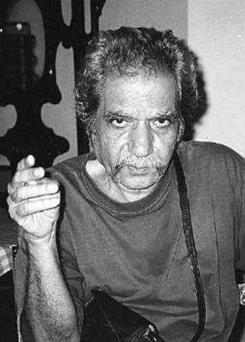
Arun Kolatkar (1 November 1931 – 25 September 2004) was a poet of independent India who wrote in Marathi and in English. Born into a Hindu family in Kolhapur, a large city in south-western Maharashtra, he was introduced to the English language and Western art by his father. He attended Raja Ram School in Kolhapur, where the medium of instruction was Marathi. He thus grew up bilingual.
After finishing school he moved to Mumbai in 1947 and studied at the renowned J.J. School of Arts. Professionally, Kolatkar worked as a graphic designer, bringing novel elements to India's advertising world through his own creative style. During this time he became friends with the then up-and-coming young Marathi writers such as Dilip Chitre, Ashok Shahane and Bhalchandra Nemade, and in 1954 he began writing his first poems. His bilingualism as a writer was entirely natural to him. He said: "Just as I have two legs, two buttocks, two eyes, I have two tongues (languages) in my head."
The Sathottari Period
The Marathi word Sathottari means "after the 60s". The Sathottari period is understood as a literary era in Maharashtra, and above all in Mumbai, that began in 1955 and ended in 1980. This period was primarily shaped by two political upheavals in Maharashtra: on the one hand, the various effects of the Ambedkar movement, including the mass conversion of Dalits to Buddhism on the initiative of Dr. B.R. Ambedkar; on the other, the creation of the state of Maharashtra based on the Marathi language (1960). These political events also affected the everyday life of people in Maharashtra, and above all in Mumbai, so that authors of the time processed them in their works. The mass conversion of Dalits to Buddhism was understood as a fundamental rejection of the caste discrimination that had existed in India for centuries. The creation of the state of Maharashtra, with its capital Bombay (later Mumbai) within the boundaries of the Marathi-speaking region, was fiercely criticised by many young writers of the time. Kolatkar, as a representative of the Sathottari period, expressed his criticism of caste discrimination in his poems and refused to confine his identity to a single language. Of this stance he said: "Since poetry is what I do with languages, and since I only know two languages, I wrote in two languages. Had I known three languages, I would have written in three."
Works
Kolatkar's Marathi poems were first published in magazines such as Satyakatha, Yugwani, Chhand Shabd and Atharva. Two and a half decades passed before the poems published in these magazines appeared in book form.
His first collection of poems in Marathi, Arun Kolatkarchya Kavita ("The Poems of Arun Kolatkar"), was published in 1977. The poems in this volume were written in the poet's youth. In them, Kolatkar attempts to reinterpret old songs and legends and to bring certain objects — buildings, mirrors, rooms, wind, dwellings — to life through vivid descriptions. Kolatkar uses symbols to express content and experience in these poems. His knowledge of graphic art as well as of the compositional structure of Indian classical music is also visible in them. He frequently expresses his views on social problems as well.
Chirimiri ("Bribe"), a collection of poems by Kolatkar published in 2003, depicts the present-day state of a powerful cultural and religious movement within Hinduism: that of devotion to God (bhakti), specifically of the Warkari sect, which has many followers particularly in Maharashtra. But the mentality of today's urban pilgrims has changed their attitude towards this pilgrimage. Balwantbua, a bhajan singer and a fun-loving, witty character, appears in most of these poems. This figure has a strong connection to Kolatkar's real life. Among Kolatkar's acquaintances there was a real-life model for Balwantbua, whom Kolatkar visited several times together with the pakhwaj maestro Arjunbua Shejwal. In these poems, Balwantbua is someone who regularly visits prostitutes to satisfy his physical needs. He takes 107 prostitutes with him on the pilgrimage to Pandharpur. In doing so he performs a good deed, enabling people from the lower class to have darshan (a sight) of the deity Vitthal. Thus Balwantbua — like the deity Vitthal himself — becomes a life partner, father and friend to these people. Most of the characters in Chirimiri live in the metropolis of Mumbai but were born and raised in the countryside. At some point in their lives they left their villages and came to Mumbai to build an existence there. There they learned all the legal and illegal methods needed to survive in metropolises like Mumbai. Through Balwantbua's pilgrimage with the prostitutes, Kolatkar makes clear that it is not social class or status but pure devotion that brings people closer to God. Even a prostitute can think of Vitthal in the course of her daily work. Kolatkar depicts the god Vitthal in his poem Wamangi as a human being, thereby critically examining his divinity.
Kolatkar's first English collection of poems, Jejuri, was published in 1976. It contains a single long poem consisting of 31 sections. Each section reads like an independent poem with its own title. Jejuri is a much-visited holy site in western Maharashtra, home to the temple of the Hindu god Khandoba, understood as an incarnation of Shiva. Not only inhabitants of Maharashtra but many other people from all over India worship the god. They make a pilgrimage to this place to pay their respects to the god, to worship his images and figures and to bring their offerings, seeking to win his favour. In the poems of this collection, however, Kolatkar expresses no reverence for the god, but instead views the pilgrimage and the worship critically. The protagonist of these poems, Manohar, visits Jejuri himself in order to explore the beliefs under whose influence people make the pilgrimage there. Manohar is a man who grew up in the city. He travels to Jejuri in the manner of a tourist rather than a pilgrim, since he has no intention of worshipping the god Khandoba. Through Manohar's various observations, the reader glimpses a society in which religion has become a business. The poems also show people for whom religion is a way to make money easily and quickly. The temple leaders decide, on the basis of the offerings brought, who will be closer to God. The pilgrimage to Jejuri is thus, for Kolatkar, a clear example of the commercialisation of religion.
From a table at the café called Wayside Inn, Kolatkar regularly observed life in South Mumbai. His observations resulted in an English collection of poems called Kalaghoda Poems, published in 2004. Kala Ghoda is the name of a very crowded area in South Bombay. The famous Jahangir Art Gallery is located there. This quarter includes colonial-era buildings such as the Rajabai Tower and the Prince of Wales Museum. The literal meaning of the Hindi expression Kala Ghoda is "black horse". It refers to a statue of black granite, donated by Sir Alfred Sassoon, commemorating the visit of the Prince of Wales to Bombay in 1876. The monument was damaged and removed in 1965. But the area continues to be named after this missing statue. The poems in this volume depict postmodern India. They illustrate the lives of the underprivileged and contrast their wretched lives with India's technological and material progress. These poems portray the lives of people at the lower end of the social pyramid — street sweepers, lepers, prostitutes, beggars, drunkards. In them, Kolatkar seeks to make clear his view that India, even after independence, has failed to solve the problem of hunger and poverty. The Kala Ghoda quarter reminds Indians of British colonial rule. In its place has now come the rule of capital.
Isha Pandit
Published in German
- Schwarze Gedichte, bilingual, from Marathi by Hans-Georg Türstig, edited by Lothar Lutze, Heidelberger Südasien Texte 4, South Asia Institute Heidelberg 1978
- Jejuri, poems, bilingual, from English by Giovanni Bandini, Verlag Wolf Mersch 1984
Further Reading
- Anjali Nerlekar: Bombay Modern: Arun Kolatkar and Bilingual Literary Culture, Northwestern University Press, Evanston 2016
- Laetitia Zecchini: Arun Kolatkar and Literary Modernism in India, Moving Lines. (Historicizing Modernism Series). London/Oxford/New York/New Delhi/Sydney: Bloomsbury, 2016
Awards
- Commonwealth Poetry Prize (1977) for the English collection Jejuri
- Sahitya Akademi Award (2005) for the Marathi collection Bhijki Vahi
- Alongside the poet Kabir, Kolatkar is the only Indian poet featured among the World Classics titles of the New York Review of Books
Web Link
Many thanks to Mr Prafull Shiledar, chairman of the Vidarbha Sahitya Sangh (Literary Association of Vidarbha) and editor of the Marathi magazine Yugwani, for sending the issue of the magazine dedicated to Arun Kolatkar for the purposes of this author portrait.
📄 Download this author portrait as PDF (in German, with excerpt "Schwarze Gedichte")