Anees Salim
Biography
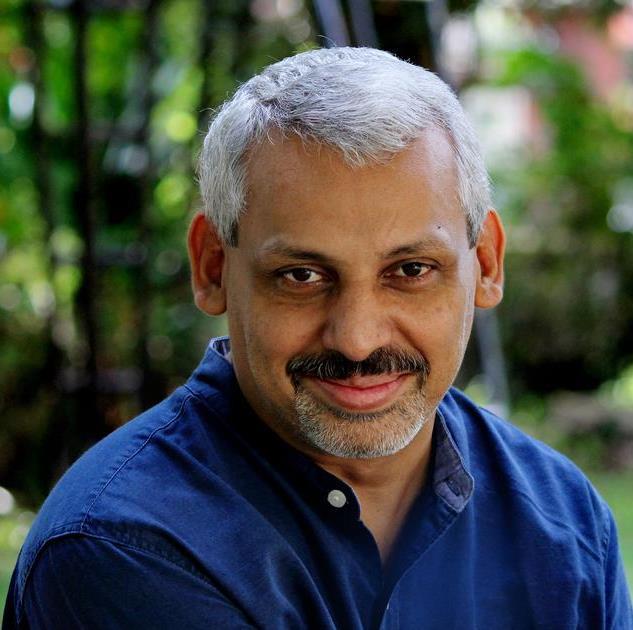
"A writer's everyday life today is shaped by readings, panel discussions, contributions to debates, radio interviews, television appearances, photo shoots, meetings with agents and tax advisors, conversations with schoolchildren and students, and trips at home and abroad." So wrote the German author Tanja Dückers in 2021 in her "Self-Portrait of the Writer as a Public Person".
None of this applies to Anees Salim. Like the American Thomas Pynchon, the German Patrick Süskind, or the Japanese Haruki Murakami, he is one of the few authors in an overheated literary world who deliberately wish to disappear behind their work — as Anees Salim himself put it in one of his rare interviews, with The Hindu on 6 December 2018.
Anees Salim, born in 1970 in Varkala in Kerala's Thiruvananthapuram district (formerly Trivandrum), whose mother tongue is Malayalam, is known "as a recluse, an introvert who has trouble dealing with crowds and strangers, so much so that he doesn't even attend award ceremonies to collect his literary prizes", as the article "You can write for the market or you can write without compromise" of 28 January 2019 puts it.
What is also unusual about Anees Salim is his dual occupation. By day he works as creative director of the multinational advertising agency FCB (Foote, Cone & Belding); in the early morning hours before work begins, he writes his novels. This deliberate withdrawal makes writing, as he has put it elsewhere, "a highly private matter, almost a closely guarded secret" for Anees Salim. It is therefore not surprising that almost all his novels contain many private, autobiographical elements.
One could perhaps even identify his distinctive style, as well as his choice of themes and settings, at least in part as a working-through of his own life experience: his interrupted school career, his wish, already as a teenager, to become a writer, and his rather joyless youth in a bleak small town.
In his 2013 novel Vanity Bagh, this name denotes a city neighbourhood, while the city itself is called Mangobagh — a sly play on words by the author: with Vanity Bagh one is meant to think of W.M. Thackeray's Vanity Fair, while with Mangobagh one may recall that in Hindi "mango" can be read as aam, which also characterises this city as a "city of small, insignificant people" (aam log). The city Anees Salim portrays is indeed a city of small people, in which Muslims and Hindus together form a small cosmos of ambitions, aggressions and frustrations, and in which humour, the grotesque and tragedy are always closely intertwined.
Asked about his literary models, Salim unsurprisingly names, alongside Graham Greene, Saul Bellow and Julian Barnes, the popular Anglo-Indian storyteller Ruskin Bond and the famous chronicler of small-town India (the fictional town of Malgudi), R.K. Narayan.
That Anees Salim is anything but a writer of idyllic or nostalgic small-town life is shown by his laconic, unsentimental treatment of politically charged conditions, such as the state of emergency declared by Indira Gandhi (1975-1977), in his 2012 debut novel, The Vicks Mango Tree. Vanity Bagh, too, plays out against the backdrop of the ongoing tensions between Hindus and Muslims, which in 20th- and 21st-century India have indeed already led to murder and bloodshed.
Gerhard Bierwirth
Further Works
- Tales from a Vending Machine (2013) — the rather engaging story of the longings and troubles of a young woman, Hasina Mansoor, who tends tea vending machines at an airport
- The Blind Lady's Descendants (2014) — the story of the author's blind grandmother
- The Small-Town Sea (2017) — a strongly autobiographical novel in which Anees Salim erects an amusing and moving memorial to a small boy determined to become a writer. Salim has said he modelled the narrator's voice on the voice of his own young son.
Honours and Awards (selection)
- Hindu Literary Prize for Vanity Bagh
- Sahitya Akademi Award for The Blind Lady's Descendants
Published in German
So far, only the novel Fünfeinhalb Männer, a translation of Vanity Bagh, has been published in German (Draupadi Verlag, Heidelberg, 2021) (in German).
Excerpt from Vanity Bagh
Retranslated into English from the German edition, Fünfeinhalb Männer.
Barely a mile long, Vanity Bagh consists of a long row of old buildings that seem to be waiting at the traffic light of the Char Bazaar junction for it to turn green, so they can shuffle across the crossing and catch up with the architectural revolution that has swept over the city of Mangobagh since the turn of the millennium. But for them it will never turn green, and so they simply remain standing on either side of a fairly wide and disproportionately hectic road. That is something I had always noticed about Vanity Bagh. There was always something going on there, which is actually hard to understand, since there are no important offices or firms located there — no government departments where you can get important permits or certificates through bribery, no well-known shops that have a sale running all year round, and no eminent fakir living there who can even cure hepatitis B by blowing into your ears. Nothing that could draw crowds. The only thing there is a row of dusty green colonnades with wooden balconies and wrought-iron railings. All the buildings are equally neglected, and not one of them has seen so much as a dab of paint since Bushra Jabbari, my mother, entered this neighbourhood as a young bride.
As far as I can remember, these houses haven't changed one bit in thirty years.
Bushra Jabbari (1962-)
In the midst of this ghastly row of buildings stands the Masjid-e-Mosavi, a tiny mosque with a green dome, where all the people of the neighbourhood come to pray on Fridays. Beside its arched entrance there is a narrow staircase leading up to the terrace, from which the pigeons rise into the air five times a day at the muezzin's call.
Do not sit on the steps. No smoking here. This is a house of God. Not a place to loiter.
Kareem Jabbari (1953-)
Even though we were no highway robbers or mass murderers, and not even half as famous as Master Abu Hathim, the people in the neighbourhood always thought there was something not quite right about our gang. People knew exactly where they might run into us, and tried their best to avoid it. We used to hang around the Mogul Bakery, which probably makes the best kebabs in all of Mangobagh, or crouch on the wall the railway had built to keep people off its land. Whenever a police patrol wandered through the neighbourhood, we'd slip into the alley near the Café Irani, where we'd loiter in the shade of Abu Hathim's two-storey house, ducking our heads whenever he spat his betel juice down into the alley from one of the upper windows.
We called ourselves "Five and a Half Men", even though there were actually six of us. But the neighbourhood is full of odd names with odd stories behind them. Once the imam of the Masjid-e-Mosavi told us that our neighbourhood was actually named after the wife of a British engineer who built the bridge over the Moosa River a hundred years ago. But has there ever been a lady on this planet named "Vanity"? I have my gravest doubts as to whether this story is even true — even though the imam in question happens to be my own father.
By kind permission of Draupadi Verlag
Further Links
- Tanja Dückers: Selbstportrait des Schriftstellers als öffentliche Person (in German)
- I prefer my writings to speak for me: Anees Salim, The Hindu (6 December 2018)
- You can write for the market or you can write without compromise (28 January 2019)
📄 Download this author profile as a PDF (in German)