Ambai (C.S. Lakshmi)
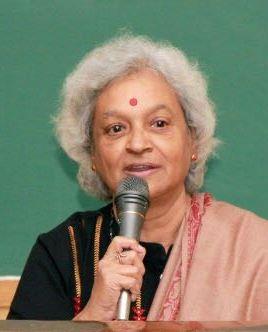
Ambai is the pen name that C.S. Lakshmi chose for herself in her youth. The inspiration came from a strong female character named Parvathi in a novella by the writer Devan. Insulted and rejected by her husband, Parvathi begins to write under the pseudonym Ambai. C.S. Lakshmi was so impressed by the woman's strength that she adopted the name. She was also fascinated by the figure of Amba in the epic Mahabharatha, who, by virtue of her asceticism, is reborn as a man in order to take part in the war and take revenge on Bhishma, the statesman of the Kuru dynasty. "I liked the androgynous aspect of Ambai," says Lakshmi — the idea of an unbounded gender order.
Studies
Ambai was born in Coimbatore (Tamil Nadu) in 1944. She completed her studies in history in three of India's metropolises: a bachelor's degree in Chennai, a master's in Bangalore and a doctorate in Delhi. After her studies she worked for two years as a lecturer at a college in Delhi. In 1981 she received a grant from the Ford Foundation for the project Illustrated Social History of Women in Tamil Nadu. In 1992 she received a grant from the Homi Bhabha Foundation for a project on women in the fields of music, dance and art. The results were published by the publishing house Kali for Women in two volumes as Singer and the Song and Mirrors and Gestures.
Beginnings of Her Literary Career
The course for her literary work was set in her youth. Her grandmother, a self-taught woman and connoisseur of Tamil literature, awakened in her a great love for it. The books and magazines written in a conventional, often romantic style, which Ambai devoured as a young girl, shaped her own writing when she began to write at the age of sixteen. Her view of the world, and with it her creative writing, matured over time. She experimented with form and expanded her themes.
Core Themes
Her short stories – her speciality – focus on themes such as human relationships, male-dominated social structures, and the disempowerment and empowerment of women. They emphasise that women have a right to their bodies and sexuality and that they are not objects owned by others, but self-determining subjects.
Feminism
In her later works, Ambai's female characters question the patterns of behaviour prescribed and imposed on them by the male world. How a "good" woman is supposed to think, love and live is determined by others, says Ambai. In her view, violence by male society against women amounts to the expropriation of their bodies and the withdrawal of the possibilities connected with them.
Asked about the largely tabooed subject of sexuality, Ambai emphasises that it has only become a taboo in more recent times. In classical Tamil literature, desire and physical love had a firm place.
Ambai, however, rejects the label of a women's writer and argues that her work should be seen as addressed to society as a whole.
Works (Selection)
Looking at life from a woman's perspective, and the questions that arise from it, characterise Ambai's writing. Her story Tanimaiyennum Iruttu ("In the Darkness of Loneliness"), published in 1970, deals with domestic isolation and loneliness, yet the woman clings to her absent husband or to the idealised image of him created in her imagination. Her later works mark a radical departure from this attitude.
Amma Kolai Seythal ("Mother Committed a Murder") and Kaattil oru Maan ("A Deer in the Forest") address the physicality of women and the socio-cultural entanglements arising from it.
Veettin moolayil oru samayalarai ("A Kitchen in the Corner of the House") describes the 'realm' of the women in an extended family, a tiny, dark corner of the house where the female figures move like shadows and tirelessly produce food day in, day out. The youngest daughter-in-law organises a family outing to give the women a break, but is appalled to see that on that day the kitchen wakes up even earlier to prepare food parcels for the journey. In this story Ambai contrasts the attitude of the older women, who resign themselves for better or worse to the prevailing patriarchal system, with the critical spirit of the youngest. For the eldest daughter-in-law the kitchen key suffices as a symbol of her authority, while the youngest strives for autonomy, for escape from this 'realm'.
Arambakala kavithaigal ("Early Poems") tells of a sixteen-year-old girl who wants nothing more than to write poems. Her first devotional poems are an appeal to her gods to grant her the gift. One day, after she witnesses the drunken husband of Kempamma, the domestic help, brutally knocking her to the ground, her lyrical drive slowly drains away. The trauma of everyday life robs her of her creativity. Ambai made it her life's work to give space to women like the protagonist of this story and to bring their talents to light.
Ambai's themes are manifold; each theme illuminates a different aspect of reality. Ambai sees the role of literature in giving a language to this constantly changing reality.
Memoirs
- When I was Young: Walking Erect with an Unfaltering Gaze, National Book Trust, 2013
Non-Fiction
Ambai has also written non-fiction books in English, including: The Face Behind the Mask: Women in Tamil Literature (Vikas, New Delhi, 1984); Consciousness and Women as part of the series "Seven Seas and Seven Mountains": The Singer and the Song and Mirrors and Gestures, published in 2000 and 2002 respectively by Kali for Women, New Delhi.
Practical Social Research, Ambai's Second Wing
Despite her considerable achievements and recognition in the literary world, Ambai does not have a very high opinion of literature's ability to bring about social change. The changes one wants to see in society should come about through activities that include literature but must go beyond it, says Ambai.
Based on this conviction, in 1988 she founded SPARROW (Sound and Picture Archives for Research on Women), an organisation that documents the lives and stories of women from all walks of life, in addition to maintaining an extensive archive of books, newspaper clippings and visual materials. Ambai's artistic activity through her writing and the practice-oriented research through SPARROW complement and enrich each other. About the work-related travels and encounters with people in many different regions and cultures she says: "Some of these experiences find their way into my stories in an abstract way."
Literary Works in Translation
English translations of Ambai's stories have appeared in six volumes: A Purple Sea, In a Forest, A Deer, Fish in a Dwindling Lake, A Night with a Black Spider, A Meeting on the Andheri Overbridge and A Red-Necked Green Bird.
Ambai's works have also been translated into numerous Indian languages as well as into French, Spanish and Swedish.
Published in German
- Ein Reh im Wald ("A Deer in the Forest") in "Meine Welt", issue 2, 2013, pp. 60–63
- Im Küchenanbau ("A Kitchen in the Corner of the House") in: "Frauen in Indien. Erzählungen", dtv 2006, pp. 38–61
Awards (Selection)
Ambai has received numerous awards for her literary work and her social engagement. The most significant recognition is the Sahitya Akademi Award (2021), India's highest literary honour, for her 2018 collection of stories Sivappu kazhuthudan oru pachhai paravai ("A Red-Necked Green Bird").
Work as a Translator
Ambai is also active as a translator. Particularly noteworthy is her English translation Black Coffee in a Coconut Shell: Caste As Lived Experience (Sage/Yoda Press, 2018), with more than 30 personal accounts on the subject of caste, edited by the well-known Tamil writer Perumal Murugan.
Hem Mahesh
Reading Excerpt
Reviews
- In a Forest, A Deer (Women's Web, 3 January 2013)
- A night with a black spider (Book and Conversations, 24.02.2018)
- A kitchen in the corner of the house (Washington Independent Review of Books, Sept. 2019)
- A red necked green bird (Livewire, May 2021)
Interviews
- Feminism is about leading a non-degraded life (India Together, 2 January 2016)
- There is no need to specify that I am a woman writer (Scroll.in, September 2017)
Further Links
📄 Download this author portrait as PDF (in German)