Yashpal (Yaśpāl)
Life
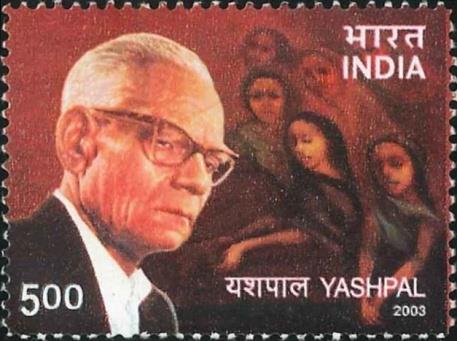
Alongside Agyeya and Jainendra Kumar, Yashpal (1903-1976) is counted among the three "revolutionary authors" of Hindi literature, whose works engaged with the struggle for independence from the 1930s to the 1950s.
Yashpal was born in 1903 in Firozpur (Punjab, northern India). In his youth he was a committed follower of Gandhi and campaigned as an activist among the rural population for the Non-Cooperation Movement. Later, as a student at the Punjab National College (Lahore), disillusioned with the politics of the Indian National Congress, he turned to the more radical Hindustan Socialist Republican Association (HSRA), which proclaimed armed resistance as the more effective path to liberating India from the British. At college he met Bhagat Singh and Sukhdev Thapar, two important members of the HSRA who would later become famous as martyred revolutionaries. Between 1932 and 1938 he was imprisoned for an attempted bomb attack. Besides his work as an activist and much-honoured author, he was also a journalist, critic, editor, playwright and translator.
Work
Yashpal is seen as a successor to Premchand in that he wrote about the injustices within Indian society. However, he combined his socially critical realism more strongly with urban themes and Marxist perspectives that placed newly awakened class consciousness, the exposure of religious double standards and caste prejudice at the centre. His sympathies for Marxism are probably also one reason why many of his works were translated into Russian. The novel Dada Kamred (1941), for instance, deals with Indian communists in the late 1930s and early 1940s and critically engages with questions of violent resistance as well as the moral dilemma of leaving one's family for the revolution. Yashpal also addressed rigid gender orders, generational conflicts and sexual taboos; especially in Amita (1956), male-dominated society is called into question. Two further novels that cemented Yashpal's fame are Jhutha Sach (False Truth, 1958-60), about the partition of the subcontinent into India and Pakistan, and Meri teri uski bat (My Story, Your Story, His Story, 1974), about the independence movement, for which he received the Sahitya Akademi Award in 1976.
Johanna Hahn
German Translations
- Phulos Hemdchen. Erzählungen von Yashpal [Phulo's Little Shirt. Stories by Yashpal] (ed. Konrad Meisig, transl. Hannelore Bauhaus-Lötzke, Barbara Börner-Westphal, Ines Fornell et al.), Harrassowitz, Wiesbaden 2001. Contains fourteen short stories translated directly from Hindi. (in German)
- The story Achteinhalb Millionen Wiedergeburten [Eight and a Half Million Rebirths], transl. Ayşe Ülker, in the anthology Chili, Chai, Chapati (ed. F. Grenner et al.), Kitab Verlag, Klagenfurt 2011 (in German)
Further Reading
- Nikhil Govind (2014): Between Love and Freedom. The Revolutionary in the Hindi Novel. London/New York/New Delhi: Routledge
- Friend, Corinne (1969): Yashpal: Author and Patriot. Philadelphia: University of Pennsylvania Press
Excerpt: Eight and a Half Million Rebirths
Guro, whose full name was actually Guramditti, was very naïve — so naïve that her mother-in-law and sister-in-law considered her simple-minded. Whenever there was trouble or a quarrel with the neighbours, it was always only the mother-in-law and sister-in-law who were involved in it, never Guro.
Guro's wedding had taken place at a good, already advanced age: at the time of her marriage she was already seventeen years old, which is why she moved into her father-in-law's house right after the wedding. Her new home enjoyed great prestige. It was the largest building in the neighbourhood and had a spacious courtyard. That two water buffalo cows were tethered there bothered no one. The house even had a bricked entrance hall.
When Guro's palanquin reached her father-in-law's house, she was received at the gate with the customary welcome greetings, and various musical instruments were played — flutes, drums, trumpets, even foreign instruments brought from the city. Her brother-in-law set off a firework of flares and firecrackers. All the residents of the house wore wonderful, precious and colourful silk garments. Even Beni, the house dog, had been wrapped in a silken blanket. Guro understood at once that Beni was greatly loved and pampered in this house.
Guro had been raised strictly religious by her mother. By the time she began to veil herself, she had learned the thousand names of Vishnu by heart. She devoutly worshipped Brahma, Vishnu, Mahesh, Ram, Krishna, Hanumanji, the ten Gurus and Pir Saluhi.
From childhood Guro's mother had taught her that in her father-in-law's household it would be her duty to serve her parents-in-law, her brothers- and sisters-in-law — indeed everyone.
After Guro moved into her father-in-law's house, she readily awaited the instructions of her mother-in-law and sister-in-law. Whenever Lalaji, her father-in-law, returned from the shop at dusk, Guro would spread a mat for him in the courtyard and cover it with a sheet. She fetched a jug of water and washed his feet in a basin. Then she poured fresh water into the water pipe, filled the pipe bowl and placed it beside his bed. When Lalaji woke early in the morning and came out into the courtyard coughing, she immediately brought him a jug of water and a green datun twig for cleaning his teeth. Then she prepared a fresh water pipe for him. When her mother-in-law lay down in bed in the evening, she massaged her back and calves. Guro was so virtuous that even during all these household chores and services, the end of her sari always covered her face. She spoke so reservedly that her father-in-law and the elders among the neighbours sometimes did not even hear her say anything. Besides washing dishes and tending the buffaloes, she also devoted no small amount of attention to caring for Beni.
Her mother-in-law and sister-in-law had told Guro why Beni was so loved and pampered in the house: about twelve months before Guro had come to the house, her father-in-law Lalaji's mother had died. Until that time, Lalaji, in the manner of a Hindu concerned with purity, had abhorred dogs running into the courtyard of the house. If a stray dog or bitch from the neighbourhood ever wandered into the courtyard because the gate stood open, he would threaten it with a stick and chase it out with loud shouts. But with Beni it was different. It was as if this were her own house.
Lala Gandamal had greatly revered his old mother. His father Chittarmal, too, had greatly cherished his wife. He had been convinced that his entire success rested on the good fortune his wife had brought into the house. Right after the wedding his business began to flourish, even though the economic situation of his household had not been good before that. Before his wedding, he and his father had travelled from village to village as itinerant traders with a bundle of clothes on their backs. But with his bride, the goddess of fortune Lakshmi also entered the house, and his lucky star began to shine.
On the day Lala Gandamal was deprived of his mother's protective love and kindness, he was sick with grief. He laid his head on her feet and wept late into the night. Yet since she was dead, it was ultimately unavoidable to carry her lifeless body to the cremation ground.
While Lalaji and his two sons, together with the people from the neighbourhood, carried the mother's bier to the cremation ground, the women of the house gathered in the courtyard and quietly mourned the deceased mother. No one paid attention to the entrance gate. After the mother's bier had been carried away, the wings of the gate remained open. A bitch happened to pass by, agitated by the pangs of labour, searching for a suitable place to give birth. She settled down in a corner of the entranceway. There was such grief and confusion in the house that no one noticed the dog.
When Lala Gandamal had performed the last rites for his mother and returned home in the evening, head bowed with grief, accompanied by relatives and neighbours, he stopped at the entrance according to custom, thanked the people who had accompanied the funeral procession, and bid them farewell.
When he finally stepped through the gate, he noticed the bitch crouching in a corner on a shabby mat. His heart was filled with grief and his throat felt as if it were choked shut. He could not bring himself to utter a sound to chase away the bitch that had improperly crept into the entranceway.
When the bitch noticed Lalaji's gaze, she looked at him and her eyes silently pleaded for help. To make her situation clear, she spread her legs and showed him her newborn.
Because Lalaji had just returned from the cremation ground, his thoughts circled around the impermanence of the world, faith and compassion. He was overcome with pity for the desperate animal that had just given birth, and he could not refuse its plea. Instead of chasing the bitch out of the entranceway, he had a bowl of milk brought for her. Fortunately she had given birth to only one pup, and it was a female.
Since Lalaji was coming from the cremation ground and was ritually impure because of the death, he was not permitted to sit on his bed. So he had the floor of a room cleaned, spread a mat there and lay down. Again he pondered the impermanence of the world, birth, death and rebirth. In every life he would encounter the same mother. Suddenly he wondered in which of the eight and a half million rebirths his mother might now be embodied. Then it dawned on him: he had left one body of his mother behind on the funeral pyre, but perhaps his mother had returned to his house in another body! A living being had been born in his entranceway, and tellingly the bitch had not given birth to three, four or five puppies, but to a single female pup! When this idea struck him, he sprang up from the mattress. He went to his wife and shared his suspicion with her: a human being wanders through eight and a half million rebirths and takes on a body according to the will of the highest God. Mother could have taken on this body!
His compassion and reverence for the bitch that had just given birth in the entranceway, and for her pup, grew boundlessly. It was winter. Lalaji spread out an old blanket and covered the bitch with it. From then on he had crumbled flatbread with milk and a bowl of clean water set out for her morning and evening.
After the bitch had eaten her mush of bread and milk in Lalaji's entranceway, she would always run back out to roam the alleys, as was her nature. Lalaji did not like this. He waited for the pup to open its eyes and be able to lap milk on its own with its tongue. When the time finally came for it to run about by itself, Lalaji, because of her constant roaming, no longer let the mother in through the gate. The pup, Beni, he tied up in the courtyard. His affection for Beni had grown even further. In summer she was bathed with cold water and in winter with lukewarm water. She even had her own towel. Morning and evening she was given a meal of milk and flatbread, and a vessel of clear water always stood ready for her. Of everything cooked in the house, a little was first offered to Beni, to see whether she would eat it or not. Even when the first fruits of a season arrived, Lalaji and his wife fed a little to Beni. Having been accustomed to it since birth, Beni had learned to be content with a vegetarian diet. Oranges, apples, bananas, carrots, green peas — whatever was set before her, she ate. She was shown boundless affection and love. Only a single rule applied to her: just like the women of Lalaji's respected household, she too was not allowed to leave the house. For, after all, she was a dog. She would only stick her snout into filth and refuse, or play with utterly flea-ridden, mangy dogs.
The mother-in-law did not just tell Guro Beni's story, but also explained its meaning to her: a human being wanders through eight and a half million rebirths. In doing so, he reaps the fruits of the deeds from his previous lives. His soul is joined to a body according to God's wish. Guro therefore held a respect for Beni similar to that for her father-in-law's mother. Ruldu, the household servant, prepared the buffaloes' feed, washed them and led them to the trough. But bathing Beni and giving her milk with flatbread — that Guro did herself, with great love and devotion. Twice a day she personally washed the brass bowl before placing Beni's meal in it. If a crow dipped its beak into the water bowl standing in front of Beni, or dry leaves swirled up by the wind fell into it, she emptied the bowl, washed it and filled it with fresh water.
Six months had already passed since Guro's arrival at her father-in-law's house. She had not neglected or disregarded Beni for a single day. As soon as Beni barked, Guro would go to her and attend to her needs.
The month of Kartik had begun. Preparations for the Diwali festival were in full swing in the house. Guro and her mother-in-law were busy with housework. Beni had been barking a great deal since morning that day, but Guro did not understand why. Again and again she tugged at her chain and tried to run to the entrance gate. Guro came out into the courtyard each time and stroked her. In the afternoon Guro kneaded white wheat flour with clarified butter into a dough to prepare pastries. Again she heard Beni's barking. Since morning she had already checked on Beni a few times, so she did not get up immediately this time. But when the barking seemed especially loud, she went out anyway, her hands smeared with flour, to see what was going on.
Dabbu, the biggest dog in the neighbourhood, was pacing back and forth in front of the gate of Lalaji's house. He heard Beni barking in the courtyard and understood the reason for her excitement — his steps grew hesitant, he pricked up his ears and tail, raised his nose, sniffed, and then, in joyful anticipation of performing his manly duty, dared to push open the half-closed entrance gate and run into the courtyard.
Guro saw how, after pushing open the gate and coming in, he now ran towards Beni with his tail resolutely raised and chest swollen. Beni barked incessantly and pulled with all her strength at the chain to fling herself at the dog, which approached her growling, the hair on its neck bristling.
"Oh no!" When Guro saw the big dog, she became afraid. She turned on her heel and went back into the kitchen. From the woodpile she took the largest stick and ran back to chase away the dog and protect Beni.
By the time Guro reached Beni, however, Beni's attitude toward the strange dog had already changed. Nose to nose, the two sniffed each other. Beni too wagged her raised tail. She expressed sympathy toward the strange dog, and he laid his forepaw on her.
The stick in Guro's hand, which she had raised to strike the dog, sank down. Ashamed, she turned away from Beni and covered her face with the end of her sari. Then she went back into the kitchen.
"Hey, you!"
Guro turned around and looked toward the entrance gate.
Rampyari, the wife of the neighbour Buddhu, came running up. Rampyari saw that Guro was covering her face with the end of her sari, lowered her voice and asked: "What is it? Is Lalaji at home?" She had not expected there to be men in the house in the afternoon.
Guro pulled the end of her sari even further over her face with the thumb and forefinger of her flour-smeared hand. With a bashful smile she pointed behind her back toward Beni and answered in a whisper: "Grandfather Lalaji has come."
Rampyari raised her eyebrows in astonishment. She put her forefinger to her lips and said: "What are you saying?"
Guro veiled herself completely with the end of her sari and said with a naïve smile: "Sister, you know: when a person dies, their soul wanders through eight and a half million rebirths! Who knows what body God will give them next!"
Rampyari took a deep breath and then burst into peals of laughter. She turned to Guro's mother-in-law and called out: "Listen, just listen to your daughter-in-law's words!"
When Guro's mother-in-law heard Guro's words, she cried out angrily: "Shameless mouth! You haven't got the slightest bit of sense!"
Guro fixed her guileless eyes on her mother-in-law and said: "Honoured Mother, you yourself said that eight and a half million rebirths..."
Guro's mother-in-law snapped at her angrily: "Wicked shameless mouth! You fool, you...!"
The mother-in-law went on scolding angrily for a long while.
When the neighbour women heard the story, they stuffed the ends of their saris into their mouths to hold back their laughter, held their bellies and said: "Oh dear, indeed, the poor thing really is very naïve..."
Retranslated into English from the German translation by Ayşe Maria Ülker (from Chili, Chai, Chapati. Geschichten aus Indien, ed. Friederike Grenner, Jürgen Neuß and Anna Petersdorf, Klagenfurt 2011, pp. 18-25). Used by kind permission of Kitab Verlag, Klagenfurt.