Phanīshwarnāth "Renu"
Biography
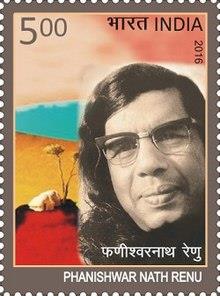
The Hindi writer Phanīshwarnāth Mandal (1921-1977) was born on 4 March 1921, the son of a farmer, in the village of Aurahi Hingna in Purnea District (Bihar). He attended school in Forbesganj (Bihar) and in Viratnagar (Nepal), after which he attended Banaras Hindu University without completing a degree.
He was politically active throughout his life, first in the Indian independence movement, later organising labourer and peasant movements in North India, including in Nepal, where he took part in an armed uprising against the rule of the Ranas. He was close to the socially revolutionary movement launched by Jayaprakash Narayan. Because of his political engagement he came to know the prisons of both British India and independent India from the inside. Renu died on 11 April 1977, aged only 56, in Patna.
As a writer he dropped his family name, Mandal, and used instead the pen name "Renu", meaning dust, grain of sand, or pollen — a sign of his modesty and a declaration of belonging to the lower strata trodden into the dust. Or was it an identification with pollen, colourful, fertilising, akin to light and air? The poetry, grace and weightlessness of his style would certainly allow for this reading too.
He won literary renown with numerous short stories and, above all, with his two great novels, Mailā ānchal (The Soiled Border, 1954) and Partī-Parikathā (The Story of the Fallow Land, 1957). With Mailā ānchal he founded a new genre in Hindi literature, the so-called "regional novel" (ānchalik upanyās).
His story Tīsrī kasam (1956, The Third Vow) achieved wider fame through Basu Bhattacharya's 1966 film adaptation starring Raj Kapoor and Waheeda Rehman in the lead roles.
In his work, Renu engages with every aspect of village life in his native North India, including the threat posed by the urban money economy, with the setting itself usually taking on the role of a fellow character, if not the hero. Renu's sympathy lies throughout with ordinary people, drifters, outsiders, the outcast. His work is rich in vivid portraits of women.
What gives Renu's style its unique vitality is its unaffected closeness to the unbroken oral storytelling tradition. This prose — interspersed with folk-literary elements, popular coinages, proverbs, wordplay, onomatopoeia — wants to be heard. Renu's stories and novels are essentially conceived as texts meant to be read aloud, and so are able to reach even people who cannot read, but who are nonetheless connoisseurs of orally transmitted traditions.
Everything is suffused with a particular musicality: in the preface to his story collection Thumrī — the term for a vocal style in North Indian classical music — Renu called himself a singer of stories. A subtly deployed art of allusion, an echo of classical Sanskrit traditions, paired with precise observation and depiction of the outer world's reality, produces an unusual expressive power and suggestiveness. It is thus no surprise that many critics, for instance Indu Prakash Pandey, regard Phanīshwarnāth Renu as the most significant Hindi storyteller in the line of succession to Premchand, who died in 1936.
Hedy Sadoc and Ines Fornell
Works (selection)
Novels:
- Mailā ānchal (1954, A Soiled Border)
- Partī-Parikathā (1957, The Story of the Fallow Land)
- Dīrghtapā (1963, The Long-Suffering Woman)
- Julūs (1965, The Demonstration)
- Kitne chaurāhe (1966, How Many Crossroads)
- Kalank mukti (1967, Liberation from Disgrace)
- Pāltū Bābū Rod (1979, Paltu Babu Road)*
Story collections:
- Thumrī (1956, Thumri)
- Ādim rātri kī mahak (1967, The Scent of the First Night)
- Aginkhor (1973, The Fire-Eater)
- Ek shrāvanī dopaharī kī dhūp (1984, The Sun's Heat on an Afternoon in the Month of Shravan)*
- Achchhe ādmī (1986, Good People)*
Memoirs:
- Van-Tulsi kī Gandh (1984, The Scent of Wild Basil)*
* published posthumously
Published in German
- "Raspriya", translated from Hindi by Helmut Nespital, in Der Tigerkönig. Erzählungen und Kurzgeschichten aus Indien, Berlin: Volk und Welt, 1966, pp. 256-273 (in German)
- Pfauentanz. Dorfgeschichten aus Bihar, translated from Hindi by Hedy Sadoc and Lothar Lutze, Freiburg: Verlag Wolf Mersch, 1983 (also containing materials: Renu's own statements on his work and correspondence with Jayaprakash Narayan) (in German)
On Phanīshwarnāth Renu and his Work
- Fornell, Ines: "Phaṇīśvarnāth Reṇu – 'Mailā āṃcal'". In: Kindlers Literatur Lexikon. 3rd, completely revised edition. Ed. by Heinz Ludwig Arnold. Stuttgart/Weimar: Verlag J.B. Metzler 2009, vol. 13, pp. 588-589 (in German)
- Hansen, Kathryn: "Renu's Regionalism: Language and Form", in: Journal of Asian Studies, Vol. XL, No. 2, 1981, pp. 273-294
- Junghare, Indira: "Introduction", in Phanishwarnath Renu: The Soiled Border (Maila anchal), Delhi: Chanakya Publications 1991, vii-xxvii
- Meisig, Konrad: Erzähltechniken der Nayī Kahānī. Die Neue Erzählung in der Hindi-Literatur, Wiesbaden: Harrassowitz, 1996 (in German)
- Pandey, Indu Prakash: Regionalism in Hindi Novels. Beiträge zur Südasien-Forschung, South Asia Institute, University of Heidelberg, vol. 3, Wiesbaden: Franz Steiner Verlag 1974
- The Writings of Phanishwarnath Renu, published by: Asian Studies Center, Michigan State University, Journal of South Asian Literature, Vol. 17, No. 2, Summer/Fall 1982
Awards
In protest against Indira Gandhi's declaration of the state of emergency, Renu returned the prestigious Padma Shree award, which he had received in 1970 for his literary work.
Excerpt
📄 Download this author profile as a PDF (in German)