Gauri Deshpande (1942–2003)
About the Author
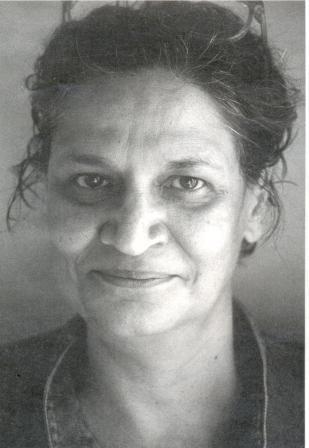
Gauri Deshpande was a novelist, short-story writer and poet from Maharashtra, India. She wrote in Marathi and English.
She is among the authors of independent India who had the courage to rebel against social norms. This is hardly surprising, since she came from a family that had actively contributed to social reform in Maharashtra.
Her grandfather Maharshi Dhondo Keshav Karve positively influenced the lives of many women by founding schools and homes for women at a time when women's fate was entirely determined by men and depended on their marital status.
Her uncle Raghunath Karve recognised very early that India's population growth should be curbed. He worked to educate the public and politicians – unfortunately without success.
Gauri Deshpande was born in Pune, the youngest of three children of Irawati and Dinkar Dhondo Karve. Her father was a professor of chemistry, her mother an anthropologist and author. Gauri Deshpande's daughter Urmila has also come forward with a debut novel.
Gauri Deshpande studied English literature at Fergusson College and earned her doctorate in this subject at the University of Pune. She taught in the English department at Fergusson College and later worked as a professor at the University of Pune.
Work
Gauri Deshpande wrote mainly in Marathi, but also wrote short stories, articles and poems in English.
She belonged to the first generation of feminist authors in India. Her ideas were far advanced for her time. She still shocks many women of today's generation with the openness of her expression.
She translated the Arabian Nights edited by Richard Francis Burton from English into Marathi, including the quite explicit descriptions of sexual acts. In other translations into Marathi, such passages had been omitted "for the sake of decency".
Her books were translated into Gujarati and English. The Marathi film Aamhi Doghi ("We Two Women") is based on her book Paus Ala Motha ("It Poured Like Buckets").
Her narrative style is simple, her character descriptions vivid. Suspense arises because certain things are only hinted at and only elaborated in more detail later in the book. In this way she creates tension and keeps readers engaged.
The women she portrays want to lead self-determined lives. For example, her short novel Mukkam ("Terminus") is about a woman, Kalindi, who wants to leave her husband and enters into relationships with two other men, which she keeps secret from her parents because she wants to lead an independent life. By European standards this may not be anything special, but by Indian standards it was, in the past century (and to some extent still is), unusual. Respect for other people's privacy is unfortunately not a concept here. Rather, society believes it must interfere in everything.
Once one has been abroad, it is inevitable to compare one's own country with the country visited. Such comparisons occur quite often in Gauri Deshpande's work as well. In Mukkam she writes:
"I wonder, can I take him (referring to her friend Dimitri, a Greek) everywhere in my country? I love my country, but no one will understand my sadness and regret that I am simultaneously ashamed of it. Especially to someone like Dimitri, who is so proud of Greece, I cannot explain it."
It may be presumed that her works contain autobiographical traits. This cannot, however, be proven.
Readers' reactions to her works are very divided. Some find her works "outstanding", others do not like her as an author "at all".
Chitrarekha Mehendale
Works in Marathi (Selection)
- Ekek Pan Galawaya (1985, short stories)
- Ahe He Ase Ahe (1986, short stories)
- Dustar Ha Ghat Ani Thang (1989, two short novels)
- Mukkam (1992, short novel)
Works in English (Selection)
- The Lackadaisical Sweeper (1997) (short stories)
Literary Translations (Selection)
- From English into Marathi: Arabian Nights by Richard Francis Burton (1976–77)
- From Marathi into English: And Pine for What Is Not (1995, the autobiography of Sunita Deshpande, Ahe Manohar Tari...)
Published in German
Deshpande's story Atha kuthe jashil, Tolambhatta from the collection Ahe He Ase Ahe even appeared in two different German translations:
- Translated from Marathi by Manjiri Paranjape and Johanna Wernicke-Rothmayer under the title Und jetzt wohin, Grashüpferchen? in "Fünf Rupien Bakschisch für Iwan Denissowitsch. Gegenwartsliteratur aus dem indischen Subkontinent" (= die horen, vol. 188, 1997)
- Under the title Neuauflage, in a secondary translation from English by Claudia Arlinghaus, in "Liebe aus Indien. Moderne Erzählungen, gesammelt von Sudhir Kakar", C.H. Beck Verlag, Munich 2006
- Also in the anthology "Wie queren wir Flüsse? Geschichten und Gedichte vom indischen Subkontinent", edited by Ines Fornell and Reinhold Schein, Draupadi Verlag, Heidelberg 2016
Further Links
- Aamhi Doghi (film adaptation of "Paus Ala Motha") on Wikipedia
- Arabian Nights on Wikipedia
- Richard Francis Burton on Wikipedia
📄 Download this author portrait as PDF (in German)