Buddhadeva Bose (1908–1974)
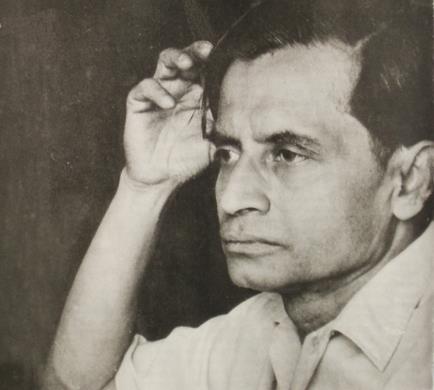
Buddhadeva Bose (pronounced like Buddhodeb Boshu), born 1908 in Comilla (today Bangladesh), died 1974 in Calcutta, was one of the most important Bengali literary figures of the twentieth century. He was above all a highly gifted poet, but also an author of novels, short stories, plays and works of literary criticism. What distinguishes him in the literary context of Bengal, besides his own work, is his long, tireless commitment to his fellow poets, to Bengali literature itself and to a modern comparative literary scholarship.
In the Succession of Tagore
In the early 20th century, Bengali literature was dominated by Rabindranath Tagore, who in 1913 became the first non-European to receive the Nobel Prize for Literature and who outside Bengal is regarded as the Bengali poet par excellence.
Buddhadeva Bose said of Tagore:
Although we were young and immature, we sensed that in reading him we were doing more than merely passing our time pleasantly, that we were being changed by it and that it translated the world into words for us. He immersed us in a new sensibility — I would almost say, in a new way of being. We witnessed how, alone and unaided, he connected Bengali to world literature and opened up the world to us.
Nevertheless, or perhaps precisely for that reason, Tagore was for the following literary generation not only a great model but also an almost crushing burden.
When Bose was born in 1908, the Indian independence movement had already gripped large parts of the population. Bose's lifespan reached from the first partition of Bengal (1905–1912) to shortly after the declaration of independence of Bangladesh (1971). In between lay two world wars and the division of India into two independent states, India and Pakistan — particularly grave for Bengal, as it simultaneously led to the bisection of Bengal. Political themes played a central role for Bose and his literary colleagues. The growing tensions between the Indian population and the British colonial power, the strong communist movement in Kolkata and the splitting of Bengal into East and West — all this occupied and troubled the post-Tagore generation of writers.
They saw themselves as secular, left-wing intellectuals and had largely left behind the religious dimensions of Tagore's work. But Bose was not prepared to sacrifice his artistic understanding of literature on the altar of political slogans and withdrew from active political life in the 1940s. This earned him a great deal of criticism, but he insisted that literature had to be more than a vehicle for advertising and propaganda. In his poetry journal he wrote as early as 1938, when he was still eagerly taking part in anti-fascist gatherings:
What we call progress, whatever it may be, is no yardstick for poetry or literature. We cannot measure literature by what it contributes to the transformation of society. I even believe that hardly anything in our society can really be changed by the creation of literature.
Life and Work
Who was this Buddhadeva Bose? He was born in 1908 in Comilla (East Bengal) and grew up in Noakhali and Dhaka. He studied English literature at the university in Dhaka and founded his first literary journal Progoti (Progress) at the age of just nineteen. He wrote poems and prose, produced and staged his first play, and was in lively exchange with his fellow students on literary topics. After completing his studies (1931) he was drawn to Calcutta, the geographical heartland of Bengali literature, and with a few interruptions he spent the rest of his life there. He had an intense relationship with Calcutta and, many years later, wrote a fascinating, passionate poem to this city. From 1937 to 1966 Bose lived with his wife and three children at 202 Rashbehari Avenue, and for a long time this house served as the headquarters of literary activity in Calcutta.
Buddhadeva Bose's work is characterised by a mixture of romanticism and humanism, and by a strong interest in philosophical and psychological questions. His novels deal above all with human connections, the relationship between man and woman, social and family conflicts, the embeddedness of the individual in an often constricting social order, and the individual's relationship to himself. Bose's literary expressiveness is versatile, virtuosic and captivating. There are no clumsy formulations or platitudes. His prose combines witty intelligence with originality and linguistic elegance.
Twice in his life Bose was taken to court on charges of obscenity because he had ventured into subjects tabooed in India, such as extramarital sex (1933) and adultery (1967). In both cases the charges were dismissed as groundless.
Bose was passionately committed to his mother tongue Bengali and was determined, following in Tagore's footsteps, to weave the Bengali language into the web of world literary languages. For intellectual Indians it was a matter of course that they spoke fluent English and were familiar with English-language literature. Bose went one step further and developed a lively interest in German and French literature as well. He translated entire cycles of poems by Baudelaire, Hölderlin and Rilke into Bengali.
Works
Buddhadeva Bose's complete works comprise over 200 titles (novels, volumes of poetry, plays, stories, essays, memoirs). Some important works have been translated into English; into German, so far only:
- Das Mädchen meines Herzens (Ullstein Verlag, 2010)
Hanne-Ruth Thompson
Further Links
Two articles on Bose's life and work in English:
📄 Download this author portrait as PDF (in German)