Alka Saraogi
About the Person
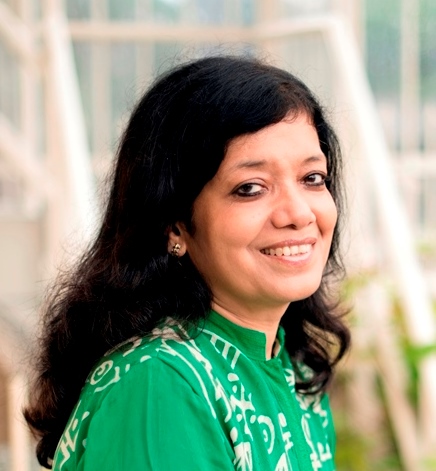
Alka Saraogi was born on 17 November 1960 in Kolkata and still lives there today. Her family belongs to the Marwari community, who originally came from Rajasthan and moved to Kolkata before the First World War. The Marwari still speak their own language, a dialect of Rajasthani, today, though Hindi is predominantly used in everyday life. Alka Saraogi writes in Hindi, a deliberate choice, since she is also fluent in Marwari, English and Bengali.
At the age of twenty she married Mahesh Kumar Saraogi. The marriage produced two children. Since early childhood, Alka Saraogi has loved reading and acquiring knowledge; she was a dedicated pupil and student who completed her education with a B.A. even before her marriage and was already strongly interested in literature at an early age. It was not until 1988, however, that she broke free of the conservative structures of her surroundings, with her husband's support, by resuming her studies. At the University of Calcutta she earned a master's and a doctoral degree in Hindi Literature; her doctoral thesis was on the poetry of the Hindi author Raghuvir Sahay. A poem by Raghuvir Sahay also provided the title of her first published short story, which appeared in 1991: Āp kī haṁsī. She additionally earned a diploma in journalism and wrote newspaper articles on health and women's issues.
It did not take long, however, before Alka Saraogi had earned a reputation as a leading figure of modern Hindi literature. She has since published eight novels, several of which have been translated into various European languages (English, French, Italian, Spanish, Czech, German) as well as Indian languages. In 2001 she was awarded the highly regarded Sahitya Akademi Award for Hindi literature for her novel Kalikathā via Bypass, making her, at the time, the youngest recipient and the first woman to win the prize since Krishna Sobti. She also received a number of further awards: the 1998 Srikant Verma Award, the 2006 Bihari Puraskar of the K. K. Birla Foundation, the 2015 Indu Sharma Katha International Award, the 2021 Kalinga Literary Festival Hindi Book of the Year Award, the 2021 Valley of Words Award, the 2022 Dayawati Modi Stree Shakti Samman, and the 2023 Fakir Mohan Senapati National Literary Award.
In 2002 she taught a course on the relationship between Hindi and Bengali literature at the Università Ca' Foscari in Venice. She has taken part in numerous literary festivals in India, France, Italy, the United Kingdom, Norway and Mauritius. In 2006 Alka Saraogi presented her novel Umweg nach Kalkutta [Detour to Kolkata] at the Frankfurt Book Fair. In 2024 she was invited to the international literary festival feeLit in Heidelberg.
Alka Saraogi translated her own novels Kalikathā via Bypass and Śeṣ Kādaṃbarī into English. She has translated numerous short stories from Bengali for Amazon Audible. In 2022 an anthology of stories by women from across India, titled Terah Halafnāme ("Thirteen Affidavits", Vani Prakashan), appeared, translated by Alka Saraogi from English, Bengali and Urdu.
Literary Work
Novels:
- Kalikathā via Bypass (1998), in German: Umweg nach Kalkutta
- Śeṣ Kādambarī (2002)
- Koī bāt nahīṁ (2004)
- Ek break ke bād (2008)
- Jānkīdās Tejpāl Mansion (2015)
- Ek saccī jhūṭhī Gāthā (2018)
- Kulbhūṣaṇ kā nām darj kījie (2020), in German: Entwurzelt
- Gāndhī aur Sarlādevī Caudharānī (2023)
Short story collections:
- Kahānī kī talāś meṁ ("In Search of the Story", 1996)
- Dūsrī Kahānī (2000)
Themes and Style
Alka Saraogi's literary career began, following her academic training, with short stories that offered room to experiment with language and form. She draws inspiration for her creative writing from her sharp eye on her surroundings; for the historical and social background of her novels she carries out extensive research through personal contacts as well as in libraries and archives.
Her often strongly self-reflexive novels deal with the historicity of human beings and with history made by human beings. Again and again they explore the interweaving of present and past, the investigation of identity, and repression and rediscovery from a historical perspective. The fate of Marwari families in the Bengali diaspora, the partition of Bengal and the political development of India, migration, alienation, social change, patriarchal society in a capitalist world, and the role of the writer, especially the woman writer — all of this she weaves into unique narratives in a writing style that shifts with each work yet always remains unmistakably her own, in which genres blend and ancient Indian myths meet modern narrative technique.
The Sahitya Akademi Award-winning novel Umweg nach Kalkutta [Detour to Kolkata] opens on the 50th anniversary of India's independence. Kishor Babu, however, looks back into the past: the era of the independence movement and further back still, into the 19th century, when Kolkata was the capital of the British colonial empire. He wanders through the streets and lanes of Kolkata, reads old diaries, and increasingly becomes an oddity in the eyes of his relatives, while the true protagonist of the novel emerges more and more as the city of Kolkata itself.
Kulbhushan, the protagonist of Entwurzelt [Uprooted] (Kulbhūṣaṇ kā nām darj kījie), is a migrant from East Bengal who only partially manages to gain a foothold in a changed environment. His counterpart on the East Bengali side — East Pakistan since the partition of the subcontinent — is the washerman and rickshaw driver Shyama, who devotes himself to the struggle for an independent state of Bangladesh. The two men are bound together by their friendship and their love for one woman. The multi-layered novel tells of the loss of homeland and the hardships of those who had to flee East Bengal after India's independence, of despair and courage, of heartlessness and misery, of generosity and selfless love.
Almuth Degener
Published in German
- Umweg nach Kalkutta [Detour to Kolkata]. Novel. Insel-Verlag, Frankfurt am Main/Leipzig 2006, ISBN 3-458-17313-7. Translated by Margot Gatzlaff-Hälsig. (in German)
- Tod eines Baumes [Death of a Tree]. Story. Translated by Monika Horstmann. In: Ulrike Stark (ed.): Mauern und Fenster. Neue Erzählungen aus Indien. Draupadi Verlag, Heidelberg 2006, ISBN 978-3-937603-10-0. (in German)
- Entwurzelt [Uprooted]. Novel. Draupadi Verlag, Heidelberg 2024, ISBN 978-3-945191-85-9. Translated by Almuth Degener. (in German)
Excerpt
- Excerpt from "Entwurzelt" (PDF) (in German)
Review: Claudia Kramatschek on "Entwurzelt" (SWR Kultur) (in German). Readings with Alka Saraogi: see Readings (in German) (2024 reading tour).